
- Purpose and benefits of using support
- Types of supporting structures
- With the letter "G"
- With one plane (single-plane)
- On two strips (two-plane)
- T-shaped
- V-shaped
- Arch
- Semi-arch
- Pergola
- Selecting a material for the support
- Tree
- Metal
- Reinforced concrete
- Asbestos cement
- Profile pipes
- Net
- Wire
- Calculating and building a frame yourself
- Forming and growing a bush on a trellis
- Fan-shaped
- Sleeve
- Methods of tying grape vines to a trellis
- Dry
- Green
Trellis for growing grapes not only enhance the landscape but also serve a variety of useful functions. This method of cultivating grapes has recently become fashionable among gardeners.
Purpose and benefits of using support
To facilitate growing vineyards in the countryside, trellises are constructed as hedges. They serve a variety of useful functions and offer numerous advantages. These supports offer the following benefits:
- facilitate the harvesting process;
- fits well into the landscape design of the dacha;
- create good ventilation in the grape crown;
- promote the penetration of direct sunlight to all areas of the vineyard;
- saves space on the site.
The structure is designed for growing grapes or other climbing plants. It serves as a support for the plants. After the buds form, they hang through the holes in the trellis, making it easier to monitor the condition of the bunches, determine their ripeness, and facilitate harvesting.
Important! Using a trellis can cause foliage to become crowded. Regular pruning is recommended to prevent this.
Types of supporting structures
Several design types have been developed: L-shaped, single-sided, double-sided, arched, pergola-shaped, and semi-arched. Each gardener makes their own choice, taking into account the vineyard's location, the amount of available space, and the specific characteristics of the grape variety.
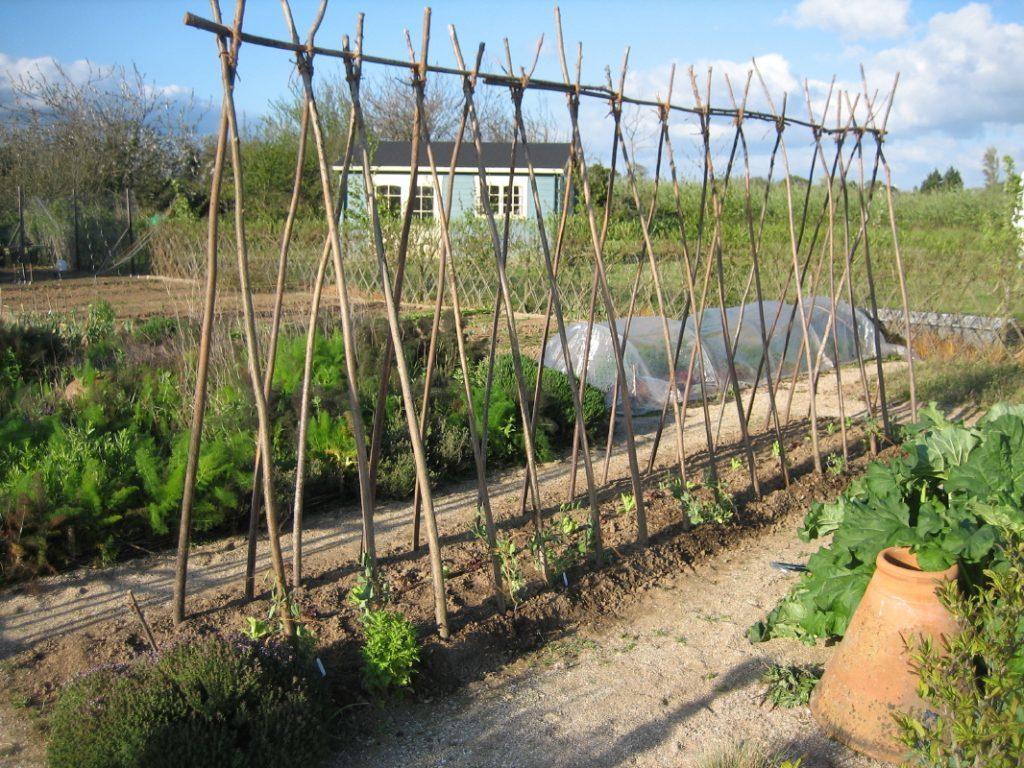
With the letter "G"
The conveniently shaped structure allows for a summer bench to be placed under the vineyard, providing constant shade. Building such a structure doesn't take much time. Any gardener can make one themselves.
For a trellis, make sure it is at least 2 m high. Support poles are installed at a distance of 120 cm from each other.
A thick rope is stretched, secured, and the grapes are allowed to grow along it. Plants should be spaced at least 60-70 cm apart. The holes in the structure are medium-sized to ensure good air permeability.
With one plane (single-plane)
Single-row trellises are easy to make. They're most often installed as a fence around a property. This allows the structure to serve two functions simultaneously. This type of trellis is the easiest to make.
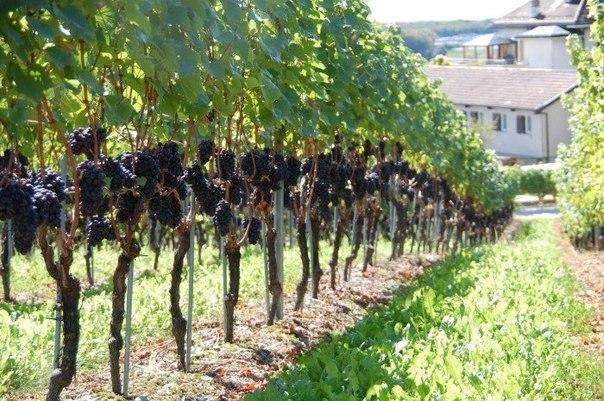
On two strips (two-plane)
Double-strip trellises offer greater variety than single-strip trellises. They come in a variety of designs and are manufactured in various configurations. These trellises can accommodate more grapevines than single-strip trellises.
T-shaped
The supports are installed opposite each other. Three or four perpendicular fasteners are attached to each sturdy pole. The bottom fastener should be at least 60 cm above the ground. Thin metal rods and strong rope are attached to the beams. The distance between the tiers is approximately 50 cm. The grape vines are planted at the same distance.
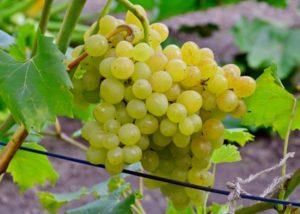
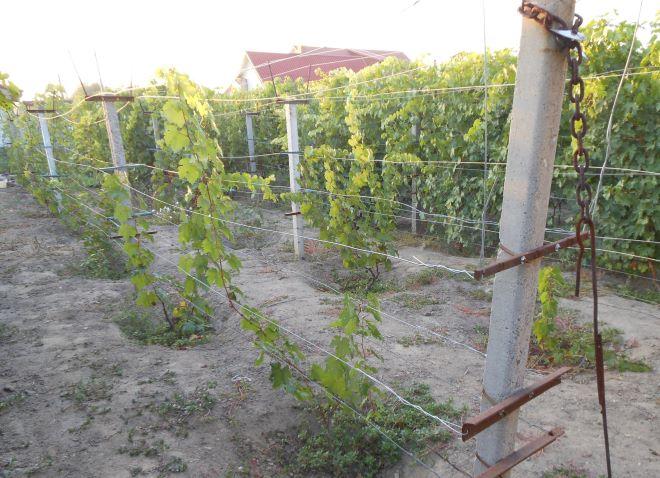
If done correctly, the plants will grow evenly and uniformly. It's recommended to use the same variety on a single trellis. This will ensure the vines are distributed in two rows, not touching each other.
This will provide better sunlight and air permeability.
For planting a vineyard, select areas with good, constant lighting and protection from drafts.
V-shaped
This type of structure is available at any specialty store. Custom-made structures are also available. They are over 2 meters high, with a width to suit the customer's needs. The supporting structures are shaped like a "slingshot." A single pole runs from the bottom, splitting into two in the middle and tilted at a 45° angle. The supporting beams are installed opposite each other at a distance of 2 meters.
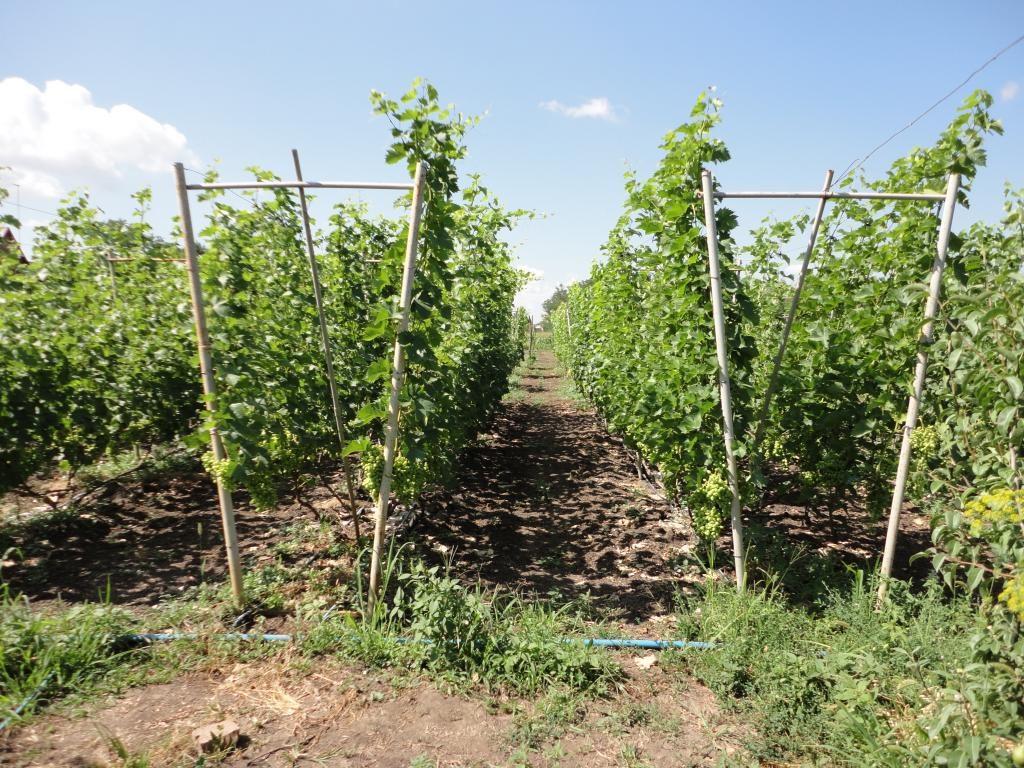
Long metal poles are secured to the ends of the V-shaped fork. The length depends on the area allocated for the grapes. From these, two more poles, shorter than the tallest, are placed down the tier.
One plant is planted per structure. It will completely cover the entire trellis within a season. Two plants can also be grown, but the vines will then become intertwined.
Arch
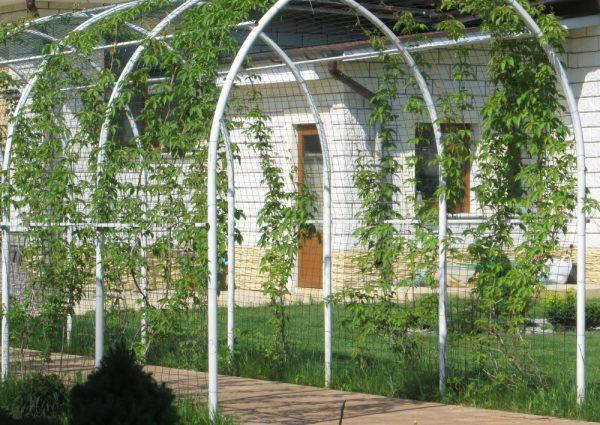
Suitable for growing arched varieties. Any arch can be constructed: round, square, or unusually shaped. Wide openings are made throughout the entire surface to allow the grapevines to grow.
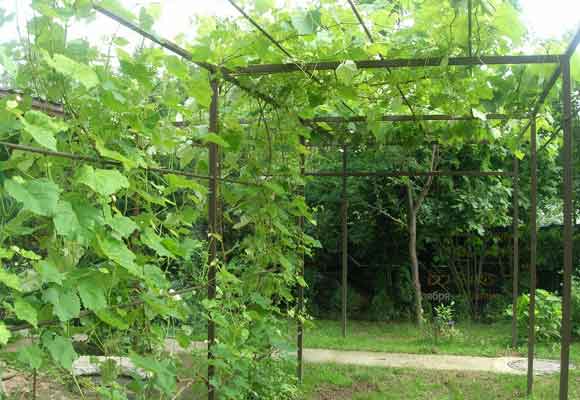
The arch can be placed in any well-lit area protected from drafts. This option fits perfectly into any landscape design, adding a decorative touch with its lush branches and creating a lush appearance. At the same time, the vineyard receives ample sunlight and ventilation.
Semi-arch
They imagine an arch cut in half, one half of which looks like a canopy facing north. Half-arches are quite difficult to make, so they not only take a lot of time but also require funding.
They are installed in a sunny area, away from strong drafts. The semi-arches allow them to be used as awnings, benches, or summer swings.
This arrangement of grapes improves aeration and protects them from afternoon shading. The structures are also decorated with various artistic patterns. Plants are planted 2-3 per trellis.
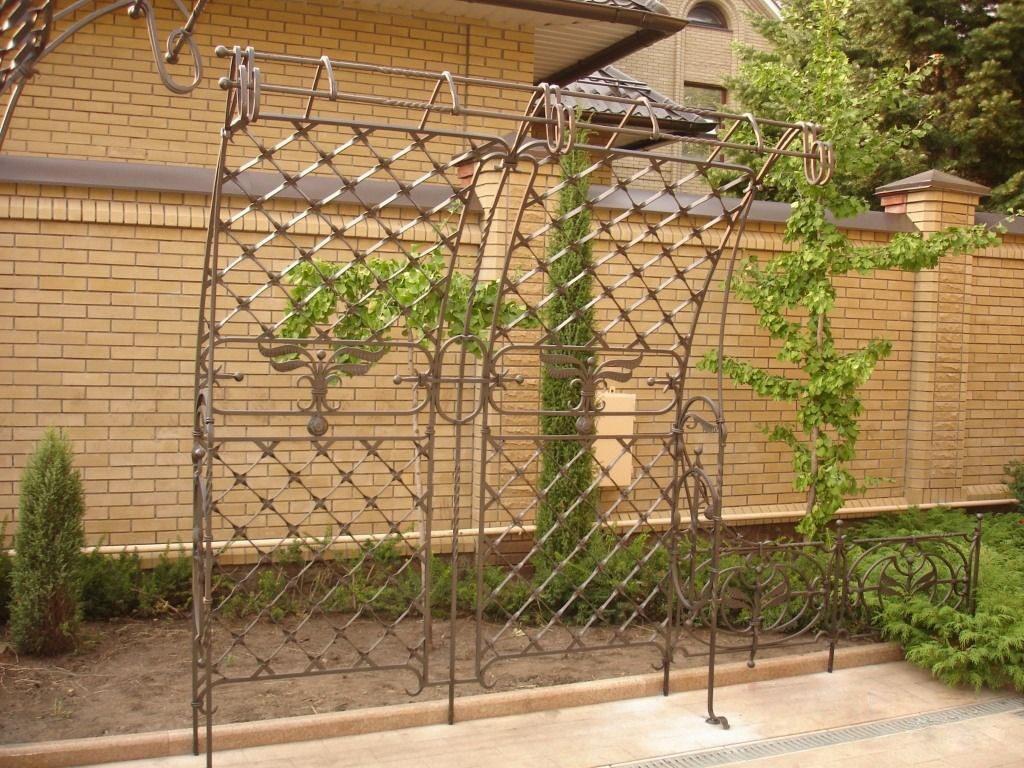 Important! Avoid planting too many grapes on a single trellis, as this will create crowding and encourage infection.
Pergola
Pergolas are installed in summer cottages and gardens to support the growth of vineyards. Any material can be used for their construction: wood, metal, and others.
It can serve as a canopy for a gazebo, a summer swing, or as a decoration for a veranda canopy.
Creating artistic designs is a time-consuming and expensive undertaking. They are most often made to order from trusted vendors. Home-made designs aren't always successful, but you can always try your hand.
Selecting a material for the support
Various materials are used for trellises: wood, metal, reinforced concrete, profile pipes, mesh, wire, and asbestos cement. All of these materials are necessary for constructing a DIY support and can be purchased at any hardware store.
Take a look Also
Tree
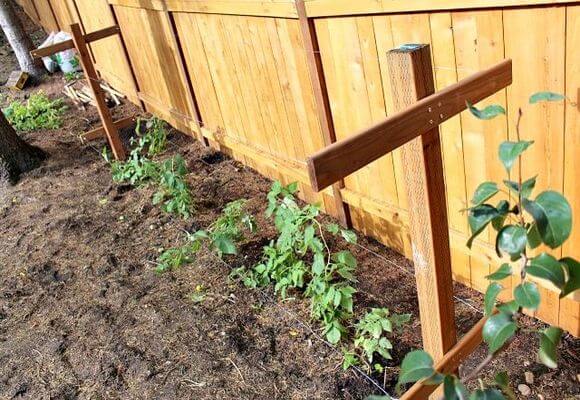
Of all the tree species, the most suitable for grape trellises are:
- ash;
- chestnut;
- oak;
- acacia.
The entire section of the post that needs to be buried in the ground is soaked in a water-repellent solution for three days. A 3-5% copper sulfate solution is suitable. Before immersion, the wood is coated with kerosene or resin.
Important! If left untreated, the wood will soften from the moisture in the ground, and the post will gradually collapse.
Metal
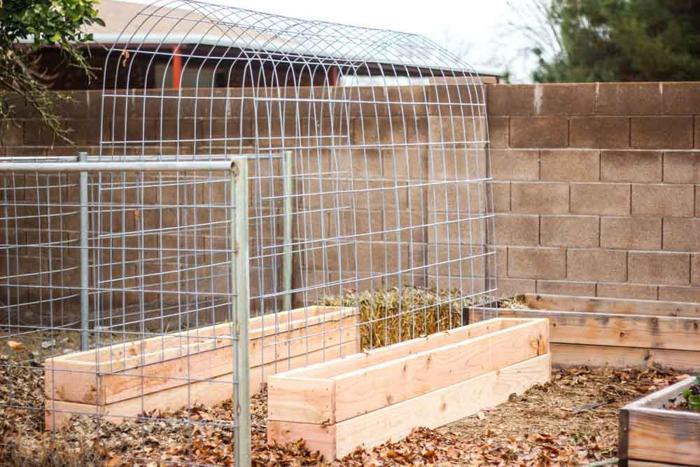
Metal supports come in any length and height, but they are thin. This option is inexpensive. It is used for single-plane trellises and L-, T-, and V-shaped structures.
It is better to use thin pipes for intermediate supports, and thicker and more durable ones for lateral ones, since they perform the main support function and take on the entire load.
It's best to have the metal free of rust before installing the structure. Once completed, the trellis can be painted in any color to match the design.
Reinforced concrete
Concrete pillars are the most durable. They provide support. Reinforced concrete is also resistant to corrosion, rot, crumbling, or fracture. It's important to note that the material is quite heavy; if improperly installed, the structure could collapse, along with the vines.
Asbestos cement
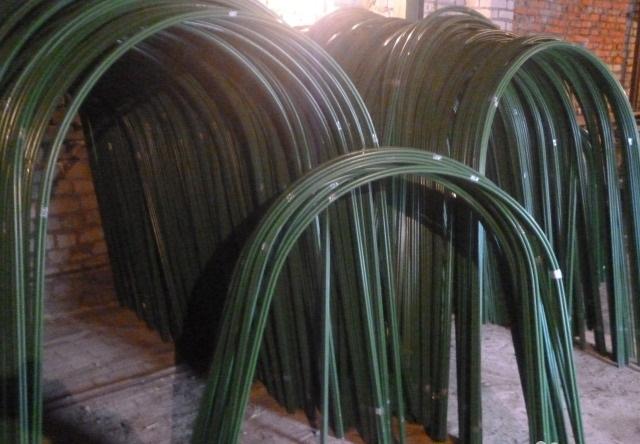
This material is used to secure support strips or posts into the ground. It is mixed with water according to the instructions and poured into a pre-drilled hole.
For the supports, holes are dug 2 meters apart and 60 cm deep. Half of the holes are filled with fine crushed stone, the other half is filled with asbestos cement.
This material guarantees strength and secure fastening of the structure. The key is to prepare the mixture correctly to ensure proper fastening.
Profile pipes
They are used as intermediate beams located between the main posts. They help create multiple levels and tiers, and arrange grape bushes in different planes depending on the type of trellis.
Thin pipes are not suitable for side support strips.
Net
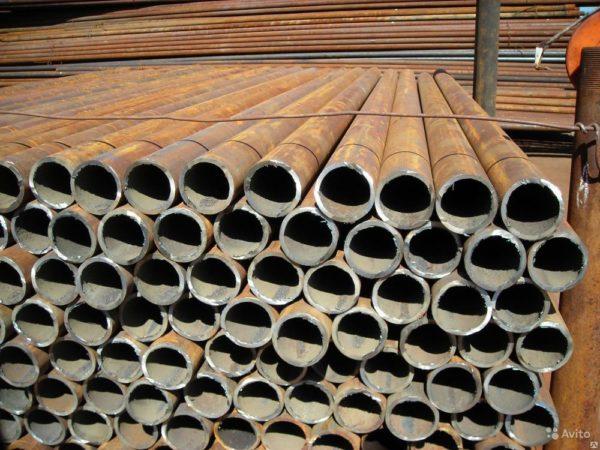
The netting is stretched between the main posts. It should have wide openings to ensure the vines are not obstructed. If the netting is too thick, infection will develop in the vineyard, preventing branches from growing properly, and causing overcrowding.
Wire
The wire is secured to wooden posts. To ensure better stability, a hole is drilled through the wood. The wire is pulled through the hole and then tied into a knot. Bolts can be used for fastening.
The wire is purchased in large quantities at once, as it is stretched in several layers for better support.
Calculating and building a frame yourself
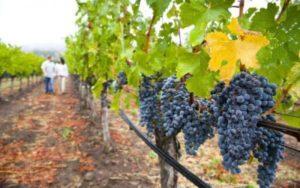
To make a trellis yourself, first draw up a plan. Choose a site and measure the available space—this will be the width. Then calculate the height—it should be no less than the length of the vine. Since gardeners most often plant grapes after installing the trellis, they usually plant young plants. I use a standard height of 180-220 cm.
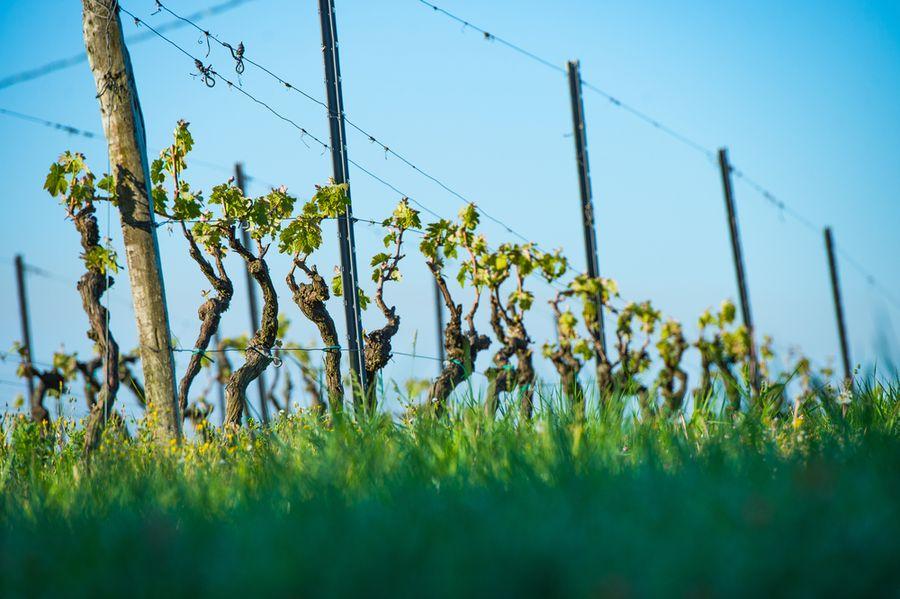
The easiest way to create a single-plane support is to perform a few steps:
- Select the material for the support beams: wood, reinforced concrete, metal.
- They are cut to the required length.
- Prepare the wire in advance.
- Dig 2 holes on the site at a distance of 2-3 m from each other.
- They begin to pull the wire in 2-3 rows, pulling it tightly.
- The wire is pulled from the bottom up, the first layer hangs above the ground by at least 50 cm, and between rows 30-40 cm.
- Between adjacent trellises, a distance of at least 3-4 m is made.
Forming and growing a bush on a trellis
When growing grapes on a trellis, special pruning techniques are necessary. There are many pruning options. The most popular are fan-shaped and sleeve-shaped. These are the most common among gardeners.
Fan-shaped
Another name for this type of crown formation is standardless multi-arm crown formation. Three to four arms are planted for a single trellis. After transplanting, wait for two to three true shoots to emerge, then prune them in the fall. After four shoots have formed in the third year, all branches are pruned in the spring. It's best to prune at least 50 cm from each branch.
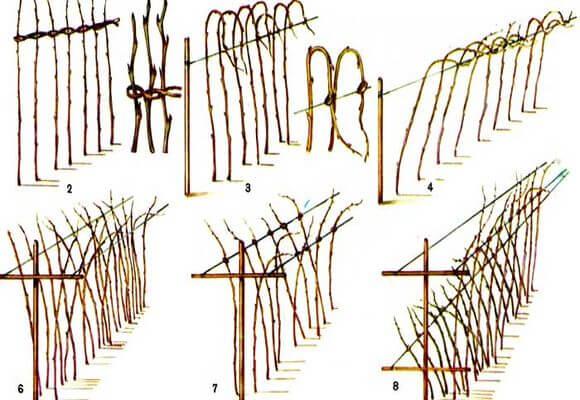
Bush training continues for two seasons, followed by sanitary pruning at the end of the season. All dead, broken, and diseased branches are removed.
Important! Proper branching prevents the growth of fungi and bacteria.
Sleeve
If you train grapes into a sleeve, you'll get a small, compact plant, about 2 by 2 meters in diameter. The principle is to create numerous branches from the sleeve, which are then spread out on a trellis.
Shaping is done over 2-3 consecutive seasons. All branches are cut off at the base of the sleeve until about 6 natural shoots are left.
Methods of tying grape vines to a trellis
When growing grapes on a trellis, it is necessary to tie new shoots to the support each season to prevent damage to the vines by wind or heavy rain.
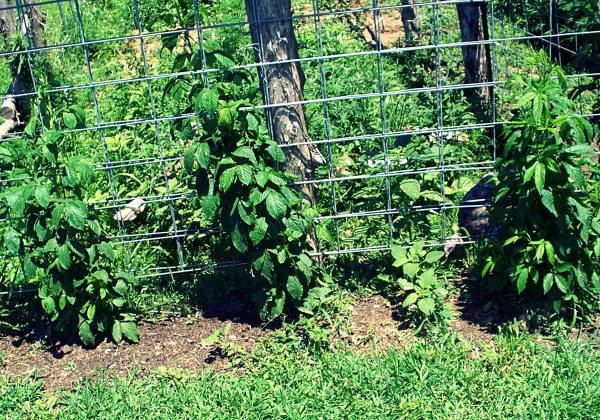
Dry
In early spring, before the buds begin to swell, tying up the shoots begins. Before beginning this process, perform a sanitary pruning, then tie all the shoots to the trellis. Cotton fabric is the best material for this. The name "dry" stems from the lack of foliage, unlike "green" trellises.
Green
Staking begins simultaneously with pinching the spring shoots. Once this is complete, each new branch is tied to the trellis. This is done carefully, not too tightly. Tie each individual section, not in bunches.
Related posts:
 How to grow grapes in the Moscow region in open ground without a greenhouse
 Description of the Julian grape variety, planting and care instructions
 Description of the Krasotka grape variety, planting and care technology
 The ripening time of grape vines by variety, how to speed up the process, and what to treat the plant with
 Beginner's Guide to Growing Grapes in Open Ground in Central Russia
 Description of 30 grape varieties for Siberia, planting and care for beginners
 How to make a cucumber trellis with your own hands from scrap materials
 Description and characteristics of the Preobrazhenie grape variety, planting and care