
- What does it represent?
- Advantages and disadvantages of the method
- What varieties of cucumbers are grown on trellises?
- Types of trellises
- Principles of planting cucumbers using trellis cultivation
- In open ground
- In the greenhouse
- Forming cucumbers on a trellis
- Topping
- Garter
- Care Features
- Possible mistakes when growing
The size of the harvest directly depends on the quality of care. In addition to watering and fertilizing, cucumbers require proper training of the central vine, which produces the majority of the fruit. One tool that can effectively influence the quality of the harvest is a trellis. What it is, and how cucumbers grown on a trellis differ from regular cucumbers, is discussed below.
What does it represent?
A trellis is a structure constructed using metal poles, a mesh stretched between them, and steel wire. As the cucumber vine grows, it climbs the mesh, spreading evenly across the entire area. The structure generally looks like this:
- Metal pipes are driven in along the garden bed (they can be replaced with wooden pegs).
- To ensure the structure's stability, the pipes are buried at least half a meter into the ground. This must be taken into account when determining their overall length.
- The height of the structure is determined depending on the selected variety.
- If there are a large number of beds, the distance between them should not be less than 1.5 meters.
Please note! Cucumbers require ample watering. When growing large crops, it's advisable to install an automatic irrigation system. This will save you time and effort.
If your budget is tight, you can build trellises using whatever you have on hand. The key is to maintain the general proportions.
Advantages and disadvantages of the method
By growing cucumbers on a trellis in open ground, you get the following benefits:
- the fruits do not come into contact with the ground, therefore they do not spoil or become covered in dirt;
- the development of cucumber vines occurs in a manner natural for this crop;
- the crop is easier to care for and more convenient to harvest;
- due to the vertical arrangement of the shoots, pollination occurs more efficiently;
- The green mass doesn't block the cucumbers from the sun, and they are well ventilated and exposed to the wind. This promotes accelerated growth;
- the beds look aesthetically pleasing;
- the surrounding space is saved.
The disadvantages include:
- erecting a trellis is a labor-intensive process;
- You will have to spend money on a good, reliable design.
The first drawback can be overcome by purchasing trellises from a specialist store. However, this will require a significant investment, which is not affordable for everyone.
What varieties of cucumbers are grown on trellises?
Almost all varieties of cucumbers can be grown on trellises, but some respond better to this method of cultivation than others:
- Focus;
- Regal F1;
- Asterix F1;
- Opera F1;
- varieties with moderate branching;
- varieties with abundant branching;
- cucumbers that ripen quickly in the garden.


Types of trellises
Today, there are many ways to build trellises, among which gardeners especially love the following types for their simplicity and reliability:
- circle trellis;
- U-shaped design;
- a frame assembled from wooden slats;
- a hut-shaped structure.
Let's take a closer look at each type. In the form of a circle:
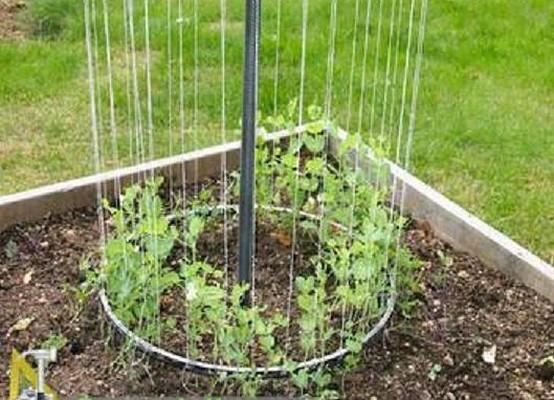
- two old bicycle wheels are mounted on a metal or wooden pole;
- one wheel is fixed 10-15 centimeters from the ground, the second - on the top of the pole;
- threads are stretched between the wheels and attached to the spokes or rim;
- This type of trellis takes up little space and has an unusual, bright appearance.
In the shape of the letter P:
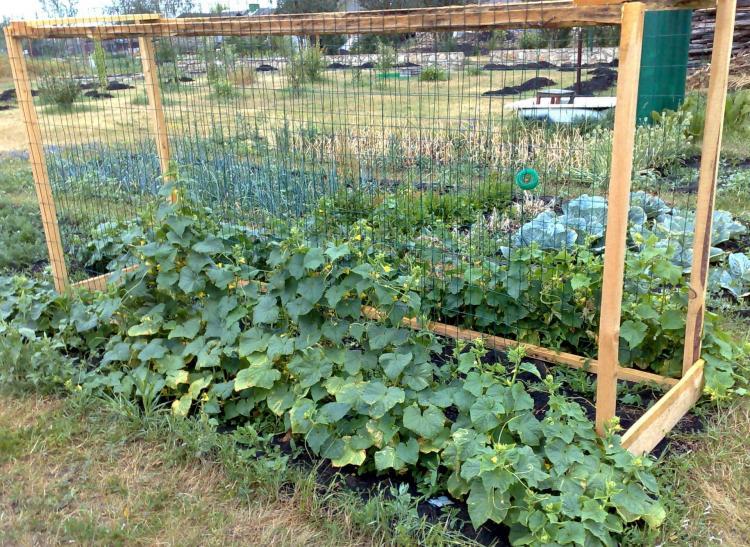
- We take two poles about 2.5 meters high. The dimensions may vary depending on the variety of cucumbers you want to grow;
- we dig them into the ground at a distance of 3 meters from each other;
- the posts are connected to each other by a vertical crossbar, over which the twine threads will be thrown;
- the ends of the thread are attached on both sides of the trellis;
- The interval between the threads is 20 centimeters.
From wooden slats:
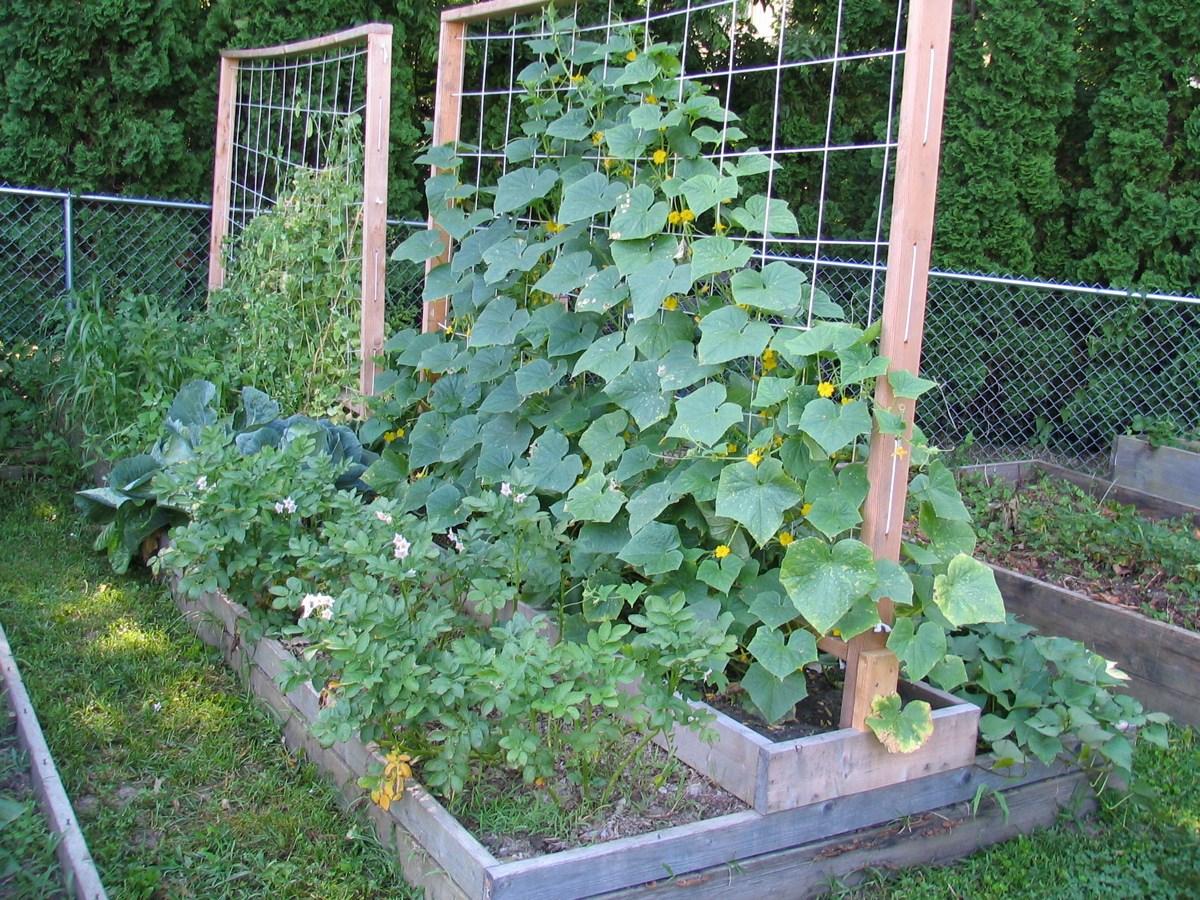
- we install a standard U-shaped structure on the beds;
- we take wooden slats and connect them together in such a way that we get a grid with cells measuring 15 by 15 centimeters;
- We attach the grating to the support.
Trellis in the form of a hut:
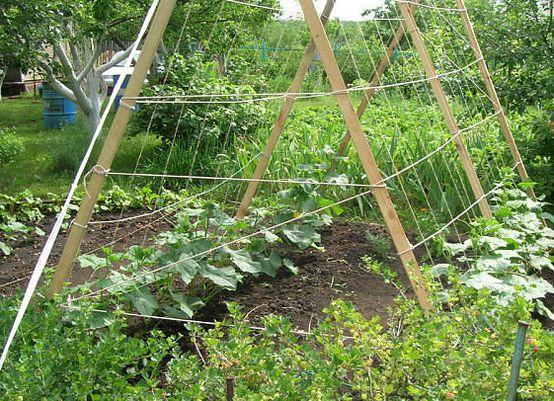
- Wooden or metal pegs are driven into the sides of the bed so that they create the shape of a hut;
- the lower part goes into the ground by 40 centimeters;
- at the top the slats are connected to each other;
- After the slats have been installed along the entire length of the bed, a horizontal slat is placed on top, serving as a fixing element for the trellis.
If you don't have the time or money to build such structures, construct a trellis from scrap materials. It may be less convenient, but it will serve its purpose perfectly.
Please note! The supports located at the edges of the garden bed are secured to the ground more firmly than the intermediate posts.
This is necessary because they bear the main load and if they are not securely fixed, the structure will collapse and the harvest will be lost.
Principles of planting cucumbers using trellis cultivation
Growing cucumbers on a trellis is done using one of two methods:
- in open ground;
- in a polycarbonate greenhouse.
Both methods have common growing conditions:
- the soil in which cucumbers grow should have low or neutral acidity;
- the soil should be loose and fertile.
This is where the similarities between the methods end, and we will consider the differences between each of them separately.
In open ground
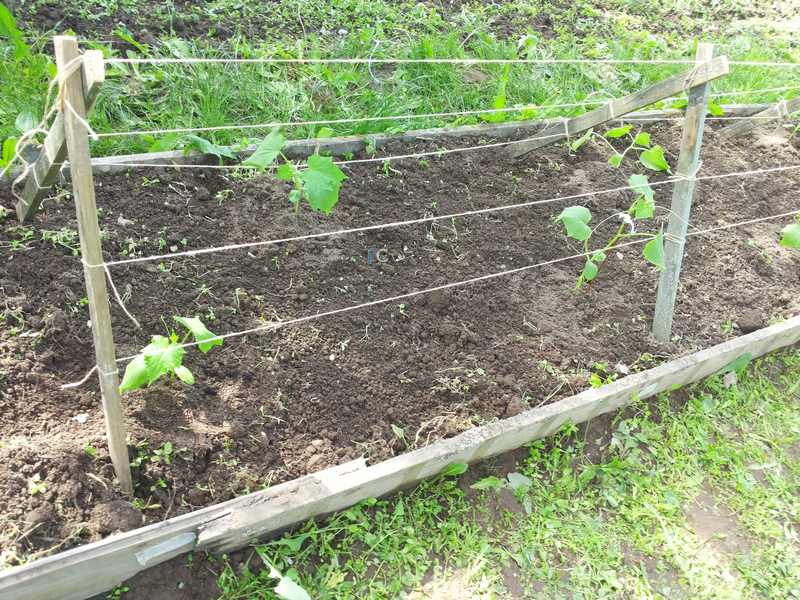
Growing cucumbers in open ground, on a trellis, is carried out in the following way:
- cucumber seedlings are grown at home, according to the standard scheme;
- as soon as the sprouts reach a size of 15-20 centimeters and at least 3 leaves have formed on them, they are transferred to open ground;
- It's important to plan your transplant to avoid night frosts. Late spring is considered the best time.
In the greenhouse
At growing cucumbers on a trellis in a greenhouse, keep in mind the following nuances:
- the seeds selected for sowing are heated to a temperature of 50 O within a few hours;
- warmed seeds are soaked in a weak solution of potassium permanganate for a quarter of an hour;
- the seeds prepared in this way are planted in soil with a temperature of at least 15 O;
- the distance between seeds should not be less than 20 centimeters;
- Developing seedlings require ample watering. It's recommended to water the beds at least once every 4 days, applying approximately 5 liters of water per square meter.

To speed up growth, seedlings are covered with film, which is removed after at least 4-5 leaves have formed on the sprouts.
Forming cucumbers on a trellis
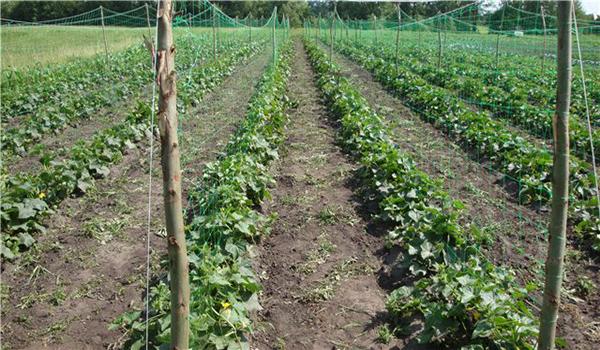
Building a trellis and planting cucumbers is only half the battle. To achieve maximum results, the gardener must control the vines' growth, guiding them in the right direction. The trellis-forming process consists of two stages:
- pinching the vine;
- garter.
If you don’t skip them and do them in the correct sequence, you will have a bountiful harvest.
Topping
The procedure is carried out in the summer and involves removing unwanted lateral shoots that drain the main vine's energy, wasting it on the formation of unnecessary green mass. Pinching technique:
- In summer, 5 leaves located at the bottom of the vine are removed;
- cucumbers that have formed next to the first 3 leaves are also removed;
- This approach will speed up the growth of the main shoot, since the first fruits take a lot of energy from the plant;
- after the 7th branch, all lateral shoots are left in place, but pinched to 2 leaves;
- in total, there should be no more than 4 leaves left on the lateral shoot;
- Twice a week, each stem is wrapped around a thread or a strip;
- There is no need to pinch the tops, just wrap them carefully around the thread without damaging them.
Please note! Cucumber runners do not affect the growth of the vine. They are removed solely for easier shaping.
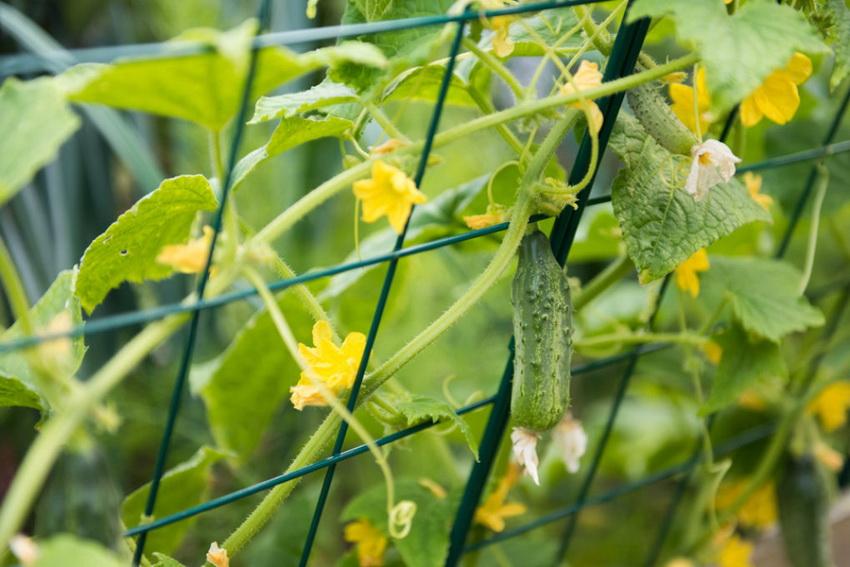
It is advisable to pinch the shoots with sharp objects so as not to injure the plant unnecessarily, but, in extreme cases, this can be done by hand.
Garter
The stems are tied using flexible, soft threads to prevent damage to the vines. One end of the rope is secured to a support, the other to the top of the plant. Then, every four days, the rope is tightened proportionally to the growth of the central vine. If you tie cucumbers on a trellis in open ground using this method, you'll get a bountiful harvest in the fall.
Care Features
Here's how to care for cucumbers:
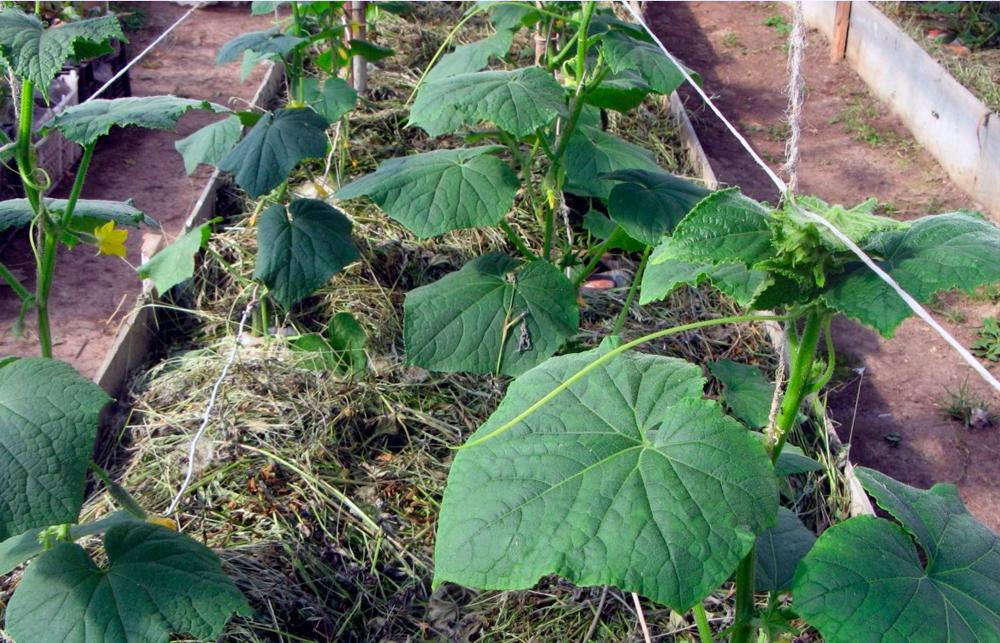
- Water generously throughout the season. Ideally, water the soil every 3 days, applying water as close to the base of the stem as possible. Avoid pouring water on the leaves, as this will cause them to burn.
- Fertilize the soil. Feeding the bushes with mineral and organic fertilizers, such as manure, will achieve impressive results;
- mulch the soil around the stem;
- Don't forget about pruning, removing excess green mass in the form of leaves and side shoots, especially in the upper part.
Possible mistakes when growing
Beginner gardeners don't know all the intricacies of growing cucumber seedlings, making the following mistakes:
- Choose planting sites exposed to strong winds or shaded areas. This is a big mistake and will prevent the bush from developing fully. Seedlings need shelter from the wind and access to sunlight.
- Planting crops in the same area for several years in a row is wrong, and experienced gardeners recommend growing cucumbers in the same spot at intervals of two years;
- Do not attach the mesh to a metal fence. The metal, when exposed to sunlight, becomes very hot and burns the stems.
Related posts:
 Description of the best varieties of Chinese cucumbers, planting, growing and care
 Description of unusual methods for planting and growing cucumbers
 How to care for cucumbers in open ground from planting to harvesting
 TOP 30 best determinate cucumber varieties with descriptions
 Why cucumber leaves are drying out and what to do, how to treat them in a greenhouse and in the ground
 TOP 30 best varieties of cold-resistant cucumbers with descriptions and characteristics
 How to properly plant cucumbers in open ground with seeds, and at what depth
 How to plant cucumbers in open ground under film: timing and cultivation technology