
A homemade cucumber greenhouse has a number of advantages. There are many different types of designs. A greenhouse helps maintain stable soil and air humidity and temperature, essential for vegetable growth. Structures can vary in material, construction type, and size. It's also important to choose a good location for the greenhouse and ensure proper maintenance.
Purpose and types of structures
A greenhouse is a small device designed for growing not only cucumbers, but also other heat-loving crops. Unlike a greenhouse, it takes up little space on the site, the height is small, and in some rooms the entire area of the land is given over to beds.
There are several types of greenhouses that are easy to make yourself:
- Arched varieties feature a semicircular roof. The structure is temporary, constructed using arches covered with plastic. Cucumbers are kept under cover until the threat of spring frost has passed. A permanent structure is also available, consisting of profile pipes and polycarbonate. This latter type of greenhouse can be used for several years.
- A distinction is made between single-pitched and double-pitched roofs. This type of greenhouse can be constructed from wood or metal. Polycarbonate, glass, or polyethylene film are the preferred covering materials.
- If the climate in the area is cold, a recessed version is suitable. The structure's walls are made of wooden planks or beams. The room is enclosed with double-glazed frames.
There are other types of homemade greenhouses for cucumbers. Each type of structure must meet the following requirements:
- the air inside the room should be at a constant temperature: +25 degrees during the day and +16 degrees at night;
- soil temperature at +20 degrees;
- humidity at 75%;
- there should be no draft;
- It is important to ensure sufficient access of light to plants;
- It is necessary to think about convenient access for insects during pollination;
- Be sure to equip the room with supports for tying up cucumber bushes.
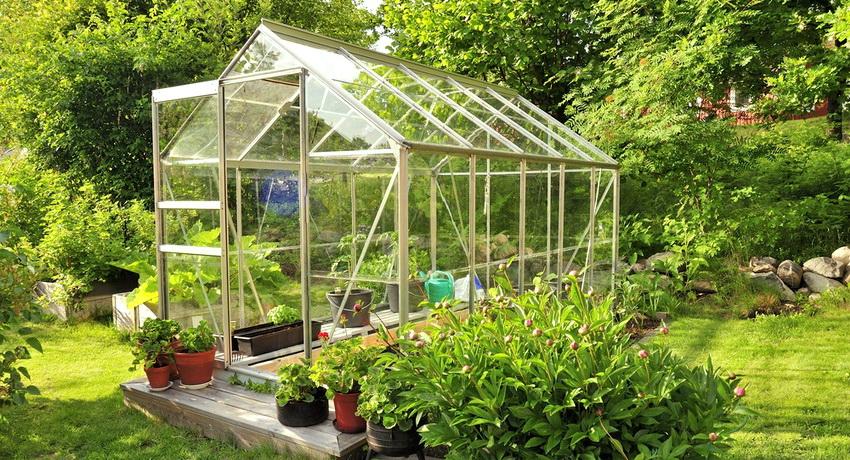
You can make an enclosed space for vegetable crops from any available materials:
- The structure is quickly assembled from discarded window frames. They are laid and secured to a prepared wooden frame.
- It's easy to make a triangular greenhouse from wooden planks. Create a box, install beam posts in the center, and connect them with a pipe. Attach the side beams to the long side boards, and then attach two slanted boards.
Each structure must have a rope stretched from the base to the top. This is necessary to train the cucumbers vertically.
Butterfly
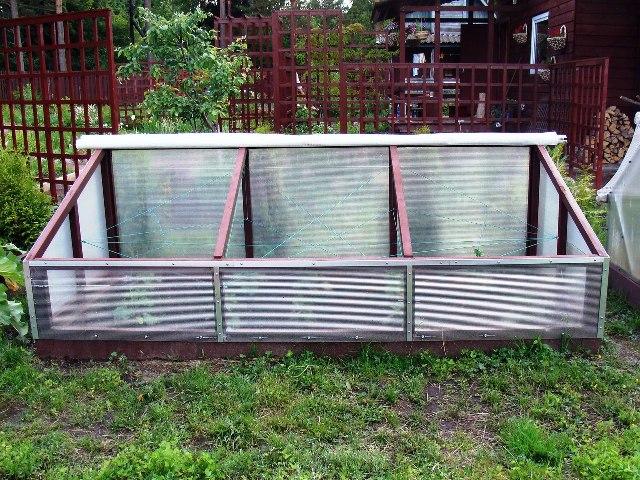
The butterfly greenhouse is unique in that it features two opening roof panels. When both sides are lifted for ventilation, the structure resembles the outspread wings of a butterfly.
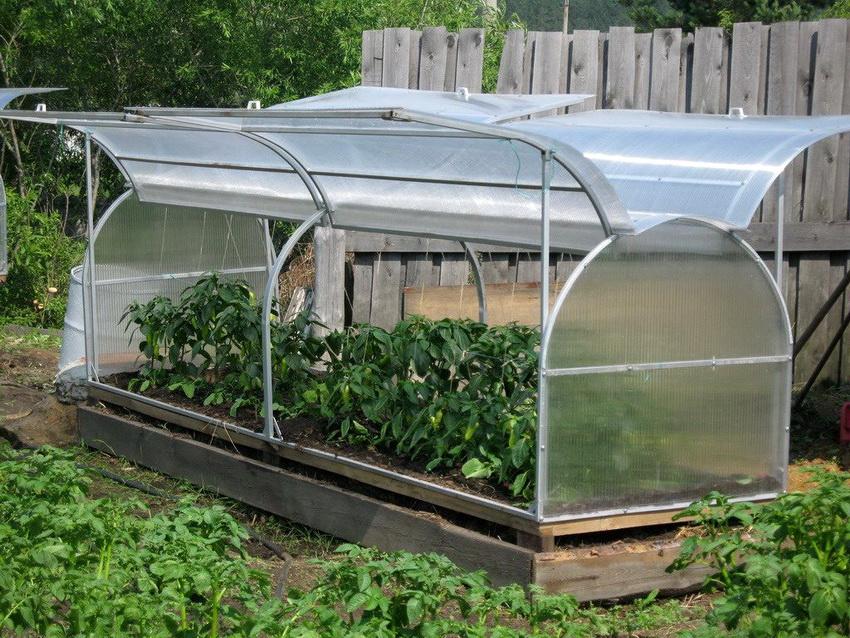
This type of greenhouse is convenient to use. Since each side opens, it's easy to work with the bed from any angle. The entire room is used for the beds. The butterfly greenhouse takes up little space. The standard length is 260 cm, the width is 140 cm, and the height is 100 cm. Before assembly, a detailed drawing is made:
- First, begin assembling the wooden frame. The side end walls consist of three connected beams. They will be attached with brackets and screws to the two long side boards.
- Notches 26 mm deep and 5 mm wide are made in the center of the long side boards. These notches are necessary for installing the frame.
- A ridge board is installed between the side walls.
- Supports for the wings are made from narrow boards, which are installed in the grooves of the long side boards.
- It is better to make additional supporting bars under the supports.
- After this, they begin making the wings themselves. They make a frame of the appropriate dimensions and insert the glass.
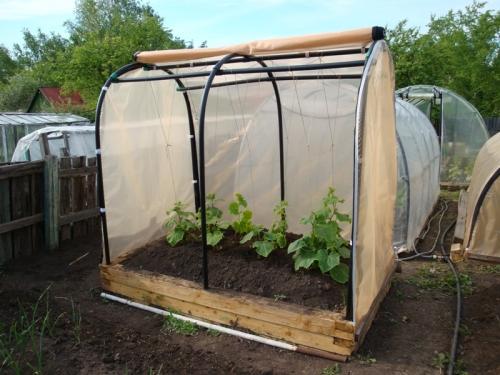
Because the greenhouse is small, it warms up quickly in the sun, retains heat well, and withstands strong winds. Wide, hinged sides allow air to reach every corner of the room.
Snail
A snail-shaped mini greenhouse is a portable structure with a hinged half on one side. It is most often used for germinating seeds. The greenhouse frame is made of profile pipes, and the covering material is polycarbonate. A hinged door is installed on both sides. Wooden beams or bricks are used for the foundation.
Belgian
The Belgian greenhouse is considered a practical and convenient indoor greenhouse. This type features a single-pitched, hinged roof. The frame is made of metal or wood. The covering is made of glass, polycarbonate, or film. The only drawback is the high side of the structure, requiring you to lean over it to tend to the plants.
Materials required for manufacturing
Before making a cucumber garden at your dacha with your own hands, you should decide on the appropriate material.
The frame can be made of the following material:
- Wood is a durable material and does not let in cold, but at the same time the structure is susceptible to rotting and requires treatment with antiseptics;
- It is easy and quick to install plastic pipes that do not rot, are easy to clean, and retain heat, but they are not used if the room is covered with glass;
- The metal profile is characterized by high strength, it can be washed and treated with disinfectants, but the material does not retain heat well.
As a covering that will protect cucumbers from the cold, you can consider the following materials:
- polyethylene or reinforced film is quickly installed and removed, but quickly tears and does not retain heat well;
- Polycarbonate has high strength, good thermal insulation and light transmittance, and is easy to install;
- Glass has good thermal insulation and light transmittance, and can withstand temperature changes, but the material must be handled with care to avoid breakage; a strong frame is required.

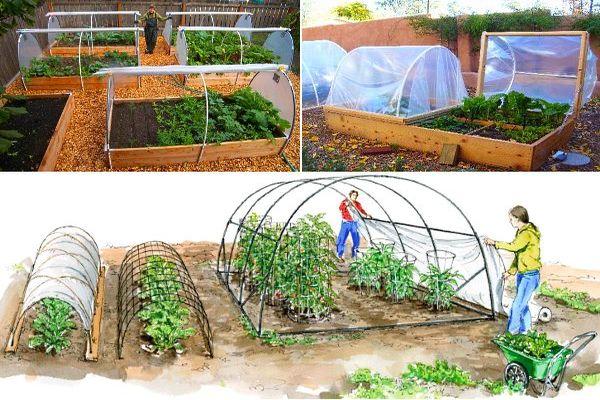
To build a greenhouse, you can combine several types of materials. This will create a structure that is reliable and easy to use.
Advice: If wood is used to construct the greenhouse, pre-treat it with an antiseptic. Metal structures should be treated with anti-corrosion compounds.
Calculating the size of a greenhouse
Each person determines the greenhouse size individually. The number of cucumber seedlings to be grown in the greenhouse is taken into account. To ensure each plant receives sufficient air and light, spacing is important. Three plants are planted per square meter.
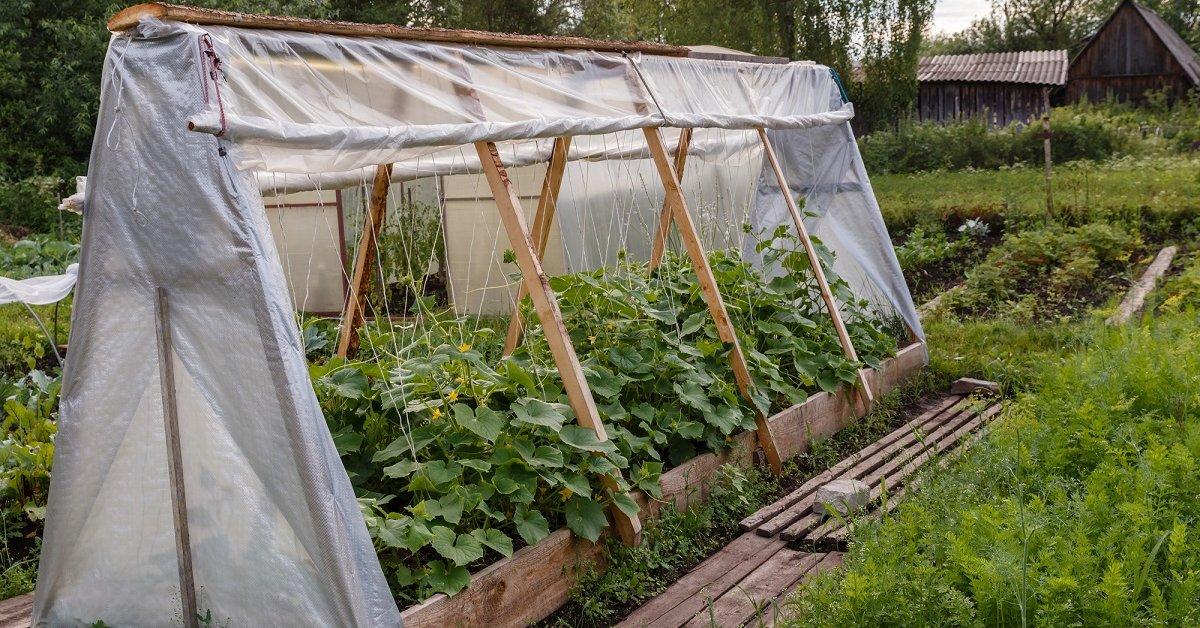
The size of the structure is influenced by the type of material chosen. For example, a single polycarbonate sheet is 210 cm wide. A greenhouse will require at least two sheets, so the structure will be at least four meters long. The height of the greenhouse should be at least 80 cm. With these dimensions, a greenhouse will take up little space in the garden and will warm up quickly. Vegetables will also thrive.
Selecting and preparing a site
To ensure that sufficient daylight enters the room, the greenhouse must be positioned from the east to the west or from the north to the south. With this arrangement, the sun's rays will freely enter in the morning and evening, and the side walls will protect from the midday heat.
The site for the structure is chosen to be level, with a slight slope to the south. The soil is first dug and fertilized. A popular mixture is humus, peat, and rotted sawdust. To ensure the soil warms up sufficiently, a mixture of straw and manure is added under the fertilizer layer. It is recommended to apply the insulating layer 20 days before planting the cucumbers.
How to make a greenhouse yourself
The simplest option for DIY construction is an arched greenhouse. You'll need arches, 3 or 6 meters long. The arches are spaced 80 cm apart and connected with longitudinal ties. The covering film is three meters longer than the greenhouse itself.
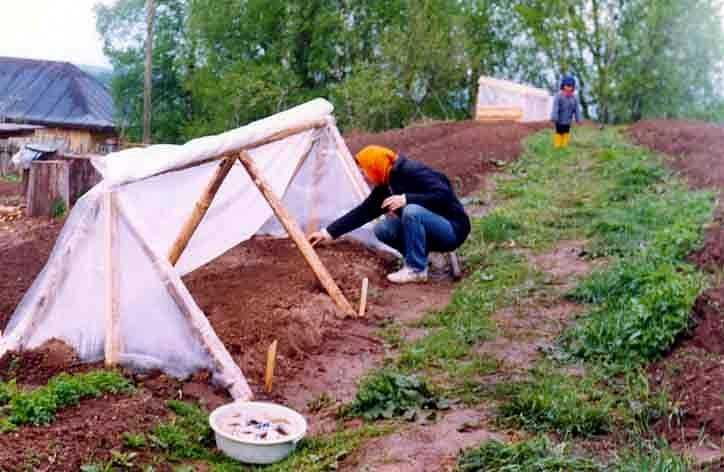
Construction of a greenhouse should include the following sequential steps:
- They dig a pit 65 cm deep.
- Sand, crushed stone or gravel are poured onto the bottom of the pit.
- A wooden base is made according to a pre-designed pattern. The resulting structure should be a rectangle of wooden beams, joined with brackets and screws.
- Pipes and rebar are cut. The length of the rebar for securing the arches should be approximately 50 cm. If the pipes are three meters long, the greenhouse will be high enough for cucumbers to grow.
- The next step involves driving rebar pieces into the ground (to a depth of 26 cm) where the arches are to be installed. The rebar should be at the same level on both sides of the wooden frame.
- The arcs are installed by bending them and placing them on pieces of rebar. The arcs should be arranged in a single, even row.
- The arches are secured together with a pipe tie equal to the entire length of the greenhouse. The tie is attached to the arches with wire. To ensure the structure is strong and the film does not sag, additional ties are installed on the sides of the greenhouse.
- They move on to finishing the end portion of the device. The film is stretched over the arches and securely fastened with fasteners.
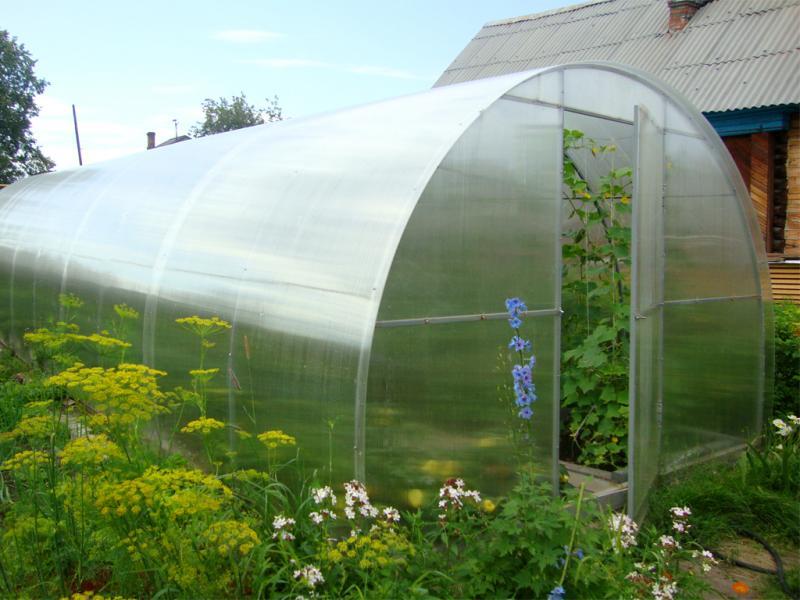
The frame can be made of metal or wood, with polycarbonate used as the covering. However, this will take longer to build.
Subtleties of the internal structure
To ensure that the greenhouse is as functional as possible, various additional equipment is installed:
- It is recommended to organize an internal heating system;
- install lamps to illuminate the interior space (phytolamps or fluorescent lamps are suitable);
- For convenience, an irrigation system is installed.
If space allows, one or two paths are laid between the beds to ensure convenient access to each cucumber bush.
Rules for operating greenhouses for cucumbers
To get a good harvest indoors, you need to properly care for not only the cucumbers, but also the greenhouse itself:
- After the structure is assembled and installed, it is left for several days to allow the room and soil to warm up.
- If film is used as a covering material, then for the winter it is carefully folded and put away until the following year.
- A polycarbonate greenhouse should not be cleaned with abrasive cleaners; wiping with a damp cloth is sufficient. It's best to store the sheets indoors for the winter.
- Before planting cucumbers, the frame and soil are disinfected with special solutions to prevent the spread of infections and pests. Disinfection is carried out using solutions based on products such as Farmayod, Climate, Actellic, and Bayleton.
Caring for cucumbers in a greenhouse is no different from caring for cucumbers in open beds. It's essential to properly organize the planting, establish a watering and fertilizing schedule, and regularly loosen and weed the soil. Staking in a greenhouse is most often done vertically.
Related posts:
 How to build a tomato greenhouse yourself
 How to make a cucumber trellis with your own hands from scrap materials
 How to properly plant cucumber seedlings in a greenhouse and care instructions
 Description of unusual methods for planting and growing cucumbers
 Description of the best varieties of Chinese cucumbers, planting, growing and care
 How to care for cucumbers in open ground from planting to harvesting
 How to grow cucumbers in a polycarbonate greenhouse: planting and care guidelines
 How to properly plant cucumbers in open ground with seeds, and at what depth