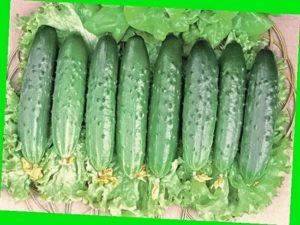
Tri Tankista cucumbers are distinguished by their high productivity, uniform, massive yield, and long fruiting period. This parthenocarpic cluster gherkin hybrid is suitable for growing both outdoors and indoors. Culinary cucumbers are used for pickling and canning; they are also included in dietary diets.
Advantages of a hybrid
The Tri Tankista f1 cucumber variety is a first-generation hybrid and is included in the State Register of Breeding Achievements. This variety is suitable for cultivation in open ground and spring tunnels. Tri Tankista cucumbers are grown in home gardens and on small farms.
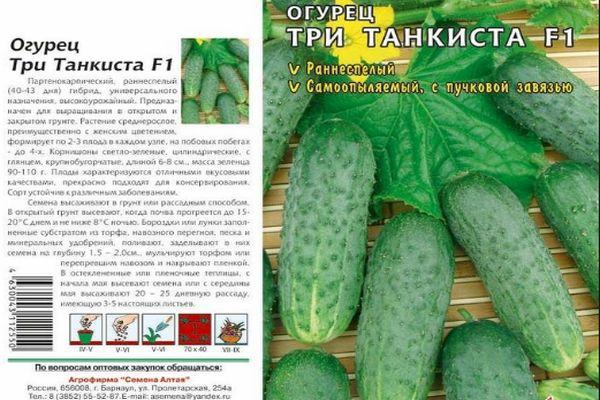
This parthenocarpic (self-pollinating) cucumber is capable of producing seedless fruit. It is an early-ripening variety with a growing season of 40-43 days and is highly productive.
The plant is an annual, indeterminate, vigorous, with a moderate number of branches. The leaves are medium-sized, green, slightly wrinkled, and slightly wavy at the edges.
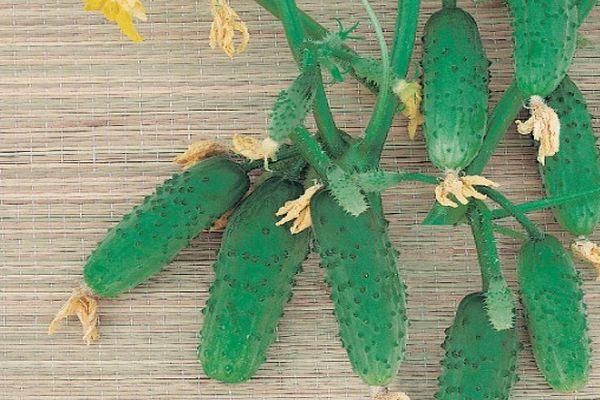
The hybrid's description indicates that it produces predominantly female flower stalks. Each node produces 2-3 fruits, and the lateral shoots produce up to 4 gherkins.
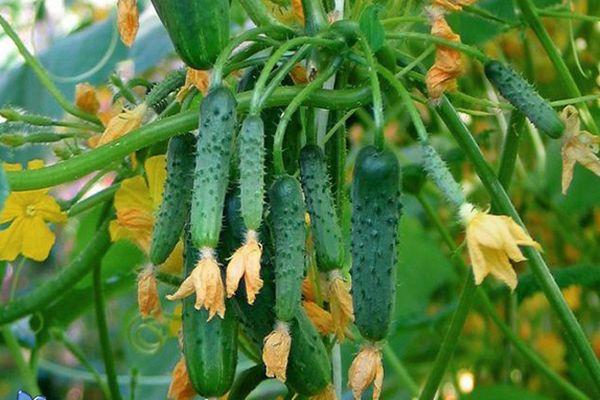
The cucumbers are cylindrical and spindle-shaped, with a slightly glossy skin, large tubercles, and white spines. The fruit has a slightly ribbed surface, green coloring with short stripes, and white pubescence.
Ripe gherkins reach 6-8 cm in length and 3.1-3.4 cm in diameter. Each cucumber weighs 90-110 g. The hybrid's marketable yield is 10-13 kg per 1 m².
Vegetable growers' reviews point to excellent taste and versatile culinary uses. Cucumbers are used fresh, in salads, pickling, and canning.
Pickled cucumbers are considered a delicacy and possess exceptional flavor. These cucumbers contain a concentrated amount of minerals. Gherkins are a key component of the cucumber diet.
The hybrid is resistant to cucumber mosaic virus, root rot, powdery mildew, and olive spot.
Ripe cucumbers should be removed from the plant in a timely manner to stimulate the development of other ovaries.
Cultivation techniques for the variety
Cucumbers are planted in May, as they are highly frost-sensitive. The plant is grown from seedlings or directly from the soil in a permanent location.
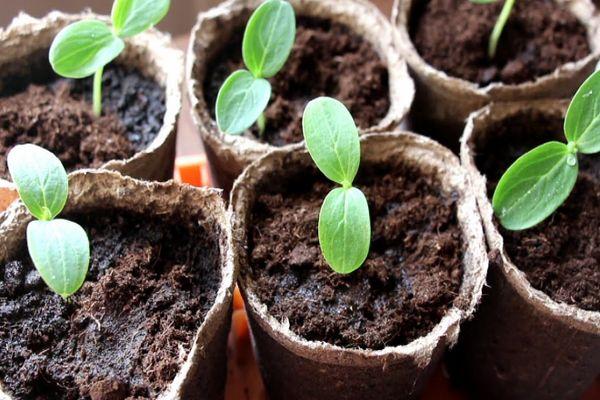
With the seedling method, seeds are planted in pots filled with growing medium. When the seedlings have three true leaves, they are transplanted into the soil. The seedlings are spaced at a distance from each other.
Cucumbers are very sensitive to transplanting, so peat pots are recommended for growing seedlings. When transplanting to their permanent location, the seedlings do not need to be removed from their containers.
Young seedlings need light, optimal temperature, and humidity. The pot decomposes in the soil, turning into an additional source of organic nutrients. This process does not damage the root system.
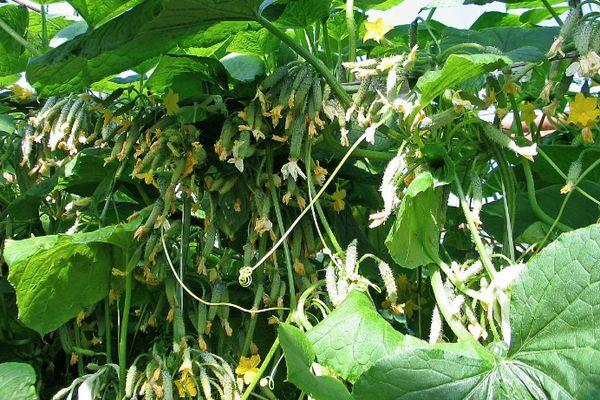
The plant should be planted in a well-lit location. When grown in greenhouses, plant 2-5 plants per square meter; in open ground, plant 3-4 plants per square meter. To ensure a strong plant, remove the shoot at the third leaf level.
Direct sowing simplifies the hybrid's cultivation process. The only drawback of this method is that the fruits begin to ripen 10-14 days later.
When planting, add humus and wood ash to the holes. After sowing, cover the area with plastic film to create a greenhouse effect. The film is removed after the seedlings emerge.
Caring for the crop involves timely watering with warm water. It is held 2-3 times a week in the evening. For uniform distribution of moisture, it is recommended to use the drip irrigation method.
Gherkins appreciate a balanced dose of organic fertilizer. To ensure normal fruiting, add potassium.
Excess organic matter can negatively impact crop health. Complex nitrogen-containing fertilizers are suitable as supplementary nutrition.
To ensure normal crop development and prevent fungal diseases, soil loosening and hilling are recommended. This technique regulates the air and moisture balance and ensures oxygen access to the roots.
It's recommended to tie cucumbers to a trellis. This ensures proper growth and oxygen supply to the above-ground portion of the plant.
Related posts:
 TOP 30 best varieties of cold-resistant cucumbers with descriptions and characteristics
 Description of the best varieties of Chinese cucumbers, planting, growing and care
 35 Best Powdery Mildew-Resistant Cucumber Varieties with Descriptions
 30 Best Dutch Cucumber Varieties with Descriptions and Characteristics
 TOP 10 recipes for quickly preparing lightly salted crispy cucumbers using cold and hot methods in a saucepan
 How to prepare pickled cucumbers in adjika for the winter without sterilization and Caucasian style: recipes
 TOP 30 best determinate cucumber varieties with descriptions
 Description of the best varieties of bee-pollinated cucumbers, rules for their formation and care