
- Origin and spread of culture
- Useful properties of peanuts
- Varietal diversity of cultivated peanuts
- Spanish varieties, or Spanish
- Runner varieties
- Virginia Peanut Group
- Varieties Valencia, or Redskin
- Tennessee
- What varieties are recommended for planting in Russia?
- Krasnodarets 14
- Valencia 430
- Klinsky
- Specifics of planting and caring for peanuts
- Site and soil preparation
- Planting and care
- Fertilizing and harvesting
Peanuts belong to the legume family, have several species, and are grown in Asia, Africa, and the Americas. They are delicious and filling, and are used in cooking and medicine. Peanut butter and paste are also made from them. The plant thrives in warmth, although it is undemanding. Peanuts contain many beneficial micro- and macronutrients, vitamins, and fatty acids. They were once considered food for the poor and feed for livestock. Soldiers during the American Civil War ate peanuts to speed up their recovery.
Origin and spread of culture
Peanuts originate from South America, where they were grown before Columbus discovered the country. The crop is also known as groundnuts.
The Spanish brought the plant to Europe, where peanuts were even used as a substitute for coffee. Later, groundnuts spread to Africa, where they grew even in poor soils, and then to North America. The Portuguese brought the plant to India, the Philippines, and China. In the early 19th century, peanuts began to be grown in South Carolina.
In the 20th century, American agricultural chemist George Carver suggested that farmers plant peanuts in soil previously occupied by cotton. Harvests were abundant, and Carver later devised numerous uses for peanuts, including culinary, medicinal, and cosmetic applications. They are now grown in China, India, Turkey, Iran, Argentina, and South Africa. There are also a few plantations in Uzbekistan, Tajikistan, and Ukraine. Peanuts arrived in Russia in the 18th century from Turkey.
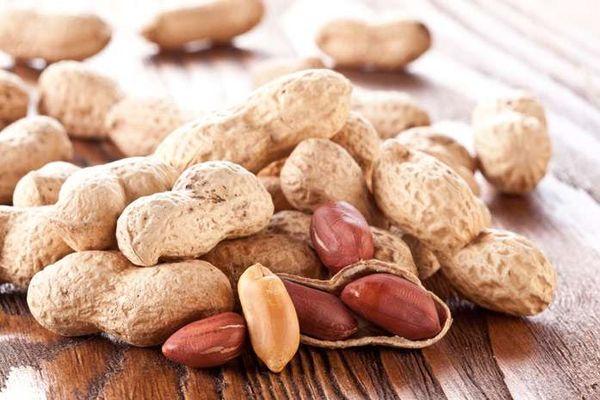
Useful properties of peanuts
Due to the content of B vitamins, vitamin E, amino acids, micro- and macroelements, the plant has many beneficial properties:
- helps the work of the heart muscle;
- promotes cell renewal;
- stimulates the nervous system;
- improves memory;
- improves hearing;
- saturates the body with energy, reduces hunger, and helps with weight loss when consumed in small amounts;
- normalizes blood pressure and metabolism;
- strengthens the immune system;
- helps prevent gallstone disease;
- maintains blood sugar levels;
- has a beneficial effect on male potency.
Take a look Also
The plant has antioxidant properties and is useful for gastrointestinal diseases.
The caloric content of raw peanuts per 100 g is 552 kcal, dried peanuts - 611 kcal, protein content - 30%, vegetable fats - 60%. Peanut consumption is prohibited in case of allergies, digestive disorders, severe liver diseases, for children under 3 years of age, and during breastfeeding.
Varietal diversity of cultivated peanuts
There are about 70 varieties of peanuts, but there are only a few main varieties.
Spanish varieties, or Spanish
It is characterized by a high oil content and is short, reaching up to 50 cm, and is cultivated in South America. Its kernels are small, pinkish-brown in color. It is used to make sugared and salted peanuts, peanut butter, or peanut oil. Its yield is average and it is susceptible to disease. Well-known varieties include Dixie Spanish, Star, Shafers, Tamspan, White Kernel, and Argentinian.
Runner varieties
Known since the 1940s, it is grown in the southern and eastern states of America. It produces high yields and tasty fruits, which are used to make salted peanuts and oil. Varieties include Egyptian Giant, Bradford, and Georgia Green.
Virginia Peanut Group
Grown in bunches and shoots, it can produce fruit at a depth of 5-10 cm. This is a large, select variety. It is used in candies, cakes, ice cream, chocolate, and pastries. The best varieties are North Carolina, Gregory, Shulamit, and Perry.
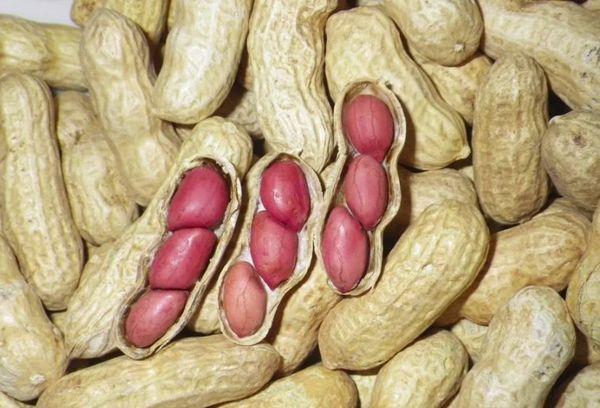
Varieties Valencia, or Redskin
Cultivated in the United States and Mexico, they are characterized by large kernels, tall, smooth fruits, and three seeds in each pod weighing 0.5 g.
Tennessee
Belonging to the Valencia genus, it is cultivated in the United States. It grows up to 1 m and matures in 110 days. The nuts are small, round, red-skinned, soft, and sweet. Varieties include Texas Red and White.
What varieties are recommended for planting in Russia?
In Russia, it is recommended to grow varieties developed by domestic breeders and adapted to local climate conditions. Peanuts can be planted in the Krasnodar and Stavropol Krais, the Astrakhan and Rostov Oblasts, and Dagestan. In colder regions, they should be grown in a greenhouse.
Take a look Also
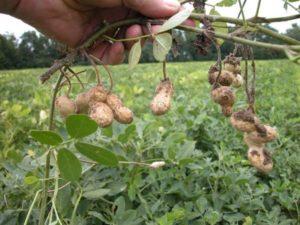
Krasnodarets 14
Bred in 1992, this disease-resistant variety reaches 25 cm in height, producing beige-colored, elongated oval-shaped beans, 1-1.5 cm wide, and sweet.
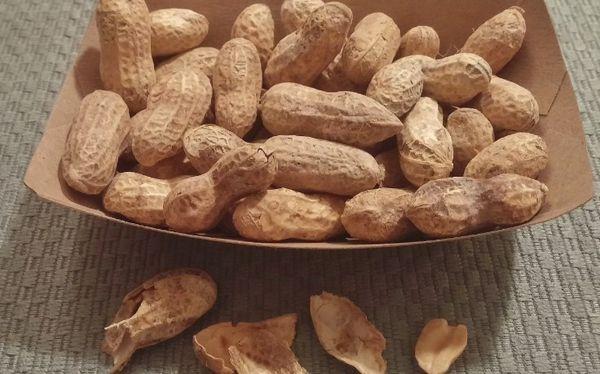
Valencia 430
A large-fruited, early-ripening, high-yielding variety. Characterized by a high oil content, it prefers warmth and moisture. A single bush can yield 0.3-0.5 kg of fruit. It is adapted to cold and drought.
Klinsky
Bred by Ukrainian farmers, cultivated since 2002, early maturing, high-yielding variety.
Specifics of planting and caring for peanuts
Peanut is an annual plant, reaching 70 cm in height, with a taproot system. The stem is erect or prostrate, the leaves are long and pointed, and it blooms in late June or early July. The flowers are yellow and unusually shaped. The fruits, called gynophores, then penetrate moist soil and ripen underground. Shoots that don't reach the ground die.
Site and soil preparation
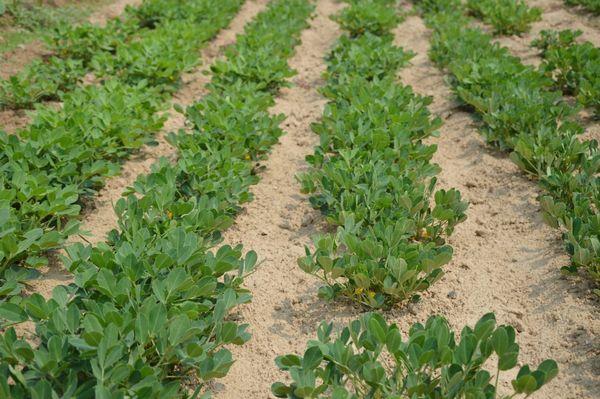
Choose a well-lit, ventilated, and shade-free site for planting peanuts. The soil should be black soil or neutral, with a high potassium, magnesium, and humus content. Peanuts do not tolerate salinity. Suitable predecessor crops include cabbage, cucumbers, and potatoes, but not legumes.
The soil is dug or plowed in the fall, and fertilizers (superphosphate, ammonium sulfate, potassium salt, and humus) are added. In the spring, weeds are removed and the soil is loosened before planting.
Planting and care
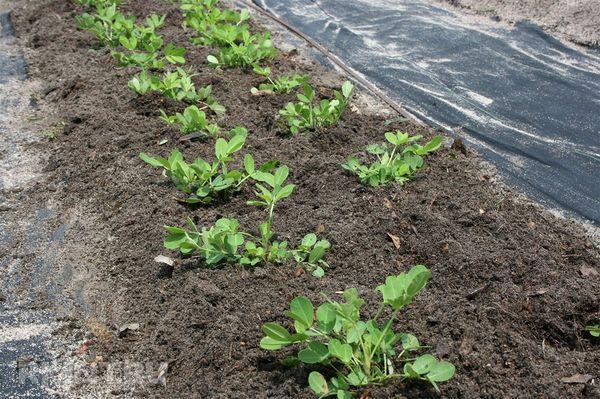
Planting is usually done in May, when the acacia is in bloom. The temperature should be +15°C. Select large, healthy beans. Sprout them, place three per hole, and plant them 8-10 cm deep. Space 15-20 cm between plants and 60-70 cm between rows.
After planting, water carefully so as not to wash away the soil.
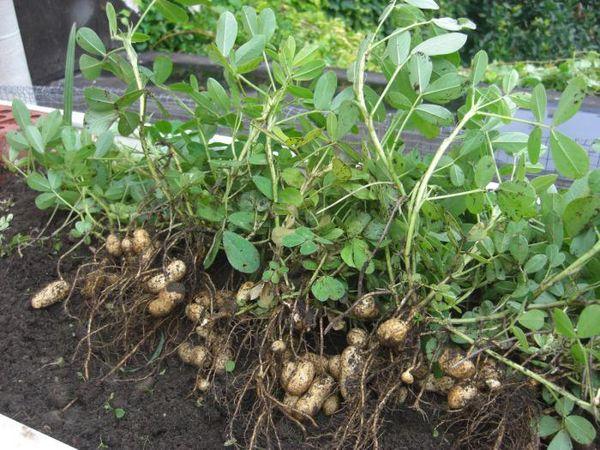
Care involves hilling the bushes to a height of 50-70 cm before flowering and 10 days after. Six hillings are recommended per season. The soil should be regularly moistened, loosened, and weeded. Water using drip irrigation or furrow irrigation with settled, warm water every 10-12 days during dry weather.

Seedlings emerge in 12-15 days, the plant flowers within 3 weeks, and the harvest is in late September or early October. Watering is stopped two weeks before harvest. The crop thrives at temperatures above 20°C. C, at lower rates its growth stops.
Fertilizing and harvesting
Fertilize the bushes three times: first, when the second pair of true leaves forms, then during the budding phase, and then at the beginning of fruiting. Fertilize with mineral mixtures. No need to add nitrogen in August.
The harvest is carried out in dry weather, the bush is dug up and removed from the soil. All plants are collected and left to dry. The pods are then separated from the stems, and the fruits are dried for 5 days in a ventilated area.
Related posts:
 The benefits and harms of peanuts for the human body, properties and contraindications
 How to plant and grow peanuts at home in your garden
 Guidelines for growing peanuts outdoors in Siberia
 How to grow peanuts in a country house in the middle zone: the intricacies of planting and care
 How to properly store peanuts at home, expiration dates and necessary conditions
 How to dry peanuts quickly and correctly in the oven
 Description of 30 varieties and types of Muscat grapes, planting, cultivation and care
 Description and characteristics of the best seeds of pea varieties and types