
This perennial plant from the Asteraceae family thrives in both the tropics and temperate latitudes. Chicory grows on virtually every continent except Antarctica, and thrives on islands in the Atlantic and Pacific Oceans. It can be found along roadsides, in forest clearings, and in abandoned vegetable gardens. In ancient times, people brewed potions from chicory. The plant's beneficial properties and contraindications were described in Egyptian papyri long before the Common Era. Chicory was used to protect against snake bites and treat illnesses.
Description of the plant
This perennial, whose medicinal properties were highly praised by Avicenna, has a fleshy root that reaches up to 1.5 meters in length. Branched branches extend from the stem. The pinnate leaves, tapering at the base, form a rosette.
Chicory's bisexual flowers, up to 50 per plant, have a blue corolla with 5 teeth. They form in the leaf axils located at the top of the perennial plant. Chicory serves as a honey plant, attracting beneficial insects. Flowering begins in June and ends in September. After pollination, an ovary forms, from which a fruit emerges.
The benefits and harms of chicory
The leaves, stems, and flowers all possess medicinal properties, but the roots accumulate the most. These help the plant survive in unfavorable conditions.
Chicory flowers are rich in glycosides, the seeds are rich in fatty oils, and young leaves are rich in carotene and calcium compounds. They, like the roots, contain insulin.
The plant contains riboflavin, vitamin C, and bitter substances, as well as macronutrients in the form of:
- gland;
- copper;
- zirconium;
- nickel.

A decoction of the perennial's roots reduces blood sugar levels because it's rich in insulin. The herb is very beneficial for diabetics. The drink improves digestion, calms the nerves, and helps with insomnia.Compresses made from this perennial plant relieve joint pain and reduce inflammation in the lymph nodes. A hot infusion of the root has a negative effect on harmful microbes.

Chicory removes toxins, helps treat anemia, kidney and eye diseases, and improves vascular tone. When consumed:
- The skin becomes elastic.
- Redness and rash disappear.
- Hair grows better.
Although the plant has many healing properties, it can also cause harm.
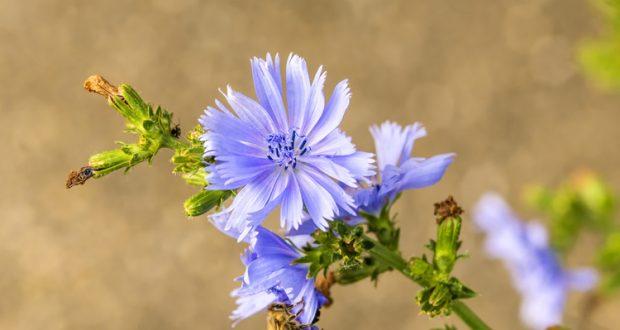
Chicory-based remedies are not recommended for those with allergies to flowering herbs. Infusions should not be consumed by those with varicose veins, as they increase the strain on blood vessels. The plant is a stimulant, so those with severe nervous system disorders should avoid chicory-based remedies.
Ways to use chicory
The soluble powder from the herb is used to flavor desserts and creams, and it's added to dough to enhance the color of baked goods. An infusion is made by placing 15 tablespoons of the crushed herb in a thermos and adding 4 cups of boiling water. Drink it four times a day to treat urinary incontinence, dysbacteriosis, and metabolic disorders. Chicory is mixed with natural coffee and consumed to saturate the body with insulin, macronutrients, and acids, as well as to stock up on vitamins.
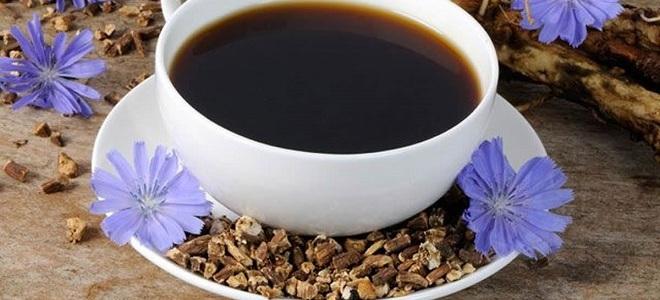
Chicory juice helps combat anemia. The stems and leaves are cut before flowering, washed in boiling water, and minced. After squeezing out the liquid, the juice is simmered for a couple of minutes. Drink a teaspoon of the mixture two or three times a day, but the results won't be noticeable for at least a month.
A decoction that is useful for diabetics is prepared from 2 cups of boiling water and 2 tablespoons of root over low heat for an hour.
To boost energy, drink tea made from instant powder with honey, milk, cream, or cinnamon. For pancreatic problems or high sugar levels, crush stevia and chicory leaves, pour them into a cup of boiling water, and steep for 10 minutes. Add lemon and honey to the infusion. Instant powder is obtained by drying at 150°C. A liquid extract, which has a high concentration of beneficial components, is produced by evaporation at 100°C.

How to brew chicory?
Before cooking, the chopped herb is ground in a coffee grinder. It can be used to make a tonic tea, just like the soluble powder:
- A spoonful of the plant is poured into a glass of cool water.
- Place on low heat.
- Cook for about three minutes.
- The settled liquid is filtered.
- They drink the drink with milk.
A healthy, invigorating tea is made from whole chicory root, which is washed, dried, chopped, roasted, and brewed. Add 1 or 2 tablespoons of the soluble powder to a cup of boiling water.

Chicory in folk medicine
A herbal decoction has long been used to treat colds. The root was dug up, washed thoroughly, and crushed. About 10 grams of this mixture was poured into a glass of water and boiled for 20 minutes. Drink ½ cup three times a day. In alternative medicine, 15 grams of chicory is brewed with the same amount of rose hips and drunk three times a day, 40-50 ml at a time.
During menopause, place a spoonful of chopped root in a saucepan, add a cup of hot water, boil for 10 minutes, and let it simmer for an hour. Take ¼ cup of the remedy for 20 days. For eczema, abscesses, burns, and dermatitis, apply a decoction made from 3 cups of hot water, one spoon of stems and leaves, and 2 roots, chopped very finely. Simmer the mixture for 15 minutes. It is also taken with honey to treat liver ailments.

For tuberculosis, take all parts of chicory along with meadowsweet and motherwort in a 3:1:1 ratio. Add 500 ml of boiling water to 5 tablespoons of each herb and let steep for an hour. Take ½ cup of the mixture, along with a mumiyo tablet.
Contraindications and side effects
Chicory contains a variety of components, and an intolerance to one of them can cause an allergic reaction. Caution should be exercised when drinking tea made from instant powder if you have bronchitis, as it can aggravate coughing. Decoctions and infusions of the herb should not be consumed by people suffering from:
- asthma;
- stomach ulcer;
- gastritis;
- dyskinesia of the gallbladder.
You should stop drinking the herb if you experience dizziness, severe nausea, increased heart rate, or weakness after drinking it. Pregnant and breastfeeding women should avoid excessive consumption of the herb.
Tea from the plant stimulates appetite; if one is prone to obesity, drinking it regularly may lead to significant weight gain.
Related posts:
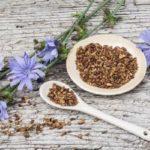 How to properly harvest and dry chicory at home, harvesting rules
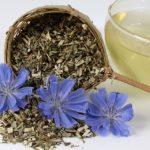 Growing and caring for chicory in the garden, transplanting and propagation
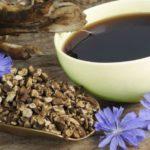 Botanical description of chicory varieties and types, beneficial properties and contraindications
 Making finger-licking good eggplant caviar with peppers and tomatoes
 40 of the best recipes for delicious homemade winter preserves
 21 step-by-step recipes for making zucchini jam for the winter
 26 Best Recipes for Delicious Eggplant for the Winter
 15 Best Redcurrant Jam and Jelly Recipes for the Winter