
- The need for tying up berry crops
- All the pros and cons of using bush supports
- Materials used to secure the bush
- Garden straps
- Clothespins and clips
- Ties
- Design options and methods for fastening currants
- On the trunk
- On a support made of pipes
- On a triangular support
- For a single frame
- Installation of supporting structures and tying to trellises
- A stand for currant bushes made from forks and simple branches
- Rope supports
- We use plastic stands for currants
- How to securely fence currant plantings yourself
- Stele-shaped supports
- Pergolas
- What mistakes do novice gardeners make when tying up currant bushes?
Every gardener should know how to properly tie up currant bushes. This procedure is essential for increasing the bushes' yield and protecting them from pests and diseases. To successfully perform the procedure, it's important to familiarize yourself with all its features.
The need for tying up berry crops
Blackcurrants and other types of currants should be staked 2-3 years after planting, as the branches begin to grow rapidly. The lower shoots touch the ground surface. Due to constant contact with the soil, viral or fungal diseases are possible, negatively affecting yield. To prevent shoots from touching the soil, they are tied to supports.
It's also a good idea to tie up the bush to speed up fruit ripening. The shoots receive more sunlight, accelerating berry formation by 2-3 times. Additionally, tying prevents the bush from growing too wide, preventing branches from breaking in gusts of wind.
Tied currant bushes look more compact and the garden becomes more well-groomed.
All the pros and cons of using bush supports
Gartering currants has a number of advantages and disadvantages, which it is important to be familiar with in advance.
| Pros | Cons |
| Protection from diseases and bugs | Building and installing a support takes time. |
| Access to fruits is simplified | |
| The bushes are protected from the wind | |
| The garden looks well-groomed |
Materials used to secure the bush
To properly tie up currant bushes, you can purchase special fasteners. Clothespins, garden straps, and zip ties are commonly used. These can be purchased at the market or in specialized gardening stores.
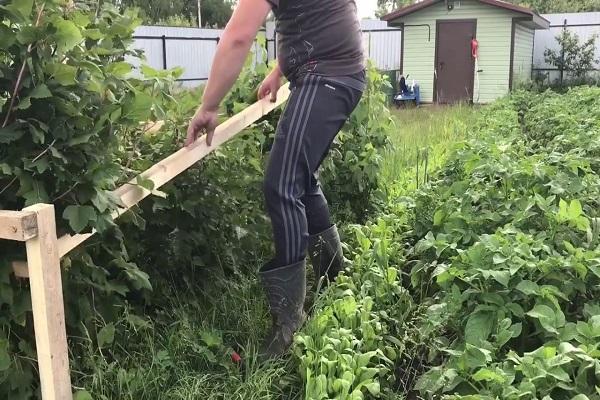
Garden straps
Beginners are advised to tie currant bushes with garden straps. They have fastening elements that allow you to tighten straps of any diameter. They can be used multiple times.
Clothespins and clips
Clips with clothespins can be used repeatedly, for several years in a row. They are attached to thin supports. When pressed, they open and close.

Ties
Tying the bush with rope is usually used when some of the fruit on the upper branches has already ripened and been picked, but the berries on the lower shoots lack warmth and light. This method is also suitable before preparing the plant for winter.
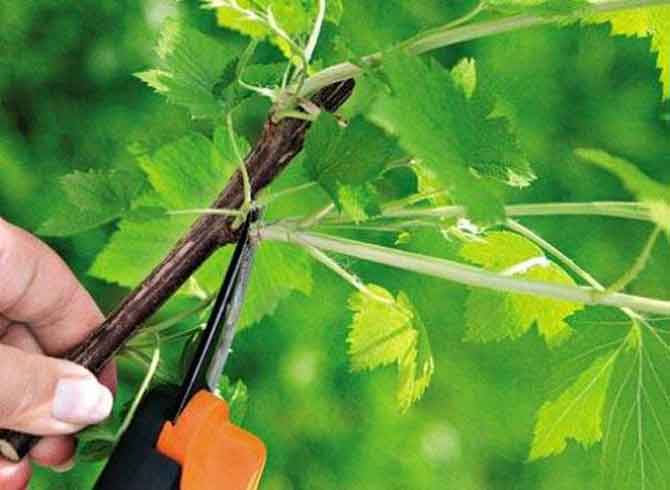
Design options and methods for fastening currants
Below are popular methods for securing currant bushes to supports. If the installation procedure is followed, the shoots will remain attached to the supports for a long time.
On the trunk
To support currant bushes using the standard method, they are secured to a single pole immediately after planting. During the growing season, excess branches growing at the base of the bush are removed. Upper branches should not be disturbed.
On a support made of pipes
Supports can be made from PVC pipes. They should be dug into the ground next to the currant bushes, forming a circle. Then, between each pipe, stretch a rope, spaced 50-60 cm apart, in pairs.
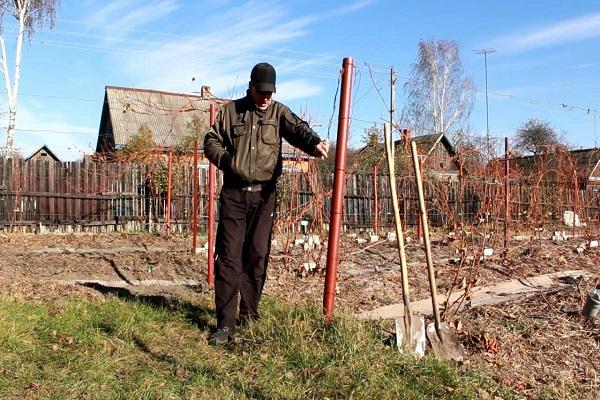
On a triangular support
The triangular support option requires the installation of a frame. It consists of three stakes, arranged to form a triangle.
For a single frame
Sometimes currant bushes are planted individually. In this case, it's best to tie them to a single frame made of stakes. To construct such a structure, four stakes are placed around the bush to form a square. The stakes are connected horizontally with localized boards, to which the lower shoots are attached.
Installation of supporting structures and tying to trellises
Before tying the bushes to the trellis, a special frame is created. Pegs are driven into the ends of each row of fruit, and a strong string is secured between them. The shoots are tied to this string. This method is extremely convenient, as it allows for the addition of a couple of upper branches to which they can be attached if needed.
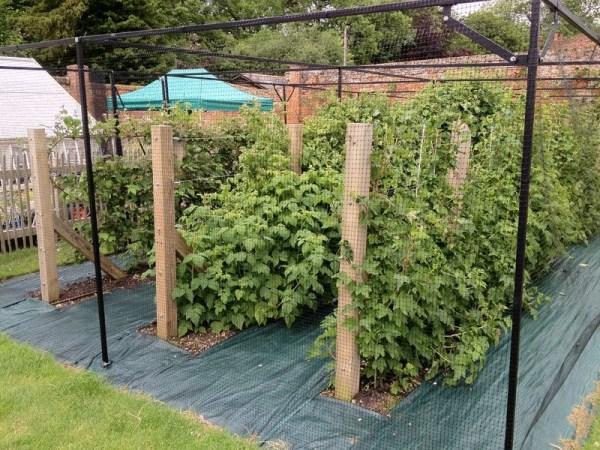
A stand for currant bushes made from forks and simple branches
Take four forked stakes, 70-80 cm long, and drive them around the plant. These can be made from fruit tree branches. Place straight stems on top.
Rope supports
Strapping currant shoots with rope is widely used when the berries on the upper stems are already ripe, while those on the lower stems are still green. The process is performed by tying up branches that have not yet ripened due to insufficient sunlight and pulling them upward. After harvesting, the ties are removed, as this method encourages the bushes to become too dense.
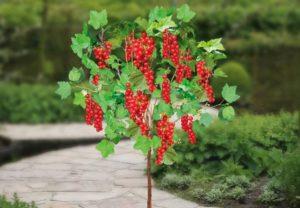
We use plastic stands for currants
Plastic fences are renowned for their affordability and a wide selection depending on the intended use: cascade, currant, rose, peony, and pyramid. They are easy to assemble, disassemble, and reassemble. Plastic stands are attractive, lightweight, quick to assemble, and durable and rigid. The holder is made of plastic pipes and costs between 150 and 300 rubles. When choosing a stand, consider the following product features.
- Bush support shape. The elements holding the upper shoots can be made in the shape of a circle, a semicircle, or a square. The shape can be based on personal preference and the shape of the bush.
- Number of supporting legs. The stand should have 2-4 supporting legs. More legs will make the structure more rigid and durable.
- Disassemblability and one-piece construction. It's often difficult to attach a one-piece stand to a dense bush, so it's best to use collapsible options. For heavy, spreading currant bushes, consider collapsible metal models with four supports.
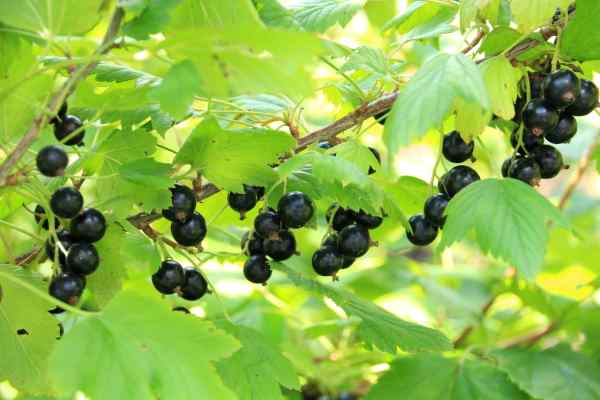 They are suitable for bushes of various sizes and are the most popular method for tying up currant bushes.
How to securely fence currant plantings yourself
Some gardeners make their own supports for tying up currants. A 150-200 cm long pipe with a diameter of 3-4 inches can be used. A former water pipe will also work. Other popular options include hoops made from old bicycle tires, gymnastics hoops, or wire with a diameter of 3-6 mm.
Fencing made from twine, plastic tape, furniture packaging, knitting wire or soft reinforcement is also used.
You can reuse broken solar lanterns. This material allows for the construction of a stable structure, but it is not suitable for heavy loads. Metal-plastic pipes can be cut into three identical pieces, and the remaining material can be cut into two circles.
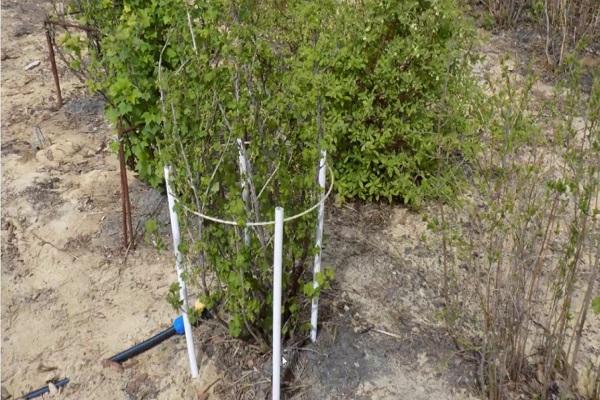
It's best to use green pipes so the structure blends in with the green leaves of the currant bush. They also protect the plant from attacks by animals and rodents.
Some gardeners use wooden supports to support currant bushes. It's recommended to use beams with cross-sections of 1 x 2, 1 x 3, or 2 x 2 cm. These are cut into 4-piece sections, 60-70 cm long. The lower ends should be sharpened.
Four more planks of the same length, each 1 meter long, are cut from these. The pointed posts are placed around the bush, and the planks are screwed to the upper ends. The main structure is placed near the bush, and the central stem is tied to it. Then, a wooden fence of small planks 90-120 cm high is built around the plant.
Take a look Also
It is advisable to cover the installed fence with varnish or paint and treat it with an antiseptic to prevent rotting.
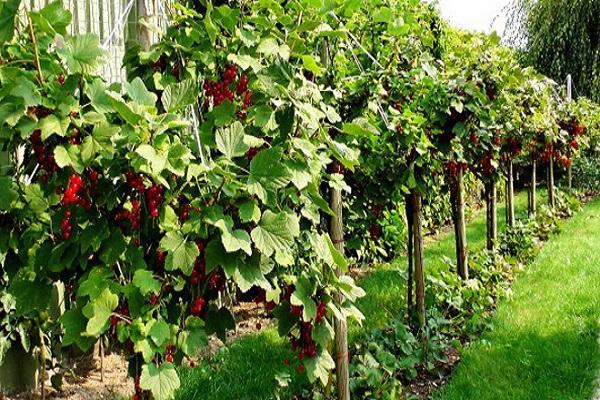
Stele-shaped supports
Steles made of metal rods, wire, or plastic brackets are often used to support currants. A pyramid-shaped support is typically constructed from 6 mm diameter rebar and thick iron wire. If you have the time, you can create a support structure in the shape of a Ferris wheel, a spiral, or a tower.
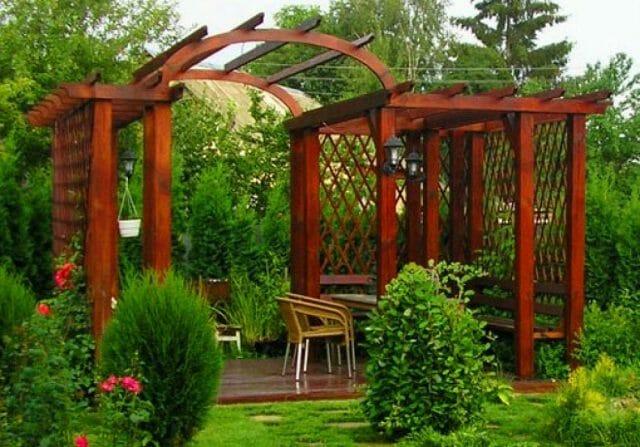
Pergolas
A pergola is an open veranda, either attached to a building or freestanding, with some openings made of fine latticework. Currant shoots serve as a roof. To construct a pergola, a wooden frame is made from sturdy timber, with some walls covered with partitions or screens.
What mistakes do novice gardeners make when tying up currant bushes?
Sometimes inexperienced gardeners make a number of mistakes when tying up currant bushes. These include the following.
- Don't tie the shoots too tightly. When the ties are too tight, the branches can break during strong gusts of wind. Also, if the sap flow in the tissues is disrupted, the plant dries out. It's better to use straps or clips; they leave space between the branches and the support.
- Don't tie up bushes at all. Sometimes gardeners consider tying up currant bushes unnecessary. Such bushes produce less fruit, with all the berries growing at the ends of the shoots because ultraviolet rays and heat don't reach the bushes. They're also more susceptible to disease. Furthermore, they're more difficult to fertilize and weed.
If you ignore the above mistakes, you can lose not only the harvest, but also all your crops.
Related posts:
 20 Best Blackcurrant Winter Preserves Recipes
 Description and rules for growing black currant variety Veloy
 When is the best time to plant currants to get a good harvest?
 The health benefits and contraindications of white currants
 Characteristics and descriptions of the 40 best red currant varieties
 The health benefits and contraindications of black currants
 TOP 10 recipes for red, black, and white currant sauce and ketchup for the winter, and how to store your preparations
 5 easy ways to propagate currants with cuttings in summer