
The Crimean Rose tomato is highly productive, has excellent flavor, and is easy to care for. The key is to grow the seedlings correctly and plant them outdoors at the right time.
The variety of nightshade crops is quite large, so you can choose worthy types of tomatoes from this abundance.
Before growing a particular variety, it's worth familiarizing yourself with its characteristics and the manufacturer's recommendations. The Crimean Rose tomato variety also has specific growing and care requirements.
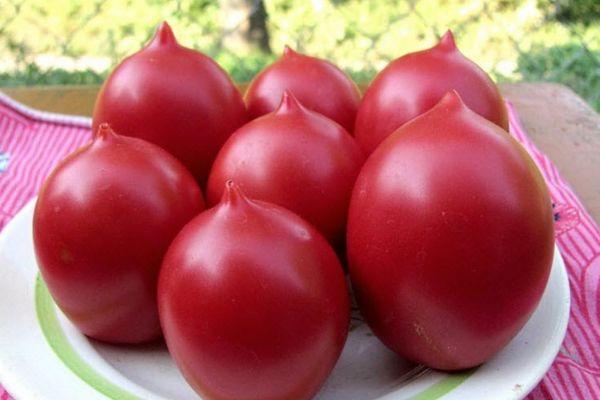
Characteristics of the variety
Tomatoes are grown in open ground, greenhouses, and hotbeds. The plant tolerates drought and minor temperature fluctuations well. This tomato variety is popular in Crimea and is considered one of the best tomatoes for its characteristics.
The Crimean Rose tomato variety is a semi-determinate variety. A mature plant averages 1.2–1.5 m in height. The bush has a strong and extensive root system. The trunk is massive, but still requires additional support. The branches are not spreading. The plant has a compact and neat appearance, and the foliage densely fills the bush.
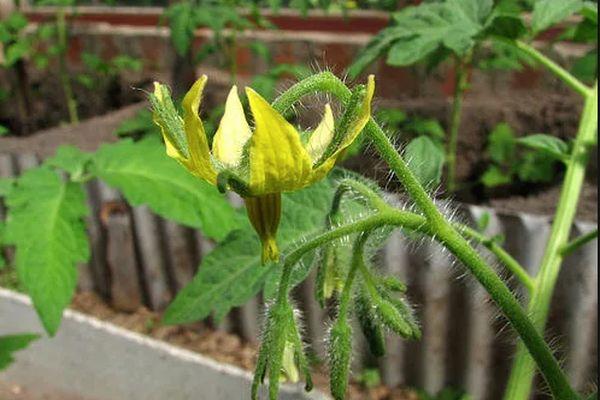
Thanks to the natural protection of the foliage, the fruits are not baked in the sun and ripen gradually. The leaves are typically elongated and deep green. The Crimean Rose tomato has a typical inflorescence. The cluster forms after the 8th or 9th leaf, and subsequent clusters form after 3 or 4 leaves. There are four or more locules per branch.
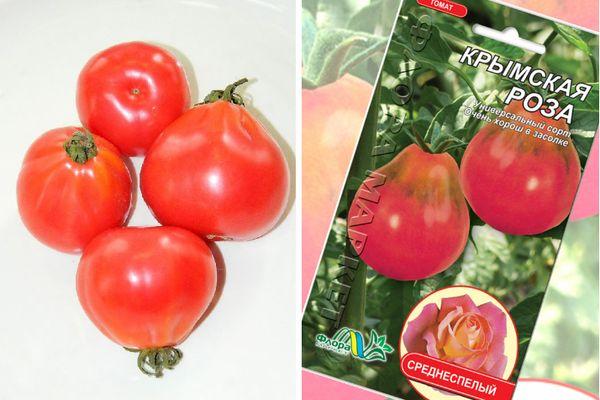
Description of fruits:
- The fruits are pear-shaped, small in size and often uniform.
- One tomato weighs on average about 90-120 g.
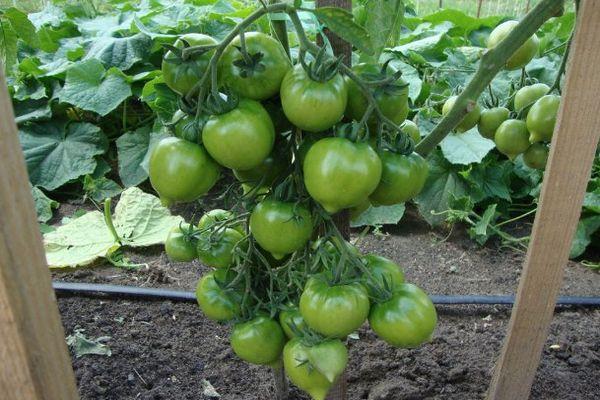
- Young fruits have a green tint with a yellow spot at the stalk.
- When ripe, tomatoes are colored pink and red.
Tomato skin is smooth, shiny, and dense. It protects the fruit from cracking and wilting. The flesh is juicy and aromatic. It has excellent flavor, making it a versatile fruit. Crimean Rose tomatoes are well suited for canning., preparation of pasta, lecho, juice and salads.
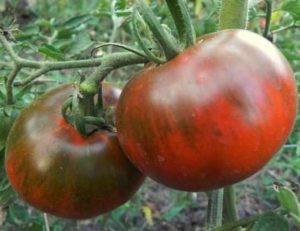
This variety has a high yield. 1 m² yields 6-7 kg. The tomato can be stored for a long time in a cool, dry place. It is suitable for long-distance transportation. Harvesting begins in July and continues through September.
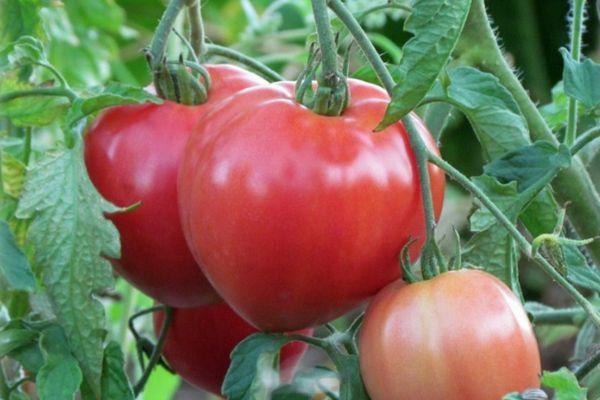
Planting seedlings
Seeds for seedlings should be sown in late February or early March. The plant produces its first fruits within 110–115 days of germination.
Prepare a special shallow container for the planting material. Fill it with nutritious soil. This soil can be purchased at specialty stores, or you can mix one part peat moss with the same amount of soil and coarse river sand.
The soil is moistened and thoroughly loosened. Then, the seeds are planted at a depth of 1.5 cm. Another layer of soil or clean peat is added on top. The planting material is watered through a sieve or sprayer. Avoid using a watering can to avoid washing the seeds out of the soil.
The box is covered with plastic wrap and placed in a warm place. The mini-greenhouse should be opened daily to allow excess moisture to evaporate and the soil to air out. Once the first shoots appear, the container with the plants is moved to a well-lit area. This is most often a windowsill or heated balcony.
Once the sprouts have two leaves, you can transplant them. Gardeners recommend transplanting the plants directly into peat pots, then simply planting them in the ground with the sprouts.
Before planting, seedlings need to be hardened off. To do this, as soon as the frost subsides and the sun begins to warm the soil, take the seedlings outside for 1-2 hours.
Planting in open ground is only possible when nighttime temperatures do not drop below 8-10°C. The soil is first dug and fertilized. Most prefer adding humus and nitrogen. Soil that has previously grown carrots, zucchini, cauliflower, cucumbers, beans, dill, and parsley is considered to have good properties.
The distance between holes should be about 40-45 cm, and between rows 50-55 cm, 3-4 plants are planted per 1 m².
After planting, the holes must be mulched with wood sawdust and watered with warm water.
In the future, the tomato is cared for in the usual manner:
- Regular morning watering with settled water.
- Weeding the beds, loosening the soil.
- Top dressing with mineral fertilizers, most often phosphorus and potassium are used.
The Crimean Rose tomato variety has received positive reviews. It's easy to grow, resistant to many diseases, produces a high yield, and has excellent flavor.
Related posts:
 Top 4 indoor rose varieties, their cultivation and care at home
 Top 12 Floribunda Rose Varieties: Planting and Care in the Open Ground
 Growing Climbing Roses and the Top 10 Varieties, Planting, and Care in the Open Ground
 Description of the Santana rose variety and planting and care instructions for outdoor use
 Description and characteristics of the Gloria Day rose, planting and care instructions
 Top 50 best new rose varieties of 2025 with descriptions and characteristics
 Description and cultivation technology of the Tea Rose tomato, reviews
 Description and characteristics of the Leonardo da Vinci rose, planting and care