
- Characteristics and description of the Black Prince tomato
- Appearance
- The Black Prince's Distinguishing Trait
- Productivity
- Pros and cons of the variety
- Peculiarities of tomato planting
- Planting dates
- Step-by-step process of sowing seedlings
- Rules for caring for seedlings
- Picking
- Transplantation into open ground
- Features of growing in a greenhouse
- Care instructions
- Watering
- Temperature
- Weeding
- Nuances of feeding
- Garter and shaping
- Diseases and pests
- Harvesting and storage
- The best reviews from our readers
Information about the Black Prince tomato can be found in the State Register. The variety was registered in 2000. It can be grown in any region. Its characteristics make it suitable for both amateur gardeners and small farmers. It can be planted in greenhouses and open ground.
Characteristics and description of the Black Prince tomato
This is a hybrid, so you need to purchase seeds. Seeds obtained from the variety's own fruits may not meet the stated characteristics. This variety is mid-season, with the time from germination to harvest of the first fruits taking 110-115 days.
Appearance
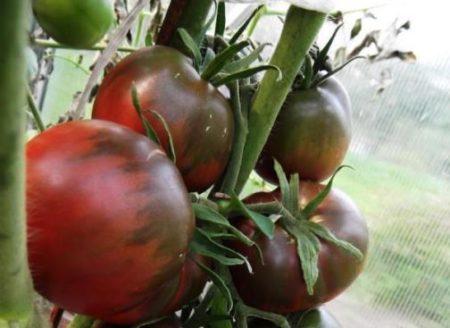
Black Prince bushes are indeterminate. They are vigorous and require pinching to slow growth. In open ground, the central stem grows up to 1.5 m, and in a greenhouse, up to 2 m or more.
The stems are strong, covered with medium-sized leaves. The inflorescences are simple and intermediate in type. They are arranged on the stem as follows:
- first - 7th or 9th sinus;
- each subsequent one - after 3 sheets.
There are 4-7 ovaries formed in one brush.
The Black Prince's Distinguishing Trait
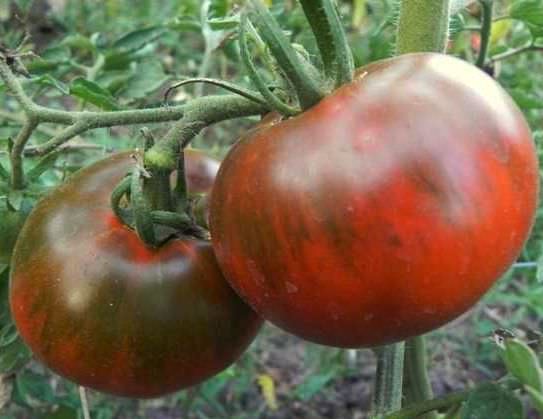
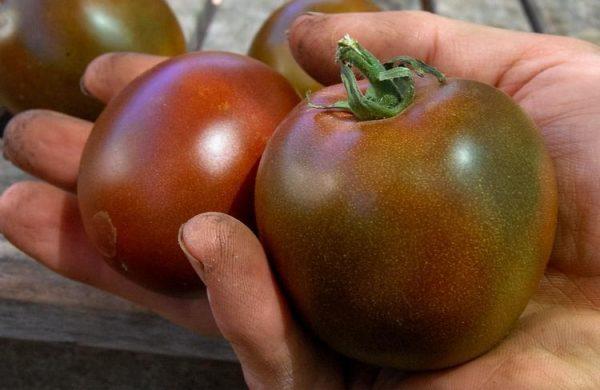
The variety's distinctive feature is its fruit. When ripe, it is reddish-brown with a purple tint. Black Prince is a dark-fruited tomato variety. The fruit is flat-round and medium-ribbed.
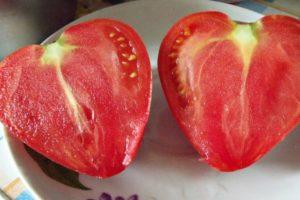
The pulp has a pleasant aroma, is juicy, and has a sweet taste. The tomatoes have thin skin and four chambers. The size of the fruit depends on the number of ovaries. The more ovaries on the bush, the smaller the average size. The variety description states a weight of 110-170 g.
Productivity
This variety is considered productive. A 1 m² bed yields 6.2 to 7 kg of fruit. Fertilizing and bush training influence the yield.
Pros and cons of the variety
Disadvantages of the Black Prince: poor shelf life, loss of marketable appearance during transportation. The advantages are as follows:
- the form quickly adapts to weather conditions;
- high resistance to fungal diseases;
- yield is stable;
- excellent taste.
Peculiarities of tomato planting
The hybrid can be grown in any climate zone of the Russian Federation. Fruit set tall tomato in protected and open groundIn the south, Black Prince is grown without seedlings. The seeds are sown directly into the ground.
Planting dates
To obtain early produce, seedlings are grown. The planting time depends on where the tomatoes will be grown—in a greenhouse or in the open ground. In the former case, seeds are sown earlier—in late February or early March. For open ground, they are sown in late March or early April.
Step-by-step process of sowing seedlings
The seeds are disinfected in a 1% manganese solution and soaked in a growth stimulator overnight. The soil is prepared from several ingredients:
- rotted sawdust (1 part);
- peat (7 parts);
- turf soil (1 part).
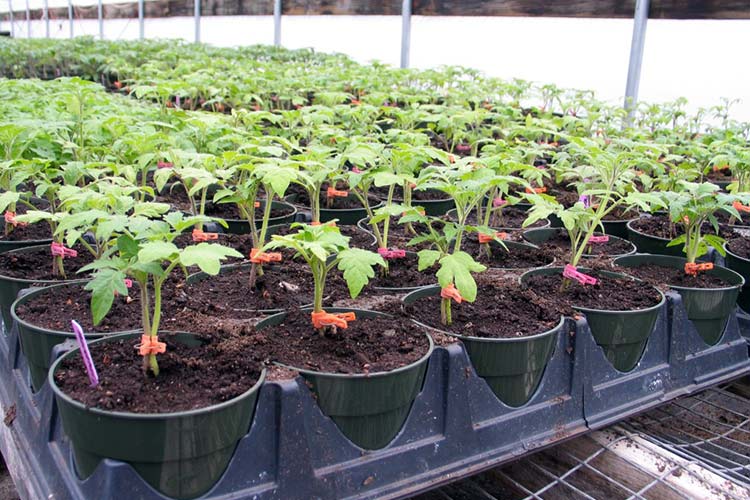
A week before planting, water the soil with a highly concentrated solution of potassium permanganate. Sow the seeds according to the following scheme:
- the soil is generously moistened the day before;
- using a wooden ruler, mark out the rows (5 cm increments);
- spread the seeds (3 cm interval);
- cover with humus (2 cm layer).
Cover the seedling tray with plastic wrap and place it in a warm location. At a temperature of 25-27°C, the seedlings will emerge in 1.5 weeks.
Rules for caring for seedlings
Tomato seedlings grow well at temperatures between 22-25°C. Water them only at the roots in the morning. In cloudy weather, turn on a fluorescent lamp (growth lamp).
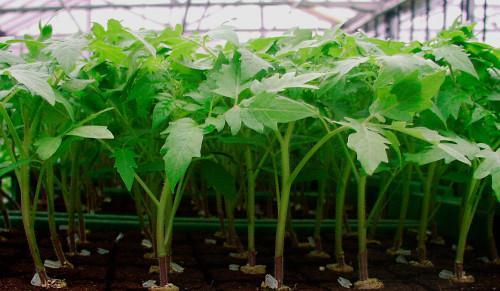
Top dressing is carried out twice:
- the first in the phase of the first 2 leaves;
- the second after the formation of the seventh.
Liquid complex fertilizers for tomatoes are used: "Malyshok", "Multiflor Aqua", "Zdraven".
Picking
Tomatoes tolerate transplanting well. This stimulates root growth. Before planting in their permanent location, seedlings can be transplanted several times, replanting them into larger containers. The first transplant is done after the second true leaf appears.
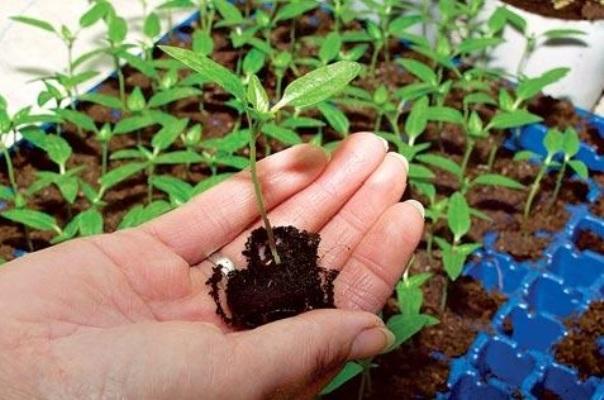
The day before transplanting, water the seedlings thoroughly. They are transplanted into individual containers along with a small lump of soil. They are planted deep down to the cotyledons and watered thoroughly. After a few days of adaptation, the seedlings begin to grow.
Transplantation into open ground
The timing of planting in open ground depends on the weather (May, early June). They are transplanted into greenhouses from mid-April. Before transplanting, harden off the seedlings for at least a week. Reduce nighttime temperatures to 8°C. Seedlings take root faster if planted in cloudy weather. The bushes are tall, so no more than 3-4 plants per square meter are planted.

Features of growing in a greenhouse
Black Prince yields higher in a greenhouse. In greenhouses, seedlings are planted earlier, so the first tomatoes ripen faster. Temperature and humidity must be controlled in the greenhouse.

In greenhouses, the risk of fungal diseases is higher. As a preventative measure, the topsoil is replenished every 2-3 years and disinfected annually. Fungicides are used. Soil fertility is restored annually. Humus, peat, ash, and mineral fertilizers are added.
Care instructions
Care for the Black Prince is the same as for other indeterminate tomatoes.
Watering
In a greenhouse, tomatoes are watered more often than in open ground. On sunny days, the air temperature there rises above the street temperature. Vegetable garden plants are watered once every 5 days, while greenhouse tomatoes are watered once every 3 days. This schedule is for hot weather. As the weather cools, the need for water decreases.

Temperature
In open ground, temperature is not controlled. The greenhouse is ventilated during hot weather. To reduce the temperature, the upper part of the ceiling is whitewashed or a light-colored covering is stretched over the bushes.
Weeding
Weeding and loosening the soil between rows are done the day after watering. To prevent weeds, mulch the spaces between rows with dry grass or black agrospan.
Nuances of feeding
In early summer, tomatoes are fed with a mullein infusion (1:10) with the addition of urea (1 tablespoon per bucket). In July and August, potassium and phosphorus fertilizers are used. Black Prince responds well to root feeding with liquid complex fertilizers:
- "Emerald";
- "Humate";
- "Ideal".

During flowering, the bushes are sprayed with a solution of boric acid and yeast. A barrel of the herbal infusion is placed in the greenhouse. The gas released during fermentation improves fruit set. Flowers and ovaries do not fall off in hot weather.
Garter and shaping
After transplanting into the ground, the seedlings are tied to a support. The bush is trained into a single stem. All side shoots are pinched out. To ensure all the fruits have time to ripen, the tops are pinched out. In a greenhouse, this is done in mid-August; in the open ground, this is done in late or mid-July.
Diseases and pests
In August, bushes may suffer from late blight. To prevent this, treat them with an aqueous solution of copper sulfate:
- water 10 l;
- drug 10 g.
Take a look Also


Other diseases, such as tobacco mosaic and brown spot, cannot be ruled out. To combat these, spray the Black Prince's leaves with a solution of potassium permanganate and dust the soil with wood ash.
Harvesting and storage
Black Prince tomatoes don't keep well. They're best eaten immediately after picking. Ripe tomatoes can be used to make juice, sauces, and ketchup. It's not recommended to over-expose tomatoes on the vine. They quickly lose their marketable appearance and become soft.
The best reviews from our readers
Most tomato lovers who have planted the Black Prince have positive reviews of the hybrid variety. The drawbacks they note are minor.
Elena Ivanovna, 41, Krasnodar Krai: "I grew these in open ground. The bushes are spreading, 1 to 1.3 m tall. Each cluster produced 1-3 fruits. Fruiting peaked in mid-August. The first tomatoes weighed 150-250 g, while the last ones were noticeably smaller. The flesh is medium-firm and has a harmonious flavor. I'd give the fruits a solid 4. The shape is beautiful, rounded and flattened, and the color is burgundy-brown. The only drawback is the green spots near the stem."
Maria Andreyevna, 61, Volgograd Oblast: "I've been growing this variety for three years. I train them as single stems and regularly remove side shoots. The first fruits are large, reaching up to 300 g, while the rest are smaller. They're not very sweet. But that's just my taste. My husband likes the tomatoes. He likes them with salt."
Galina Fedorovna, 38, Syzran: "I grow Black Prince tomatoes in a greenhouse from my own seeds. For the first three years, the variety delighted me with its flavor and yield. This year, it was disappointing. I trained the bushes into single stems. I only got eight tomatoes from each, weighing 200-250 grams."
Related posts:
 Description of the Black Prince strawberry variety, planting and care technology
 Description of the best varieties of black tomatoes for open ground and greenhouses
 Description and characteristics of the Black Prince apricot variety, planting and care
 TOP 40 New Year's 2020 Meat Recipes Using Pork, Beef, Chicken, and Lamb
 TOP 40 Hot Dish Recipes for New Year 2020: What to Cook
 Description of black potatoes, their beneficial properties, varieties, planting and care features
 Planting and caring for apricots in the middle zone, description of the best varieties
 Characteristics and description of the Black Beauty eggplant variety, planting and care