
Japanese breeders have created another high-quality nightshade hybrid—the Indio F1 tomato. This variety is distinguished by its tolerance to weather fluctuations and high resistance to various types of fungi and pests.
The Indio variety is intended for outdoor cultivation. Greenhouses are also suitable for harvesting, but experienced growers report that the fruits are larger, brighter, and have a significantly better flavor when grown outdoors. Indio tomatoes have many advantages. They are early ripening, easy on soil and care, and always produce a bountiful harvest.
To grow this tomato in your own garden, you need to purchase strong, healthy seedlings or grow them yourself. The process can be simple and enjoyable if you follow the basic rules. But first, it's worth studying the description of the Indio variety and its characteristics.
Features of the variety
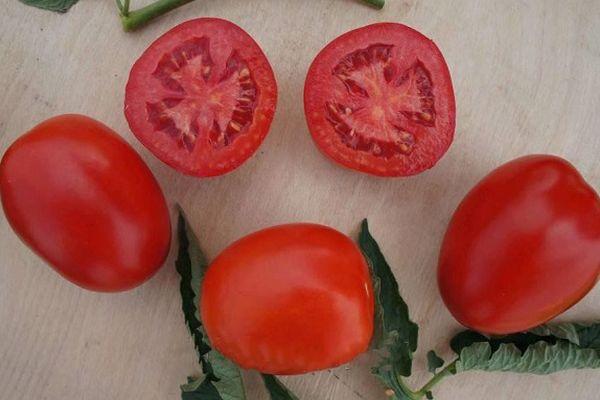
The plant is determinate. Its height rarely exceeds 80-95 cm. The bush is compact in structure and has a strong trunk. During ripening, it requires additional support and staking, as the tomatoes are quite heavy.
The tomato's foliage is large and densely arranged, dark green with a distinct corrugated pattern. This variety has an intermediate inflorescence. The first cluster forms above the 5th or 6th leaf.
Each cluster can produce 4-5 fruits. The growing season for this plant is 105-115 days from the moment the first shoot emerges.
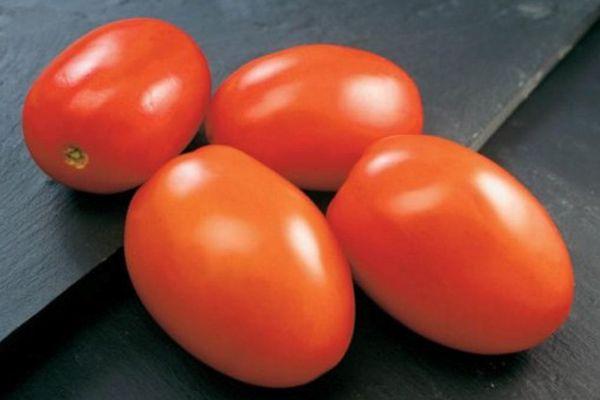
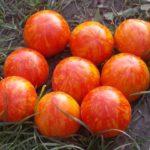
The fruits of the Indio variety can be described as follows:
- The tomatoes are quite large. Each fruit weighs between 150-200 g and reaches up to 8 cm in length.
- The Indio tomato is plum-shaped. All fruits are the same size and shape. They ripen on a single cluster at the same time.
- The fruit skin is dense and smooth. The tomato has slight ribbing.
- The tomatoes are a rich red color. There are no spots around the stem.
- Each tomato contains three seed chambers. The seeds are small and sparse.
- The fruits are not prone to cracking.
- The tomato tolerates long-distance transportation well and does not lose its marketable appearance.
- In a cool, dry place, tomatoes can be stored for up to 3-4 weeks.
- The fruits can be picked at the ripening stage. They ripen perfectly in a cool room or refrigerator.
- Tomatoes have excellent flavor. The fruits are juicy and aromatic, with a sweet, yet slightly acidic flesh. They are suitable for processing into ketchup, paste, juice, lecho, and for canning whole or in slices. They add a unique flavor to fresh salads.
The Indio variety has a high yield, which is what makes it stand out among other varieties among gardeners. Up to 12 kg of tomatoes can be harvested per square meter per season.
Growing seedlings
The Indio variety is grown using seedlings. The seed packet contains characteristics and a description of the variety. The manufacturer provides recommendations regarding sowing times and planting seedlings outdoors.
First, prepare a special shallow container or cups for the seedlings. Fill the container halfway with a soil mixture consisting of peat, sand, and soil. Moisten the soil and allow it to settle.
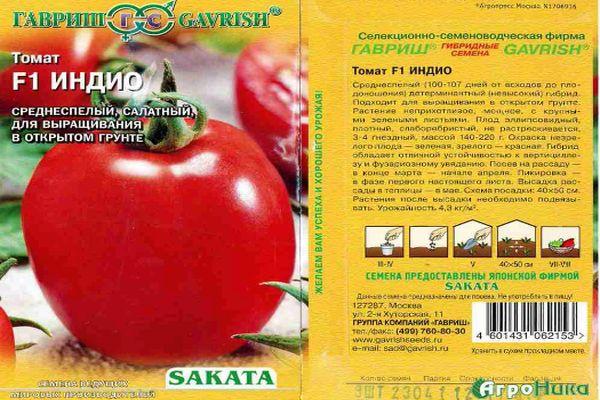
Sowing occurs in the second half of March or early April. Tomato seeds are planted 1.5-2 cm deep in the soil. They are then covered with soil, but not compacted.
The seedlings should be watered immediately with warm water. Watering should be done through a sieve. This will prevent the seeds from being washed out of the soil. Cover the seedling tray with thick plastic wrap and place it in a warm room. The air temperature should not drop below 20°C.
As soon as two strong leaves appear on the sprouts, the seedlings are pricked out. After transplanting, the plants are moved to a brighter location. The temperature should be maintained between 16 and 17°C. Tomato seedlings are kept in this mode for about a week.
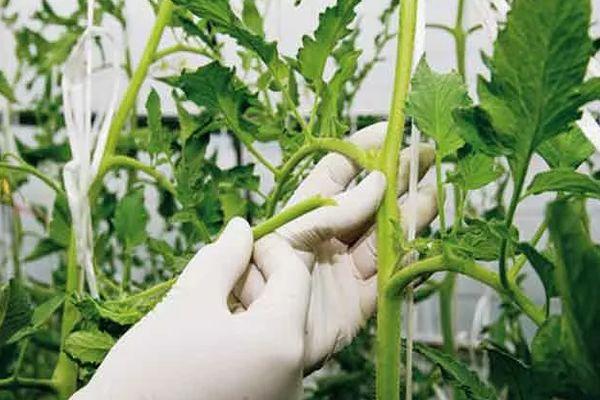
Next, the temperature is raised to 20–22°C or higher. Young seedlings are planted outdoors as soon as the first inflorescences and 6–7 leaves appear. Many gardeners recommend hardening off the seedlings beforehand. To do this, take the seedlings outside for a couple of hours. This can be done early in the morning or, conversely, in the evening.
The soil in the beds should be fertilized beforehand. Superphosphate, nitrogen, and potassium are best for nightshade crops.
Plants are spaced sparsely in the bed. 3-5 bushes are planted per square meter. The holes must be mulched with sawdust and watered with settled water. Experienced vegetable growers recommend watering Indio tomato seedlings with warm water during the first week, preferably in the morning.

Further care of the plant consists of watering, loosening the soil, fertilizing and weeding the beds.
Related posts:
 Description of the best tomato varieties for pickling and canning
 The best grape varieties for growing in the Urals, planting and care rules in summer
 80 Best Eggplant Varieties for Different Regions with Descriptions and Characteristics
 Description and characteristics of the best indeterminate tomato varieties for greenhouses
 Description of the best varieties of black tomatoes for open ground and greenhouses
 What varieties of tomatoes are best to plant in a polycarbonate greenhouse?
 Descriptions of the 20 best cherry varieties for the Moscow region, their planting and care
 Description of the best tomato varieties for open ground and greenhouses in the Krasnodar region