
The exotic Banana Legs tomato was created by American breeders in 1988. Since then, it has become widespread in Russia. Despite its foreign origins, gardeners in Siberia and the Urals successfully grow these tomatoes. In cold northern regions, Banana Legs can be grown in greenhouses.
General characteristics of the plant
The Banana Legs tomato variety is a determinate variety. Despite limited stem growth, the bushes are quite tall, reaching 1-1.2 meters. Gardeners note that a good harvest can be achieved with plenty of space around the plant. When planting in beds or a greenhouse, keep in mind that a dense planting pattern is not recommended for this variety. The distance between adjacent plants should be at least 50 cm.
The bushes tend to branch excessively, and some experienced gardeners claim that pinching out side shoots is not necessary when caring for these plants. However, others recommend shaping the bushes into 3-4 trunks and removing suckers. Only personal experience can help you determine which method is most suitable for you.
The Banana Legs tomato variety's characteristics and description in the catalog describe its high yield. Each bush can yield up to 5-6 kg of produce. This early-ripening variety allows ripe fruits to be harvested as early as 60-70 days after sowing when grown in a greenhouse. Due to its early ripening time, some vegetable growers prefer to grow Banana Legs without seedlings, sowing seeds directly into the garden beds.
Stems and leaves Banana tomatoes The legs are distinguished by their slenderness and elegance. Nevertheless, the tomato plant's trunk bears 4-6 clusters of complex, branched shapes, each producing up to 13 equally sized, calibrated tomatoes. The berries ripen very uniformly, so the bushes' fruiting period is short.

Banana Legs Tomato Fruits
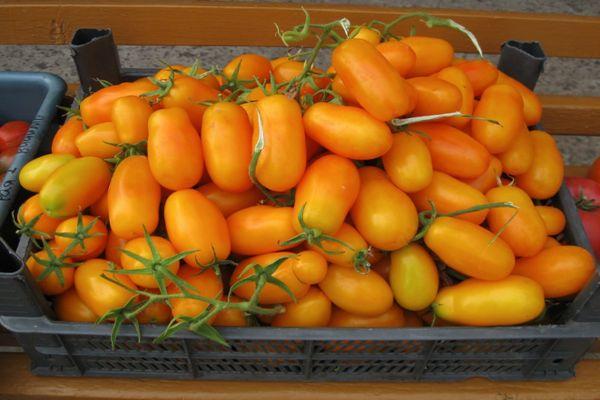
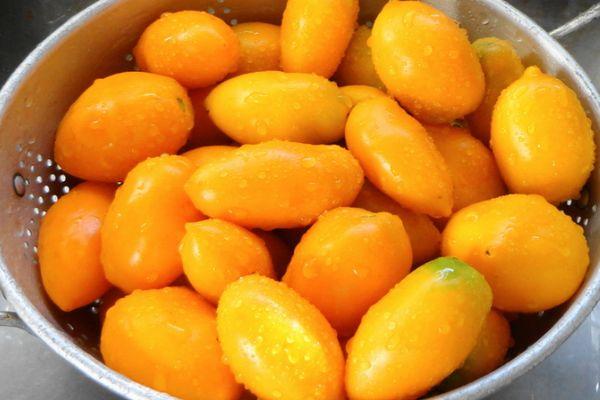
The Banana Legs tomato variety resembles a small banana with a pointed tip. The tomatoes are small: the average length is 10-12 cm, and the elongated berry diameter is approximately 3 cm. The fruit weighs between 70-80 g. Larger tomatoes, weighing around 100 g, can be grown in greenhouse conditions.
The fruit's skin is dense, very strong, and resistant to cracking. It doesn't burst when filled into jars during canning, and the harvest is not damaged by cracking caused by excess moisture. Tomatoes store well and are transported over long distances without losing their appearance or marketability.
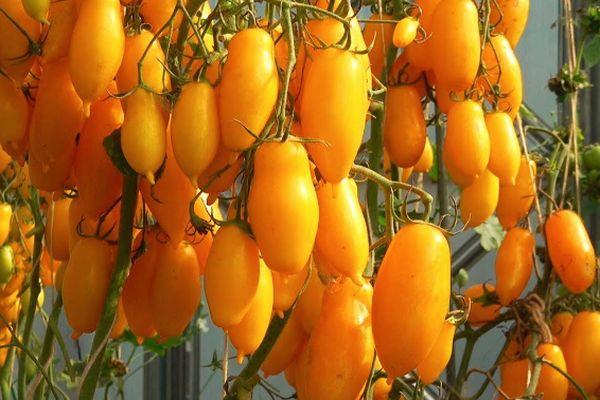
The skin contains two shades of yellow. It's difficult to classify it as a classic bicolor, as the light spots and stripes are only slightly distinct from the background. In addition to the attractive golden speckled coloring, the tomatoes have a pearlescent sheen, making Banana Legs absolutely irresistible to any lover of exotic tomatoes.
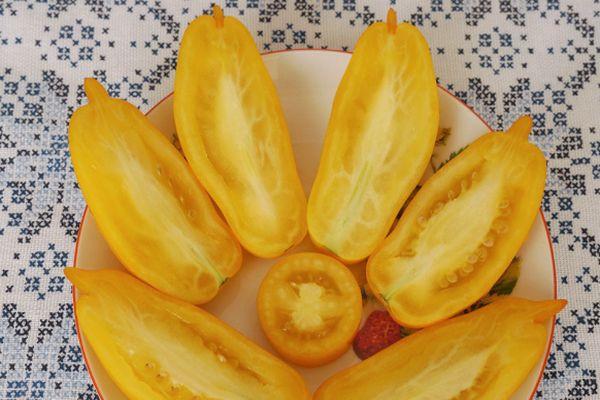
The flesh is dense and light yellow. The fruit contains 2-3 large seed chambers. The walls are thick, up to 0.5 cm, juicy and firm. The taste is rated at 5 out of 5.
The pulp's richness in dry matter and sugars makes tomatoes unusually tasty: they have a slight sourness and a distinct lemon flavor, complemented by the characteristic citrus aroma.
Delicious and beautiful, Banana Leg tomatoes are versatile. Early tomatoes are best eaten fresh, sliced, and used in salads. They make a great addition to sandwiches and are perfect for a sophisticated appetizer with a unique flavor.
Whole-fruit canning is the best way to preserve banana legs for the winter. The tomatoes retain their firm texture and look stunning in vegetable platters. Fragrant and sweet, they taste great dried, drizzled in olive oil. Small tomatoes are easy to freeze.

How to grow Banana Legs?
The Banana Legs tomato variety is not a first-generation hybrid, and its seeds can be saved for sowing the following season. To obtain high-quality seeds, leave 1-2 tomatoes on the lower trusses to fully ripen on the vine. Wash the seeds to remove any mucus, dry them, and store until spring.
Seedlings are grown just one month before planting; they are not pricked out, but transplanted directly into the ground. For southern regions or greenhouses, a direct seedling method is suitable, where seeds are sown in furrows directly in the beds, and when they reach the stage of 2-3 true leaves, excess plants are removed or transplanted to other areas.
As the bushes grow, they are pinched and fed with a complex fertilizer containing nitrogen, potassium, and phosphorus (such as Nitrophoska, Agricola Vegeta, and others). Fertilizing is applied when the plant produces one flower cluster. The mixture is dissolved in irrigation water and the tomatoes are irrigated with the nutrient solution at a rate of 0.5-0.7 liters per bush.
A characteristic of the Banana Legs variety is its sensitivity to calcium deficiency in the soil. To avoid losing a large portion of the harvest to blossom-end rot, it's best to add chalk or dolomite flour to the soil during fall or spring tillage. Spread 1-1.5 kg of fertilizer per square meter, then thoroughly mix the soil with a pitchfork or shovel.
If lime wasn't added during tilling and the first signs of disease appear on the tomatoes, there's a simpler way to help them. Add ground chalk or gypsum to the irrigation water (1 cup per 10 liters), mix, and then pour the mixture onto the soil under the bushes (0.5 liters each time). This may be enough to save the remaining tomatoes.
When the fruits begin to ripen, it's important not to overwater, otherwise the tomatoes will taste weak and watery. In hot weather, watering Banana Legs once every 5-7 days is sufficient, at a rate of about 10 liters per plant. If there's regular and heavy rainfall, the plantation may not require irrigation. The best indicator of the need for watering is when the soil dries out to a depth of 2-3 cm.
Related posts:
 When to harvest leeks from the garden for storage, ripening times
 The best eggplant varieties for growing in a polycarbonate greenhouse: planting and care
 Description of rare collectible tomato varieties from Valentina Redko, new for 2025
 The benefits and harms of lemon for the human body, the best recipes
 Top 40 DIY New Year's Baking Recipes for 2020
 The best grape varieties for growing in the Urals, planting and care rules in summer
 The health benefits and contraindications of black currants
 Methods for planting and propagating cherries at home
