
All gardeners who have grown the Canned Pear tomato provide detailed descriptions of the variety and recommend it. These tomatoes are grown equally successfully in open beds in warm climates and in greenhouses in temperate and northern regions—in other words, in virtually all climate zones. The unique shape of the ripe fruit inspires some gardeners to plant them in greenhouses, balconies, and loggias.
Main characteristics of tomato
This variety is classified as early, determinate, with fruit ripening in 92-98 days. Bush growth ceases after the buds open.
The characteristics and description of the variety are as follows:
- Plants reach a height of 75-80 cm. The trunk is straight and thick, with a compact root system. Every gardener who has planted Canning Pear recommends staking it, even when growing it in a greenhouse. Large, dark green leaves provide excellent protection for the ripening fruit from direct sunlight and precipitation such as small and medium hail.
- Growing fruits are light green. Ripe tomatoes take on a pear shape and a uniform scarlet color. The average weight of a single berry is 60 g. They form clusters of up to 10 on a branch. A single bush can bear up to 5 clusters of beautiful fruits.
- The tomatoes have a pleasant, not tart flavor. The flesh is firm and doesn't run when cut. The skin is firm and glossy, protecting the fruit well from external influences. Tomatoes can be stored for a long time under proper conditions.
- The variety's yield is average—8-12 kg per square meter. This yield depends on climate, weather, and growing conditions. Farmers report that greenhouses always produce higher yields. However, in southern regions, several hundred kilograms of delicious tomatoes can be grown outdoors.
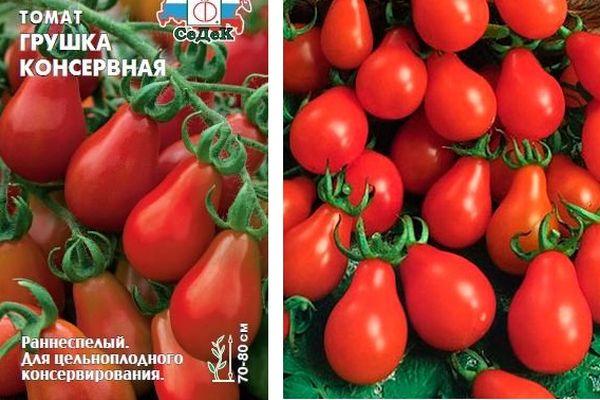
In most cases, ripe, green tomatoes are used for canning. They look great in transparent jars, even decorating shelves. Fresh tomatoes are served whole and added to salads. Tomatoes are rarely used to make juices, ketchups, and lecho. This only happens when there is a bountiful harvest and there is no way to sell the surplus.

Advantages of the variety
Grushka tomatoes are famous not only in Russia, but also far beyond its borders.
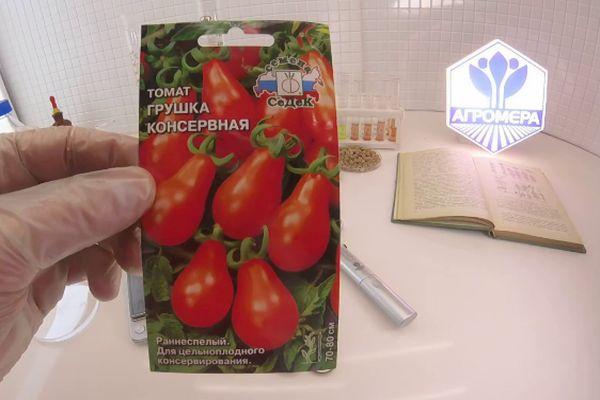
The advantages of this variety of tomatoes are as follows:
- original shape of fruits;
- tomatoes are strong and elastic, they tolerate transportation and long-term storage well;
- resistance to fungal and infectious diseases that affect nightshade crops;
- ease of cultivation, maintenance and care;
- good tolerance to fluctuations in humidity, temperature and sudden cold snaps.
Gardeners have not noted any significant drawbacks to the Pear variety. Its weak root system is strengthened with supports and ties.
How to grow tomatoes?
Tomatoes are early-ripening and can be sown as early as early spring. In warmer southern climates, this can be done as early as late February.
The seeds should be treated with an antiseptic or irradiated with an ultraviolet lamp. Afterwards, they should be placed on a cloth soaked in a nutrient solution. Once the seeds have sprouted, they are placed in seedling containers: long containers, peat tablets, and cups. The soil should be fertile, consisting of drainage, peat moss, fertilizer, and soil taken from the garden bed. The containers should be kept in a warm, dark place for a week.

Once the seedlings with leaves emerge, they need at least 16 hours of light per day to prevent them from overgrowing. It is recommended to maintain a temperature of 20 to 22°C. Water the seedlings with warm water and apply fertilizer weekly. Before moving the seedlings to the garden, they are hardened off. The containers are taken outside first during the day and then in the evening.
The seedlings are planted in the ground at a rate of 3-4 per 1 m². This is done in late April or early May. Planting holes are prepared in advance by adding sand, peat, charcoal, ash, and fertilizer. During the first week, the seedlings are watered generously with warm water.
Plant care includes:
- timely removal of weeds;
- collection of insects from the crown and fruits;
- loosening and mulching the soil;
- regular watering of bushes;
- removal of extra stepsons;
- monthly application of mineral, organic and combined fertilizers;
- Ventilating the greenhouse during hot weather to prevent high humidity.

The first fruits are expected to appear at the end of May in the south, and in the northern and middle latitudes – in mid-June.
Related posts:
 80 Best Eggplant Varieties for Different Regions with Descriptions and Characteristics
 The best grape varieties for growing in the Urals, planting and care rules in summer
 Descriptions of the 20 best cherry varieties for the Moscow region, their planting and care
 The best eggplant varieties for growing in a polycarbonate greenhouse: planting and care
 What varieties of tomatoes are best to plant in a polycarbonate greenhouse?
 Description of the 30 best plum varieties for the Moscow region, planting and care
 Description of the 23 best pear varieties for the middle zone, planting and care rules
 Description of the best varieties of black tomatoes for open ground and greenhouses