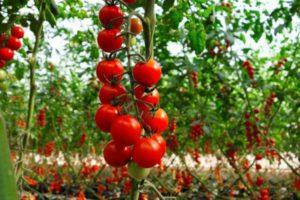
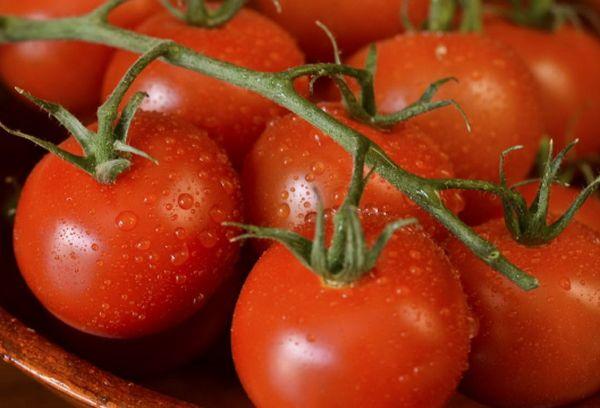
The Kistevoy Udar tomato is a first-generation hybrid of the brush type, cultivated by Russian breeders. These tomatoes are distinguished by their flavor, uniform ripening, and versatility in cooking.
Advantages of the variety
The Kistevoy Udar F1 tomato is recommended for growing in open ground and all types of greenhouses; the hybrid is ideal for industrial-scale cultivation.
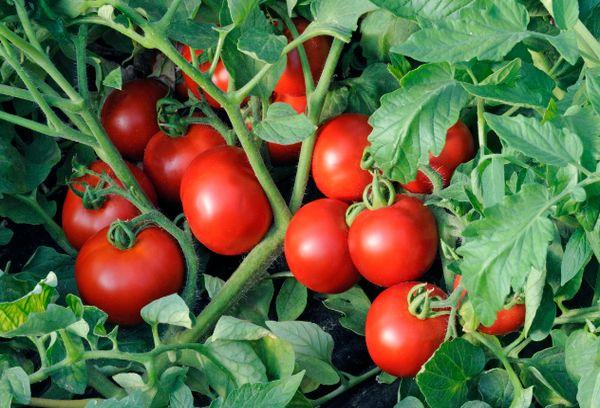
This early-ripening variety yields fruit 95-105 days after sprouting. During the growing season, it forms a compact bush with a medium number of leaves.
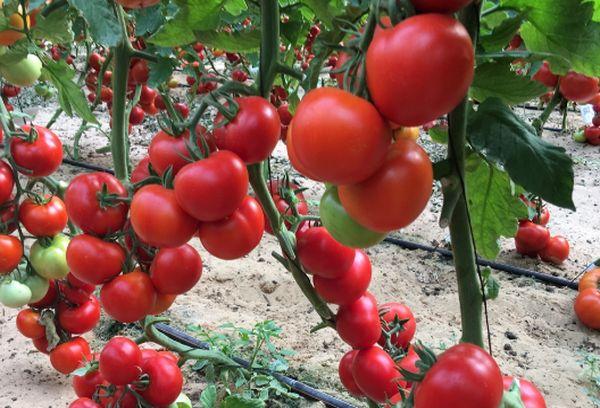
A simple inflorescence produces 6-7 fruits. The first flower stalk appears at the level of the 9th-11th leaf, and subsequent flower clusters appear after 3 leaves.
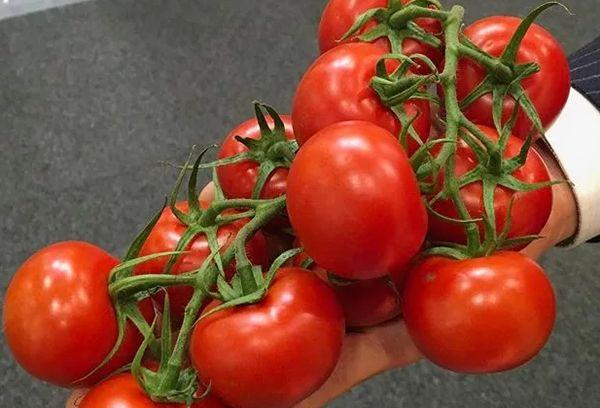
The tomatoes are round, intensely red, and glossy. They have firm skin and no green spots near the stem. Fruit weight reaches 130–150 g. The yield is 27 kg per square meter.
Tomatoes ripen in clusters, so the harvest can be picked from the bush as a whole branch or as individual fruits. After harvesting, the fruits retain their flavor and marketability for 20-30 days.
Tomatoes have excellent flavor and are easy to transport over long distances. In cooking, the fruits are used fresh and for stuffing. They are suitable for drying and retain their shape when canned.
Reviews from vegetable growers indicate the hybrid's excellent taste, high vitamin content, and resistance to viral and fungal diseases of nightshade crops.
Cultivation techniques
The best yield is achieved using the seedling cultivation method. To develop strong tomato seedlings, simple agricultural practices are required.

Seeds for seedlings are planted 55-65 days before the expected planting date. The seeds are placed 1 cm deep in containers with prepared soil.
After watering with warm water, cover the container with plastic wrap. To ensure uniform germination, maintain the air temperature at 21°C. When the seeds have developed two true leaves, transplant them into individual containers.

The development of healthy seedlings depends on the lighting conditions. Fluorescent lamps are used to extend daylight hours. Before planting in the ground, seedlings are hardened off for 7-10 days.
The recommended planting density is 2-3 plants per 1 m². In their permanent location, plants are spaced 40 cm apart, with 70 cm between rows.
Caring for the plants follows standard guidelines for tall tomatoes. Fresh tomato plants should be planted in the ground to preserve the first flower stalks. It is recommended to apply nitrogen fertilizer in the form of an aqueous solution to the soil at the roots.
To promote fruit formation, the bushes are treated with boric acid. To accelerate flowering, the plant is fed with iodine. To do this, prepare an aqueous solution of 30 drops of iodine per 10 liters of water and apply it to the plants once a week.
Vegetable growers recommend transplanting tomatoes in the afternoon if the weather is hot. On a cloudy day, planting can be done at any time. It is better to apply fertilizer closer to the evening to protect the bushes from burns.
Throughout this period, closely monitor the development of the tomatoes. If the plants appear frail, they require additional organic fertilizer. If they are growing rapidly, reduce the amount of nitrogen. Yellow foliage indicates excess phosphorus.
A potassium deficiency can cause leaves to dry out. Ripe tomatoes should be picked with the stems attached to speed up the ripening of other fruits.
An indeterminate bush requires tying to a support, timely watering, and loosening the soil to create a moisture balance and air access to the root system.
Related posts:
 Description of the best varieties of black tomatoes for open ground and greenhouses
 The best eggplant varieties for growing in a polycarbonate greenhouse: planting and care
 What varieties of tomatoes are best to plant in a polycarbonate greenhouse?
 80 Best Eggplant Varieties for Different Regions with Descriptions and Characteristics
 How to propagate and grow peas, cultivation technology, and care in open ground
 How to properly plant peas in a greenhouse and open ground
 Description of the best tomato varieties for open ground in the central zone
 Description and characteristics of the sweetest tomato varieties for greenhouses and open ground