
The Siberian Surprise tomato belongs to the group of early- to mid-season ripening plants. This variety can be grown in cold climates. It is listed in the Russian State Register of Vegetables and is recommended for cultivation in open fields and plastic greenhouses. It is eaten fresh or as an additive to various dishes. Housewives preserve Siberian Surprise for the winter, as the berries do not crack during processing, maintaining their attractive appearance.
Technical data of the crop
The characteristics and description of the Siberian Surprise variety are as follows:
- ripe fruits of this plant can be obtained 105-110 days after sowing the seedlings;
- the height of the tomato bush of the described type reaches 1.1-1.2 m;
- the plant has a fairly strong stem, covered with large leaves, colored in dark shades of green;
- tomato has simple inflorescences, the first of which is formed above the 10th leaf, and the rest appear after 1-2 leaves;
- the berries grow in clusters, with 9-10 tomatoes developing in each cluster;
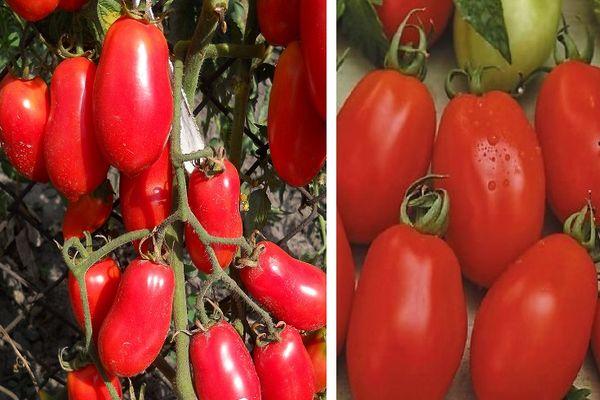
- the fruits have an elongated cylindrical shape;
- berries can set even when climate conditions worsen;
- unripe berries are colored in light shades of green, and a dark spot is visible on the tomato stalk; ripe ones are colored red;
- 1 tomato weighs 75-150 g; the skin is quite dense.
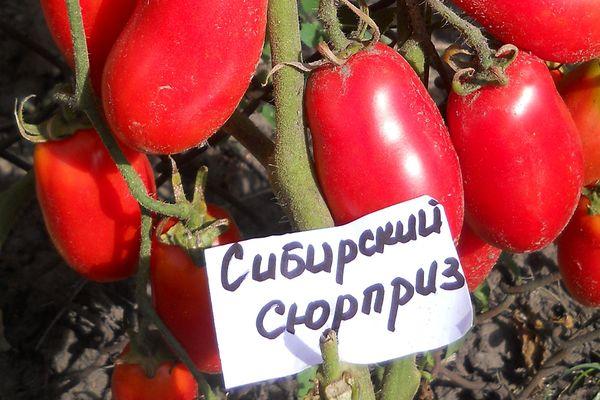
Gardener reviews indicate that the Siberian Surprise yields 9-10 kg of berries per square meter of garden bed. Farmers note the plant's low maintenance and its ability to withstand any weather conditions.
Thanks to the strong skin, which protects the fruit from mechanical impacts, the berries can be stored for about a month and transported over any distance.
Gardeners consider the need to constantly remove lateral shoots and tie the stems to strong supports or trellises to be a disadvantage of this variety.

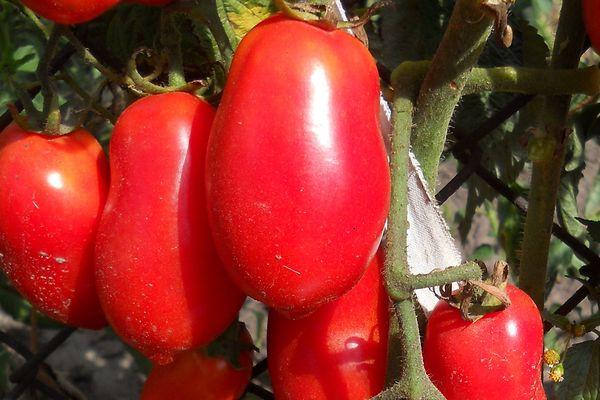
Siberian Surprise is recommended for growing outdoors in southern Russia. In the central regions, the tomato is grown in unheated greenhouses. In northern regions, the plant is grown in heated hotbeds and greenhouse blocks.
Obtaining tomato seedlings
Seeds are purchased from reputable producers or specialty stores. Before planting, the seeds are disinfected in a potassium permanganate solution. Afterwards, the seeds are soaked in a stimulator.
It is recommended to bake the soil where the seeds will be planted in an oven. This will destroy all microorganisms and fungi. Afterwards, treat the resulting soil with a potassium permanganate solution. When sowing, plant the seeds 10 mm deep. The seed sowing format is 30 x 15 mm.
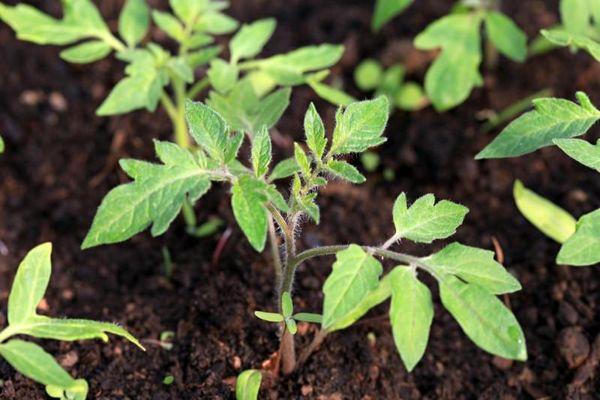
The first sprouts will appear in 7-10 days. During their growth period, before transplanting to their permanent location, it is recommended to feed the seedlings with complex fertilizer 2-3 times. Water the seedlings with warm water once every 5 days.
The seedling boxes should be placed under fluorescent lamps. The distance between the plant and the lamp should not exceed 10-12 cm. Seedlings should receive 14-16 hours of daylight.
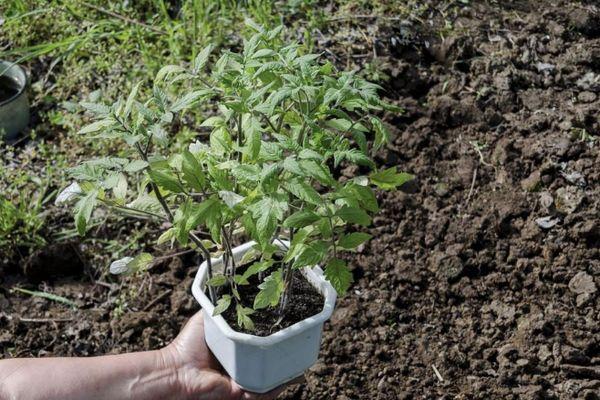
The seedlings are transferred to permanent soil only when they are 60-70 days old. Before this, it is recommended to harden the seedlings for a week. The beds are fertilized with wood ash, the soil is treated with potassium permanganate, and watered with warm water. Stake holders are placed next to each bush for tying. Three to five bushes are planted per 1 m² of bed.

Caring for plants before fruiting
The first feeding is done 15 days after transplanting the seedlings. Organic fertilizers or complex mixtures can be used for this. The second feeding is done 25-30 days later. Use only complex mineral fertilizers.
Plants require regular, moderate watering. Avoid getting the leaves wet, as this will burn them. Water with warm water early in the morning or in the evening after sunset.

The beds are loosened twice a week, as Siberian Surprise prefers loose, moist soil. Loosening the soil helps aerate the tomato's root system, which improves plant growth. Weeding is done once every two weeks. The operation helps prevent the development of certain fungal diseases. When weeding, garden pests that live on weeds also die.
The bushes are trained into 2-3 stems. This procedure ensures a stable and higher yield. Gardeners should remove side shoots weekly. If the farmer notices symptoms of any diseases affecting the plants, it is recommended to immediately destroy the affected bushes to prevent the infection from spreading to all the tomato plants. Garden pests (Colorado potato beetles, aphids, etc.) are controlled with special products or folk remedies, such as copper sulfate.
Related posts:
 Description of 36 of the best sweet and large varieties of gooseberries
 Beginner's Guide to Growing Grapes in Open Ground in Central Russia
 When and how to properly pick gooseberries with your own hands to avoid getting pricked
 Descriptions of the 20 best cherry varieties for the Moscow region, their planting and care
 What varieties of tomatoes are best to plant in a polycarbonate greenhouse?
 Which tomato varieties are best for open ground?
 The best grape varieties for growing in the Urals, planting and care rules in summer
 Simple step-by-step recipes for making lingonberry jam for the winter