
The early-ripening Mahitos F1 tomato, a description of which is essential for those choosing this variety for planting for the first time, is a Dutch-bred hybrid. These tomatoes are bred for vegetable production and offer several advantages over traditionally grown varieties. The plants are undemanding, but they do require care: this determines how many fruits a grower will harvest when planting Dutch tomatoes.
Main characteristics of the plant
Even rows of fruit-laden bushes always attract attention in photographs taken in commercial tomato fields. By choosing Dutch hybrids, you can recreate this look in your own garden. The striking appearance of greenhouse trellises is due to the ability of modern hybrids to produce evenly spaced ovaries on each fruit cluster, all with uniform ripening times.

The Mahitos F1 (Mojito) tomato bush is an indeterminate variety. These plants can reach a height of over 2 meters. Like any tall tomato, they require staking and training. In Russian conditions, tomatoes are best grown in a greenhouse, as they lose flavor in the open ground and ripen much later than the variety's characteristics and descriptions indicate.
Mahitos tomatoes are a heat-loving crop that tolerates high greenhouse temperatures well. Fruit buds and ovaries do not fall off even with slight overheating or drying out, but these factors must be monitored to ensure a good harvest. The first harvest is expected 100-105 days after germination.
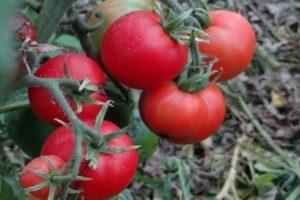
Fruit develops throughout the season. The Mahitos tomato clusters are single; each cluster produces 5-7 uniformly sized, evenly-sized tomatoes. Each tomato averages 200-210 g. Each cluster ripens completely, so the harvest is often done with the stem, allowing for longer shelf life.
This variety produces a high yield. A single bush can yield 8-10 kg of marketable produce per season. If cultivation and care practices are not followed, yields will drop slightly, but at home, this has virtually no impact on the supply of fresh vegetables.
Mahitos tomatoes are resistant to nematodes and various fungal infections that affect tomatoes in the humid microclimate of greenhouses (Alternaria, Downy mildew, and others). The crop is almost immune to late blight, but to prevent it, it is recommended to remove some leaves and avoid watering the above-ground parts of the plant when watering.

Consumer properties of fruits
The tomatoes are almost spherical in shape, without ribbing. At technical maturity, the tomatoes are a uniform, light green color. When ripe, they turn bright red. A bush covered with these berries looks unusual and decorative.
The fruit's tough skin reliably prevents cracking during ripening and retains the pulp's moisture well. Ripe tomatoes can be stored for about two weeks without signs of wilting or spoilage, maintaining an excellent marketable appearance. They are suitable for long-distance transport. Unripe tomatoes can be stored in the pantry and gradually ripen, providing growers with fresh produce until mid-winter.
The flesh is dense and juicy. When slightly unripe, the fruit walls remain firm, but become softer as they ripen. The center of the berry contains 4-6 chambers containing seeds. The fruit walls are thick. The flesh is uniformly colored, without a white core.
The taste is excellent. The tomato has a sweet and sour flavor with a characteristic tomato note in the aroma. Fruits of the Mahitos variety ripened on the vine are sweeter than those ripened in a crate.

The variety is intended for salad use. These tomatoes were bred as an early variety for fresh consumption. However, gardeners note that Mahitos fruits are also well-suited for winter preservation.
Early summer vegetables are most often eaten in salads and sliced, but neat little tomatoes can be used as a base for delicacies, stuffed and baked, or used as sandwich slices. Brightly colored tomatoes can be included in hot dishes (borscht, sauces, and others) and cold dishes like gazpacho.
Small tomatoes can be used for whole-fruit canning and vegetable platters. Red tomatoes make delicious juice and a base for sauces and ketchups. Tomatoes can be included in any appetizers and winter salads that call for these ingredients.
How to grow an early harvest?
Seeds for seedlings are sown 60-70 days before planting in the greenhouse. In central Russia, this can be done in the second half of March. The seedlings are grown in a substrate consisting of equal parts sand, humus, and fertile soil from the garden. Commercial soil or peat tablets can also be used if desired.

The first thing to do is disinfect the soil. Even store-bought soil mixes can contain pathogens that cause blackleg and other diseases dangerous to young plants. Disinfect the soil by saturating it with a hot solution of potassium permanganate.
The seeds should be spread over the surface of moist soil and covered with a 0.5 cm layer of dry sand. After this, cover the boxes with plastic wrap to retain moisture and place the seeds in a warm place (25°C) to germinate. Poke 2-3 small holes in the plastic wrap to allow air circulation. Seedlings will appear in 4-5 days.
In the 2-3 leaf phase, seedlings are pricked out, observing the following rules:
- Pinch the root by 1/3.
- Place the bush into the hole up to the cotyledons.
- Press the soil down at the roots.
After transplanting, tomatoes need to be watered with warm water.
The greenhouse bed should be fertilized with humus and mineral fertilizers containing potassium and phosphorus. If this isn't done immediately, additional fertilizing will be necessary throughout the season. Well-prepared soil frees the gardener from some of the work throughout the season.
 Tomatoes should be planted according to a 40x70 cm pattern.
For tall tomatoes, bush training is essential. This is done as soon as the bushes begin to form side shoots. All side shoots on the plant are removed, shaping the bush into a trunk. After the first flower cluster forms, one shoot is left to form into two trunks. For a bush with three shoots, one additional shoot should be left, preferably just above the second flower cluster. The remaining shoots are removed throughout the summer.

As the flower clusters open, remove some of the leaves, but only those below the next flower cluster. Only the lower leaves, those that reach one-third of the bush's height, should be removed.
Related posts:
 What varieties of tomatoes are best to plant in a polycarbonate greenhouse?
 Description of the best varieties of black tomatoes for open ground and greenhouses
 The best tomato varieties for growing in the Leningrad region for greenhouses and open ground
 The best and most productive tomato varieties for greenhouse cultivation in the Urals, with descriptions
 Description of the best tomato varieties for open ground in the central zone
 Description of the best tomato varieties for open ground and greenhouses in the Krasnodar region
 Description of the best tomato varieties and ratings for greenhouses in 2025
 The best grape varieties for growing in the Urals, planting and care rules in summer