
The Black Heart Breda tomato stands out for its exceptional aroma and flavor, large fruit size, and beautiful, unusual color. The characteristics and description of this variety help you decide whether to try growing this wonder in your garden.
Characteristics of the variety
Tall, indeterminate: growth continues even after a flower cluster appears at the top of the central shoot. Mid-season, tomatoes ripen 90-130 days after seed germination. Resistant to temperature fluctuations and moderately undemanding. Ovaries form and develop throughout the growing season.
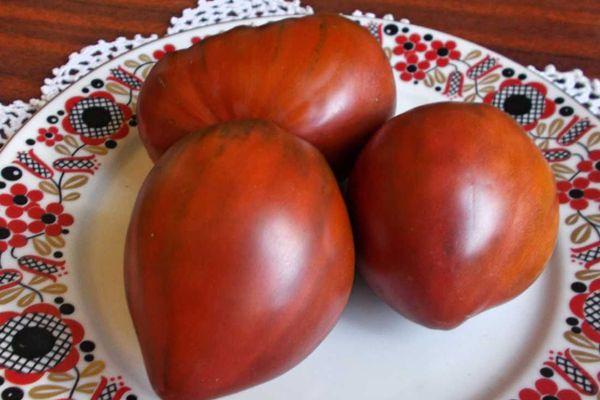
The fruits ripen well when picked from the bush, retaining their flavor. Under favorable conditions, the bush grows up to 180 cm, with ovaries forming at each internode. The foliage is drooping. Black tomato fruits can be left to produce their own seeds, as this is a non-hybrid variety.
Description of fruits
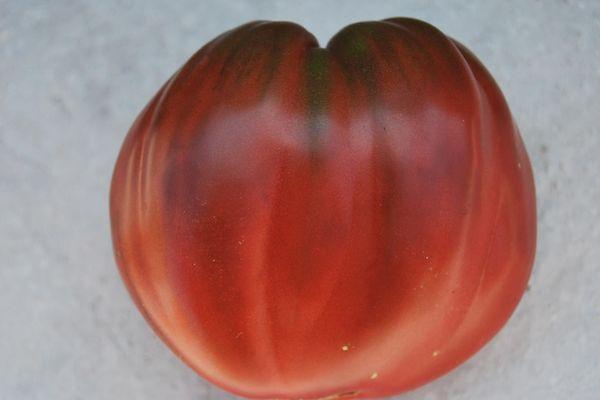
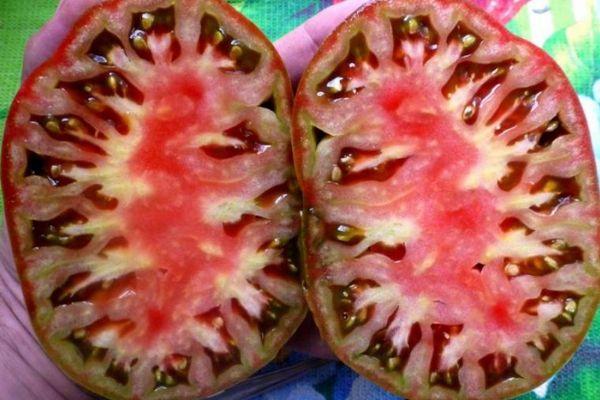
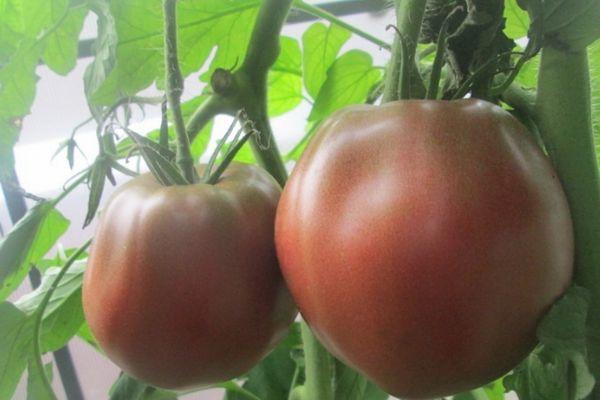
The basic shape is a regular heart, but can also be elongated or rounded. The tomatoes are black-burgundy with a purple tint. They can weigh up to a kilogram or more. The flesh is dense and meaty. The flavor of Black Heart Breda tomatoes is distinctive: aromatic, sweet, and subtle, with a hint of tropical fruit.
Tomatoes are suitable for fresh consumption, preparation of salads, juices, and sauces. Black tomatoes They are considered aphrodisiacs, and in ancient times they were even called love apples.
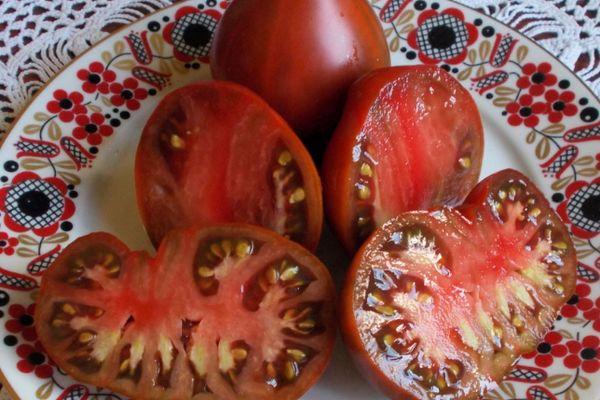
Growing recommendations
This variety is suitable for greenhouse cultivation. In areas recommended for zoning, tomatoes are grown outdoors. These include the Russian south and central regions. These tomatoes have also proven successful in the Urals and Siberian Federal District. The yield is above average. In open ground conditions, one plant produces 5-7 kg of fruit; this figure can be higher when grown in greenhouses. The variety exhibits resistance to many nightshade diseases, especially late blight.
Soil requirements are standard for all tomatoes: it should be loose, light, and nutritious. Regular watering with warm water in small amounts or drip irrigation at the roots is recommended. Seeds for seedlings are sown from mid- to late February and in early March. Before planting, they are disinfected by soaking them in a solution of potassium permanganate, then rinsed with clean water.
The seedlings are pricked out when two true leaves appear. They are regularly fertilized with complex fertilizers. Before planting in their permanent location, the seedlings must be hardened off.
Plants are planted in heated greenhouses starting in early April, and in unheated greenhouses no earlier than early to mid-May. Plants are planted in open ground once the threat of frost has passed.
Depending on weather conditions, this period begins in mid-May and ends in the first ten days of June. The planting density is 2-3 plants per square meter. This density can be increased if you plan to grow the plant as a single stem.
The variety responds well to organic fertilizers. After planting, it is recommended to water the seedlings with diluted slurry. If there are few sunny days, feed the plants with ash. To maximize the yield, it is recommended to prepare the soil in the fall by adding organic matter. The bush can withstand the weight of the fruit, but it is advisable to tie it up for safety.
To ensure adequate light for proper plant development and good ventilation to prevent fungal diseases, excess leaves are removed. According to gardener reviews, opinions on how to shape the Black Heart Breda tomato bush are divided.
Here are some of the methods of pinching out stepsons, each of which has a right to exist:
- All side shoots between the nodes are removed, except for the top. This method forms the bush into a single stem, allowing for denser planting.
- One side shoot that forms under the first inflorescence is left. As soon as a pair of flower clusters appears on it, the top is pinched off and the stem is tied up. The advantage of this method is that it forms a shorter plant, with fruit developing on the lower tiers.
- The bush is formed into several stems. The side shoots are left under the first, second, and third inflorescences. The remaining shoots are removed when they reach 5-7 cm, leaving a stump. This way, the quantity and quality of the fruit can be controlled, preventing the harvest from becoming small. To obtain large fruits, no more than 5-7 inflorescences should be left on the stem.
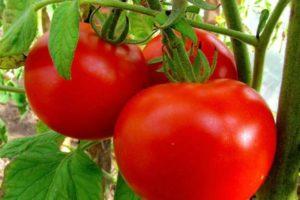
The top of the central stem is pinched after 5-7 flower clusters appear, and the second stem is pinched after the first cluster has formed.
Related posts:
 80 Best Eggplant Varieties for Different Regions with Descriptions and Characteristics
 The best eggplant varieties for growing in a polycarbonate greenhouse: planting and care
 The best grape varieties for growing in the Urals, planting and care rules in summer
 Description of the best varieties of black tomatoes for open ground and greenhouses
 Description and characteristics of the 60 best sea buckthorn varieties, how to choose depending on the region
 Beginner's Guide to Growing Grapes in Open Ground in Central Russia
 Descriptions of the 20 best cherry varieties for the Moscow region, their planting and care
 Description of the 90 best varieties of beans for open ground with names
Everyone in our family simply adores this variety of tomato, and I try to grow it every year. By the way, I use a bioactivator BioGrow to help yourself. Tomatoes are very tasty and have a slightly unusual flavor!