
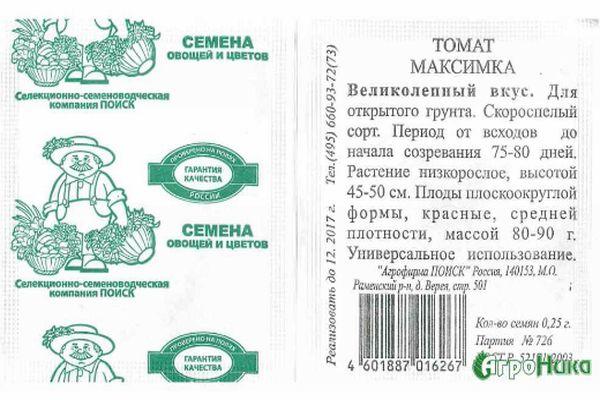
The Maximka tomato was developed by Russian breeders for open-field cultivation. This hybrid is registered in the State Register of Russia. This type of tomato is recommended for farmers and gardeners living in the Central and Central Black Earth regions of the country. However, if all agricultural practices are followed, Maximka tomatoes can be grown in plastic greenhouses in other parts of the Russian Federation, although the yield will be 30% lower than in these regions. Consumers note the excellent taste of this variety's berries.
Some information about the plant and its fruits
The characteristics and description of the Maximka variety are as follows:
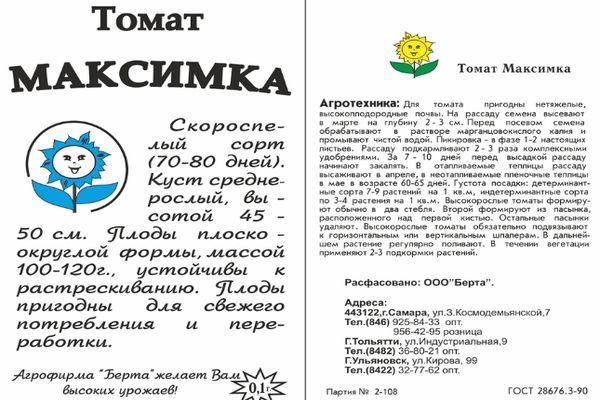
- Tomatoes ripen fairly early. From planting to harvest, it takes 75-80 days.
- The plant bushes have a medium number of leaves and branches. This variety is a determinate, semi-spreading tomato.
- The height of the plant does not exceed 55-60 cm.
- The leaves on the bushes are green and medium in size.
- The Maximka tomato produces inflorescences of an intermediate type. The first inflorescence appears at the level of the seventh leaf.
- This variety differs from others by the absence of joints near the stalk.
- Tomatoes of this variety weigh about 0.1 kg.
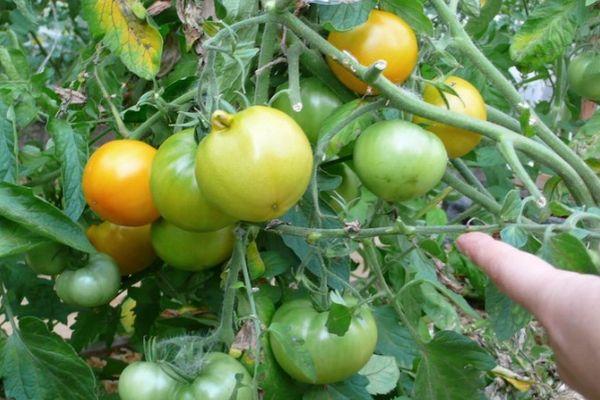
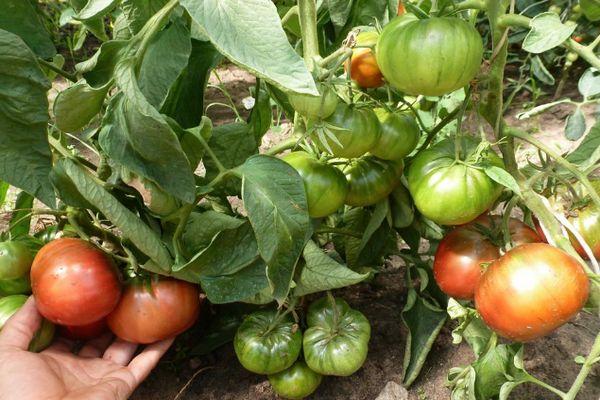
- The fruits are spherical, slightly flattened at the top and bottom. They are green before ripening, and turn orange-red when ripe. The berries contain four seed chambers. The skin is smooth and thin. The fruits have a sweet taste. The juice contains up to 7.8% dry matter.
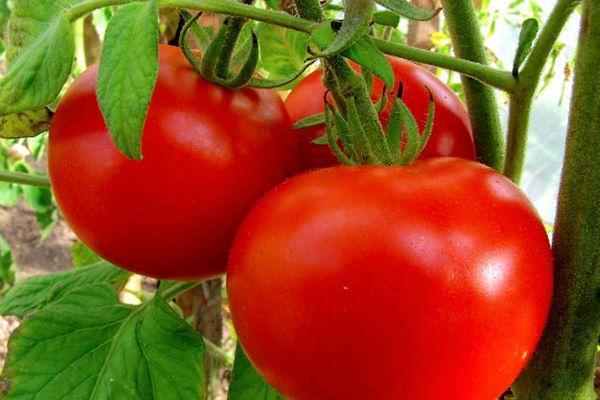
Feedback from farmers who have planted this variety indicates that the Maximka variety can yield up to 450 centners per hectare. Nearly 90-92% of the fruit are of good marketable quality.
Those farmers who planted this tomato in the southern or northern parts of Russia claim that the plant is highly resistant to many diseases common to tomatoes.
Growing this variety has proven profitable for farmers, as the fruits are medium-dense and do not crack during long-distance transportation. This has increased the interest of retailers in purchasing this type of tomato.
The fruits can be eaten fresh, added to salads, and other dishes. For the winter, it's recommended to pickle or preserve whole Maximka tomatoes.
Recommendations for growing the described tomato
It is recommended to grow Maximka tomatoes using seedlings. Purchased seeds should be planted in the second ten days of April. To grow seedlings, seeds should be planted in containers (boxes or pots) 3-4 cm apart. All seeds should be pre-treated with potassium permanganate.
Breeders recommend using universal tomato soil as a soil substitute. It can be purchased at specialty stores.
After sprouting (in 10-12 days), wait until 1-2 leaves appear and then transplant. It is recommended to water the plants with warm water. The seedlings should be moved to a well-lit area, along with the container, or a special lamp should be installed over them.
The temperature in the room with seedlings should be maintained at +20…+22 °C, and the duration of daylight hours should be regulated within 16–18 hours. After the seedlings reach a height of 8-10 cm, they need to be hardened off using the generally accepted method.
The seedlings are then transplanted to their permanent soil, fertilized with nitrogen and organic fertilizers. Since the Maximka variety's bushes are short, they don't require staking. It's recommended to plant no more than 4-5 bushes per square meter of garden bed.
After this, you need to water the plants regularly, loosen the soil under the stems, and remove various weeds. It is recommended to fertilize tomatoes with complex mineral fertilizers, such as superphosphate and potassium nitrate. Chemical pesticides can be used to control garden pests.
Related posts:
 The best grape varieties for growing in the Urals, planting and care rules in summer
 Descriptions of the 20 best cherry varieties for the Moscow region, their planting and care
 Methods for planting and propagating cherries at home
 Description and characteristics of the best seeds of pea varieties and types
 80 Best Eggplant Varieties for Different Regions with Descriptions and Characteristics
 Description of the 90 best varieties of beans for open ground with names
 What varieties of tomatoes are best to plant in a polycarbonate greenhouse?
 The best methods for growing grapes from seeds at home