
Growing the Sugar Giant tomato doesn't require much effort. This modern variety is easy to care for and resistant to environmental factors. The variety's characteristics sometimes puzzle vegetable growers, but reviews from those who have grown it agree on its merits.
General characteristics of the variety
The bush type is indeterminate, with an unrestricted main stem. The plant is standard, reaching a height of up to 1.8 m. In terms of ripening time, Sugar Giant is considered a mid-early variety; the first ripe tomatoes appear 110-120 days after sowing, but this time may be delayed when grown outdoors during cool summers.

The Sugar Giant tomato, described in the State Register catalog in 1999, has already been praised by many gardeners as a high-yielding and delicious variety. These tomatoes are suitable for both open-field and greenhouse cultivation.
Those who have been planting Sugar Giant for several years note that the tomato's flavor becomes more watery when grown in unfavorable seasons, but the yield of the bushes is practically not affected.
Sugar Giant tomatoes have genetic immunity to the tobacco mosaic virus and some fungal diseases (olive spot, Altenaria leaf spot, etc.). Like all late-ripening varieties, they are often attacked by late blight. They have moderate resistance to the fungus, but in cold and damp weather, growers may lose some of their harvest if they don't treat their plants with fungicides promptly. If the soil lacks calcium, they are prone to blossom-end rot.
The plants tolerate slightly dry soil and don't require regular watering. For normal growth, watering once every 5-7 days is sufficient, but generously (at least 10 liters per tomato plant). Other essential care methods include pinching out side shoots and tying tall plants to a support structure.
Take a look Also

The yield per bush is approximately 6 kg. With proper plant training (2-3 stems) and timely fertilizing, you can produce large, tasty tomatoes right up until the first frost.
Fruit characteristics
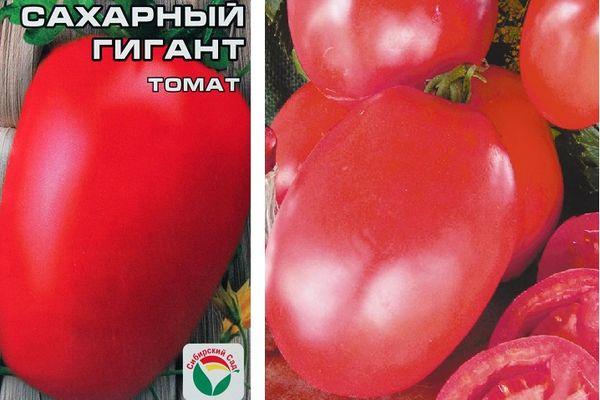
Each season, the bush produces 5-6 clusters, each bearing 3-5 large, attractive berries. The average fruit weight is 400-450 g, but record-breaking tomatoes on the lower clusters can reach 650-700 g. The fruit is cuboid, with a wide base and slightly elongated.
The tomato skin is quite thin but strong. Cracks can occur when ripening outdoors if there is heavy rainfall. This usually doesn't happen in greenhouses. Tomatoes store well when ripe and respond well to artificial ripening if picked green. Sugar Giant tomatoes easily withstand long-distance transportation without losing their appearance. The skin is bright red, with no green areas. When ripe, the berries are pale green, with a spot near the stem.
The flesh is meaty and beefsteak-like. The seed chambers are numerous but small, often seedless. The flesh breaks grainily, and the consistency is tender and juicy.
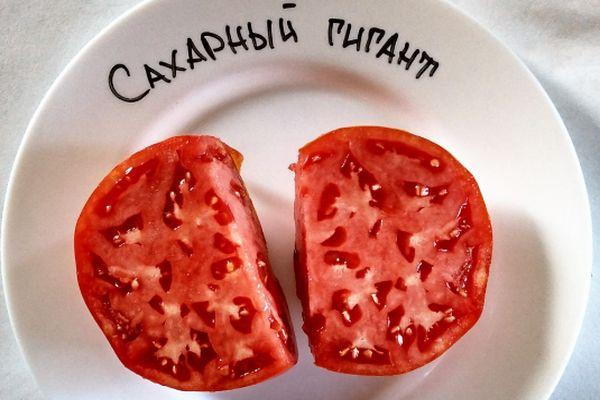
Vegetable growers' descriptions and characteristics of the variety also include opinions on the tomato's flavor. Most gardeners who have grown the Sugar Giant rate it as very good. The high sugar concentration in the pulp gives the berries a sweet taste. When grown in unfavorable conditions, the tomatoes develop a sour taste, and the sweetness becomes barely noticeable.
The Sugar Giant tomato variety is best eaten fresh. These sweet tomatoes are great in vegetable salads and can be used to enhance festive platters and gourmet appetizers. Slices and quarters are used for sandwiches and hamburgers, as well as baked vegetables. The tender flesh makes excellent hot and cold soups, gazpacho, and sauces.

This large-fruited tomato variety is ideal for making canned juices and sauces. The thick pulp doesn't require long simmering, and products made from it retain a large amount of vitamins. The bright juice is perfect for both direct consumption and as a topping for tomato preserves.
How to grow a good harvest?
Sow the seeds for seedlings so that they are 70-90 days old by the time they are planted in the garden. Then, you can expect the first harvest in about 1.5 months. Before sowing, prepare the soil: pour store-bought soil or a homemade potting mix into containers and soak them in a hot, dark pink solution of potassium permanganate. While the soil is cooling, prepare the seeds.

The Sugar Giant variety is not a hybrid, so you can harvest seeds for plant propagation yourself. This seed requires pre-sowing treatment to remove fungal spores and other pathogens. You can disinfect the seeds with a solution of Fitosporin-M, Epin, or a weak solution of potassium permanganate. Soak the seeds in the solution for about 30 minutes and then dry them until they become free-flowing.
Spread the seeds over the soil surface and cover them with dry sand (0.5 cm). Cover the boxes with plastic film with holes for air circulation. Then place them in a warm place (+25°C) for 4-5 days. During this time, the first sprouts will appear. After this, remove the plastic film, but do not move the seedlings to a cooler location for the first few days.
To prevent black leg (a fungal disease) from appearing on seedlings, water them with lukewarm water with the addition of potassium permanganate. To prevent disease, you can dust the soil and stems with sifted wood ash after each watering.
It's important to remember that fungus thrives in high humidity and cold soil, so avoid overwatering the soil if the room is cool. Watering should begin when the soil has dried out to a depth of 1 cm.

When the seedlings develop 2-3 leaves, the tomatoes should be transplanted into individual pots. The containers will need to be moved further apart when the leaves of adjacent plants begin to overlap. Despite all measures, seedlings may become leggy indoors.
Tomatoes can be transplanted to their permanent location in mid-May (into a greenhouse) or in the first ten days of June, once spring frosts have passed. Before planting, amend the soil with humus (1 bucket per 1 m²). In heavy soils, add sand (0.5 bucket per 1 m²) and limestone (1-1.5 kg of chalk or dolomite flour per 1 m²).
Related posts:
 Description and characteristics of the Sugar Baby watermelon variety, cultivation
 Description of the best varieties of black tomatoes for open ground and greenhouses
 Description of the universal tomato variety Sugar Pudovichok and plant characteristics
 Description of the Sugar Bison tomato variety, growing and care recommendations
 TOP 17 recipes for pickled sweet tomatoes for the winter
 The best eggplant varieties for growing in a polycarbonate greenhouse: planting and care
 Delicious recipes for canned tomatoes with honey for the winter, preparation steps
 Top 40 DIY New Year's Baking Recipes for 2020