
- History and description of the Apricot Whirl variety
- Features of flowering
- Pros and cons of using in garden design
- Growing daffodils
- Preparing the bulbs and planting area
- Schemes and timing of planting in the ground
- Frequency and intensity of watering
- How and what to feed the plant with
- Loosening and mulching
- Trimming
- Disease and pest control
- Preparing for winter
- Breeding methods
- Apricot Whirl Reviews
Among the many varieties, the Apricot Whirl daffodil stands out for its beauty. Although bred relatively recently, it quickly won the hearts of gardeners worldwide. This plant, with its large salmon-white blooms, can brighten any garden. Below is information on the pros and cons of growing daffodils in your backyard, flowering characteristics, and propagation methods.
History and description of the Apricot Whirl variety
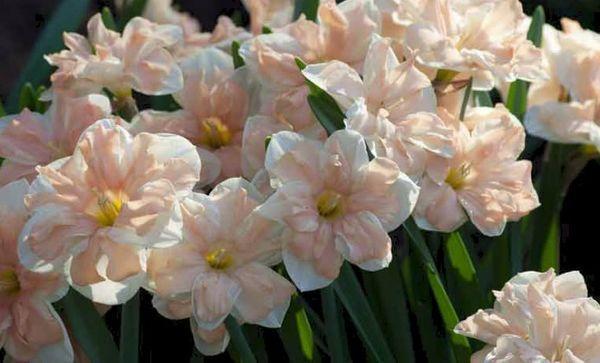
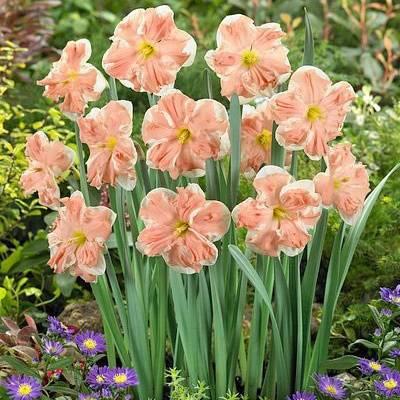
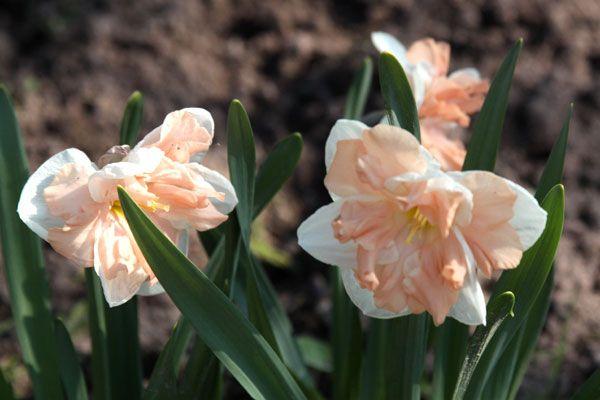
This variety was bred by Dutch specialists in 2006. It belongs to a new group of orchid-like daffodils. The bushes grow to 35-45 centimeters. Depending on growing conditions, the buds reach 7-10 centimeters in diameter. The flower's center is yellow. The corona is corrugated and apricot-colored. The outer petals are large and white. When the flowers are fully open, the plant resembles an orchid.
Please note: The vibrant petals of the Apricot Whirl daffodil will look stunning against darker-colored plants.
Features of flowering
The buds open in early April. Flowering lasts about 20 days. To ensure the daffodil produces more flowers in early spring, the bulbs should be kept in cool conditions for two months. In the flowerbed, they undergo natural stratification during the winter. If the bulbs are planted in the spring, they should be kept in the refrigerator for at least two months.
Pros and cons of using in garden design
The striking daffodil 'Apricot Whirl' is a beautiful addition to any spring garden. Its use in garden design offers the following advantages:
- already in early spring the garden takes on a beautiful appearance;
- the gardener can inhale the delicate aroma emanating from the flowerbed;
- the bushes grow well in partial shade;
- narcissus is rarely affected by diseases and pests;
- The culture does not require much care.
There are no known downsides to using primrose on the plot.
Growing daffodils
Choose a well-lit or partially shaded area for the plant. Daffodils require shelter from cold winds. Therefore, they can be planted near a fence, hedge, or under a tree canopy.
Preparing the bulbs and planting area
To prevent disease, the planting material must be of high quality, free of dents and damage. The bulbs are cleaned of excess scales. To disinfect them, they are placed in a solution of potassium permanganate for an hour.
Preparation of the plot begins 1.5 months before planting the daffodils. The soil is dug over. If it is too heavy, peat and sand are added. If the soil is light, garden soil, compost, and clay are added. If the soil is not too heavy, water will flow through it like a filter, without being retained.

Schemes and timing of planting in the ground
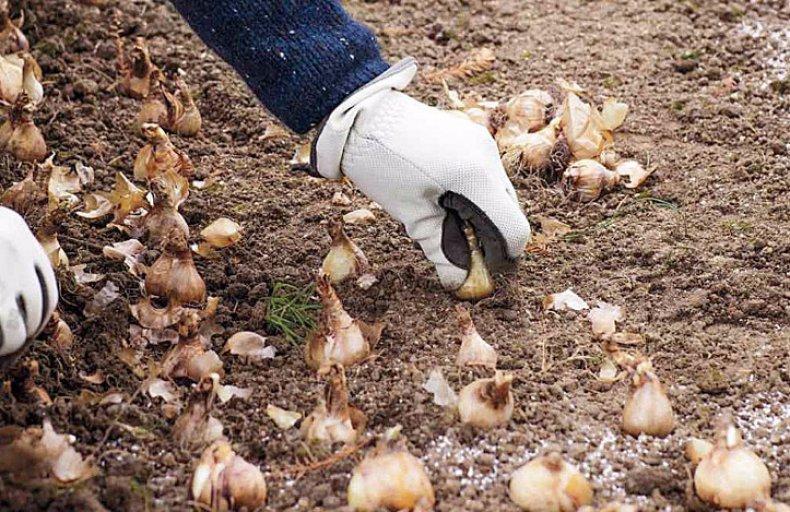
Daffodils are planted in the fall. They need to overwinter in cold conditions. The bulbs are planted as follows:
- dig holes 20 centimeters deep at a distance of 10 centimeters from each other;
- drainage consisting of sand or small stones is poured onto the bottom;
- daffodils are planted at a depth determined by 3 diameters of the bulb;
- covered with earth;
- watered.
Daffodils planted in mid-autumn have time to take root before the frost sets in.
Frequency and intensity of watering
Moisten the soil as the surface dries. Typically, water once a week. Adjust the watering frequency according to rainfall. The bulbs are deeply buried, so at least 5 liters of water are added per mature plant.
How and what to feed the plant with
Fertilizing begins in the second or third year after planting daffodils. To promote rapid growth, apply nitrogen in early spring. A potassium-phosphorus mixture is used during the budding stage. Daffodils can be given another potassium fertilizer immediately after flowering. Nutrition during this period is essential for bulb development.
Loosening and mulching
To prevent crusting, the soil around the bushes is loosened periodically. This procedure is carried out carefully, taking care not to damage the leaves and bulbs. Sharp, disinfected tools are used. Weeds growing inside the bushes are removed by hand.

The area around the daffodils is sprinkled with straw, tree bark, and peat. Mulching helps retain moisture at the base of the root system. As it decomposes, the mulch provides additional fertilizer for the daffodils.
Trimming
Remove faded flower buds and half the stem. They diminish the flowerbed's decorative appeal and rob the plant of the energy needed for bulb development. Allow the leaf blades to die back on their own. Remove dried leaves only 1.5 months after flowering.
Disease and pest control
Narcissus Apricot Whirl has a strong immune system. It is resistant to bacterial infections and harmful insects. However, under unfavorable growing conditions, it can be susceptible to fungal diseases. These are usually caused by excessive soil moisture or prolonged rainfall.
To prevent diseases, preventative measures should be taken. Before planting, bulbs are soaked in a potassium permanganate solution. A drainage layer is placed at the bottom of the hole to facilitate the drainage of excess water. Plant debris is removed from the flowerbed.
Please note! If diseases or pests appear, use special preparations according to the instructions.
Preparing for winter
Narcissus Apricot Whirl tolerates winter cold well. Mulching the flowerbed is only necessary when transplanting the bulbs. Insulating the area is also necessary in anticipation of a snowless winter. Straw, tree bark, and compost can be used as cover.
Breeding methods
The Apricot Whirl daffodil is propagated vegetatively. Seed propagation is typically done by specialists. Using this method, gardeners may end up with a plant that doesn't inherit its parent's traits. Breeding usually results in the development of a new daffodil variety.
For propagation, select a well-grown bush. Carefully dig around it on all sides and remove it from the soil. The bulbs are separated and sorted. Larger bulbs are planted in a flowerbed. Smaller bulbs are grown in a separate area. When they reach a diameter of 2.5 centimeters, they are planted in a permanent location.
Apricot Whirl Reviews
Narcissus Apricot Whirl, with its vibrant blooms, can brighten any garden. The bushes can be planted as a striking standalone focal point or combined with other plants in compositions. According to gardeners, this plant is easy to care for, rarely affected by diseases and pests, and survives winter well without shelter.
Oksana, Voronezh: "When I saw this variety of daffodils, I was speechless! I immediately started looking for Apricot Virla. I found them and planted them in the fall. They all thrived. By spring, I was admiring the large salmon-white blooms. I hope the bushes will soon grow, and I'll have a blooming spring garden."
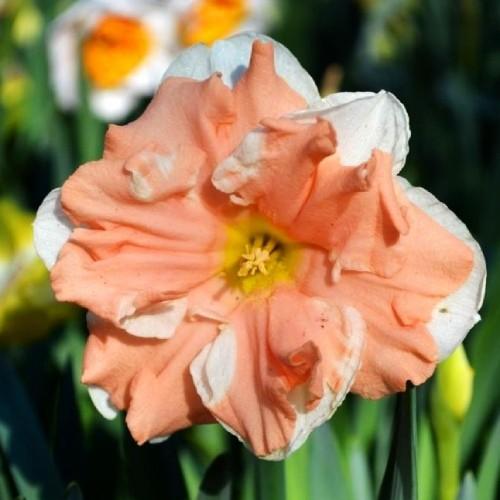
Natalia, Moscow Region: "My Apricot has been growing in the same spot for four years now. It grows quickly and blooms regularly. The crown is usually peach-colored, but this year it's a distinct pink hue. Every year I feed it with a complex fertilizer before flowering and a phosphorus-potassium mixture afterward."
Related posts:
 Description and characteristics of the Chanterelle daffodil variety, planting and care
 Description and characteristics of the Obdam double daffodil, planting and care
 Description and characteristics of the Ice King daffodil variety, planting and care instructions
 Description and characteristics of the Abba double daffodils, planting and care
 Description and characteristics of the Dick Wilden daffodil variety, planting and care instructions
 Description and characteristics of the Minnow daffodil variety, planting and care instructions
 Description and characteristics of the Calgary daffodil variety, planting and care instructions
 Description of shallot varieties, cultivation and care, when to harvest