
- Selection of varieties and cultivation regions
- What is characteristic of Narcissus Abba?
- Pros and cons of growing
- Planting and caring for the plant
- Preparatory stage
- Timing and schemes for planting bulbs
- Watering and fertilizing rules
- Loosening the soil
- Pruning and preparation for frost
- Prevention and treatment
- Diseases
- From insects
- Breeding methods
- Examples of use in the garden and flower beds
- Reviews of the terry Abba variety
Daffodils are perennial bulbous plants. These primroses make a beautiful addition to spring flowerbeds. The Abba variety of daffodil is especially beautiful. Three to five buds form on a single stem. When the flowers open, a musky aroma wafts from the flowerbed. Below are characteristics of the plant, information on planting and care, the pros and cons of growing, and propagation methods.
Selection of varieties and cultivation regions
Narcissus Abba was bred by European specialists. This variety is beloved by gardeners for its beautiful appearance, low maintenance, and ability to thrive in light shade. Narcissus Abba is grown in Europe and Asia. It is also very popular in many regions of Russia.
What is characteristic of Narcissus Abba?
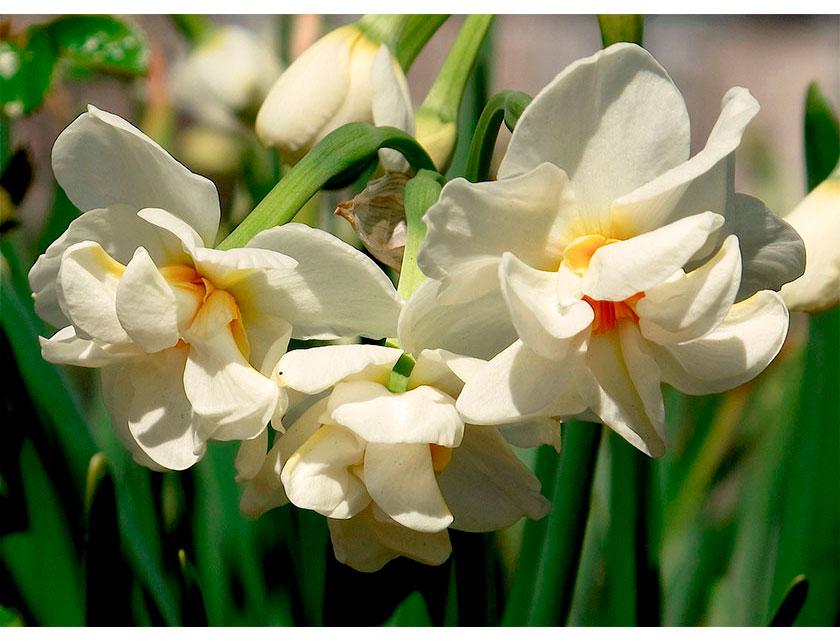
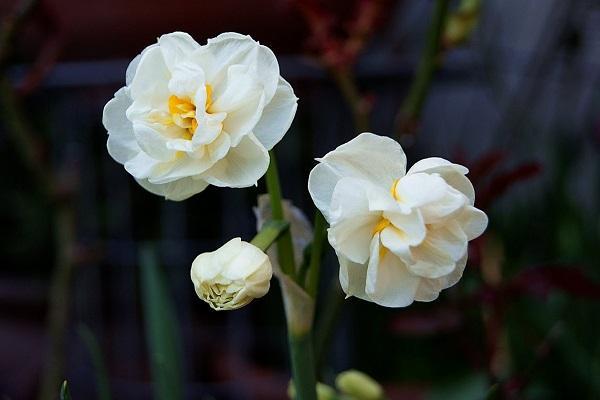
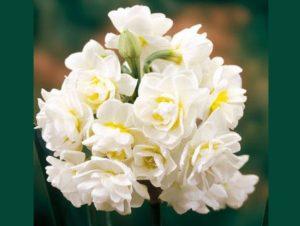
The bushes reach a height of 35-40 centimeters. The leaf blades are narrow and long. This variety is distinguished by the fact that up to five flowers grow on a single stem. The crown is orange-white, and the petals are snow-white.
The multi-flowered narcissus Abba belongs to the double group. It blooms mid-early, with buds beginning to open in late April or May. This variety is distinguished by its long blooming period.
Pros and cons of growing
This beautiful plant is a beautiful addition to any spring garden. Growing it provides the following benefits:
- spectacular view of the flower bed;
- a nutmeg aroma that spreads far beyond the planting site;
- the plant is undemanding in care;
- the culture has good immunity;
- long flowering period.

No negative qualities were found in the narcissist Abba.
Planting and caring for the plant
The further development of daffodils depends on correctly carried out agricultural measures.
Preparatory stage
The bulbs are inspected, and any showing signs of pathogenic microorganisms are discarded. To disinfect them, they are placed in a potassium permanganate solution for 1 hour. They are then dried for 2-3 days. A sunny or partially shaded location is selected. The area is cleared of plant debris, dug over, and loosened.
If the soil is heavy, river sand can be added. Nutrients are added to depleted soil.
Important! For daffodils to bloom in spring, they require 2-2.5 months at a temperature of 1-2°C. Therefore, if a gardener missed planting the bulbs in the ground in the fall, they can keep them in the vegetable compartment of the refrigerator for the specified time.
Timing and schemes for planting bulbs
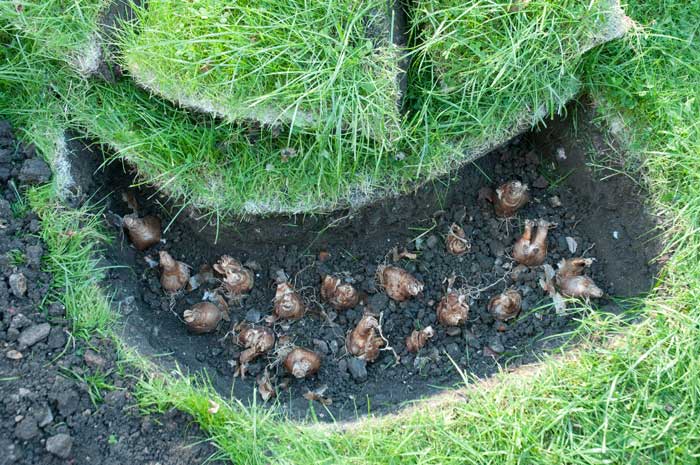
Planting daffodils begins in the fall. Maintain a distance of 20-25 centimeters between bushes. Follow the planting procedure as follows:
- dig holes 20 centimeters deep;
- sand is sprinkled on the bottom as a drainage cushion;
- small bulbs are planted at a depth of 8-10 centimeters, large ones – 10-13 centimeters;
- cover with earth.
The area is covered with mulch. Moisture will be better retained under cover.
Watering and fertilizing rules
If there is a lot of rainfall during the season, daffodils don't require additional watering. Excessive soil moisture can cause pathogenic microorganisms to attack the root system. If the weather is dry, water the bushes during budding, during, and after flowering.

The first feeding is done in early spring. A complex mineral fertilizer is used. When flower stalks emerge above the ground, a potassium-phosphorus fertilizer is applied. Before flowering, complex mineral fertilizers are used. During bud opening, daffodils are fed with a potassium-phosphorus mixture.
Loosening the soil
Two to three days after watering, loosen the soil between the bushes. Carefully, avoiding damaging the bulbs with the tool. Loosening the soil promotes air and moisture penetration. At the same time, weeds, potential carriers of fungal diseases, and harmful insects are removed.
Pruning and preparation for frost
Don't trim daffodil leaves immediately after blooming. Allow them to wither on their own. Only then should they be cut back to mid-height. Once the above-ground portions are completely dry, dig up the bulbs and store them in a cool place until fall.
Before the onset of frost, sprinkle the flowerbed with sawdust or peat to a depth of about 5 centimeters. Daffodils will survive the winter better under mulch.
Prevention and treatment
Plants can be susceptible to certain diseases and pests. To prevent this, preventative measures must be taken.
Diseases
A bush can become infected from a diseased bulb. Therefore, before planting, it is immersed in a solution of potassium permanganate for disinfection. Before flowering, the bushes are treated with copper-containing preparations. After flowering, the plants and flowerbed are sprayed with a fungicide.
From insects
To prevent insect infestations, remove nearby weeds. After flowering, remove dead leaves and other plant debris from the flowerbed. If harmful insects appear, use insecticides.
Important! When handling chemicals, wear protective clothing that covers exposed skin.
Breeding methods
Narcissus Abba is typically propagated vegetatively. Seed propagation is labor-intensive and time-consuming, and flowering occurs later. Therefore, gardeners generally avoid this method. Bushes older than 4-5 years are used for propagation. They are dug up, and the small bulbs are separated from the larger ones. The larger ones are planted in a flowerbed. The small bulbs are further grown separately in the garden, planted in rows or holes.
Examples of use in the garden and flower beds
Abba daffodils are used in gardens as early bloomers. They are planted in separate groups, combined with other flowers. They are also used to fill the spaces between plants that bloom in the summer.
Reviews of the terry Abba variety
Gardeners leave positive reviews about the plant. They note that the daffodil blooms beautifully, is fragrant, and grows quickly in their garden. The bushes are easy to grow and require little care. The plant propagates easily vegetatively.
Diana, Rostov Oblast: "I've been growing Abba daffodils for many years. I really love the scent emanating from the flowerbed when the bushes are in bloom. I've noticed that if I don't dig up the daffodils for two or three years, their buds get larger and larger each year."
Tatyana Borisovna, Brest: "I have a Narcissus Abba growing along my path. When it starts blooming in May, I just want to walk along it. I admire the blossoms and inhale the nutmeg aroma. When the buds start to shrink, I dig up the bush and replant the bulbs."
Related posts:
 Description and characteristics of the Chanterelle daffodil variety, planting and care
 Description and characteristics of the Apricot Whirl daffodil, planting and care
 Description and characteristics of the Obdam double daffodil, planting and care
 Description and characteristics of the Ice King daffodil variety, planting and care instructions
 Characteristics and descriptions of the most beautiful types of daffodils, names of the best varieties
 Description and characteristics of the Delnasho daffodil variety, planting and care instructions
 Description and characteristics of the Dick Wilden daffodil variety, planting and care instructions
 Description and characteristics of the Mount Hood daffodil, planting and care instructions