
- Selection and botanical description
- Advantages and disadvantages of using in landscape design
- Growing conditions requirements for Delnasho
- Planting and care
- Site selection and preparation
- Planting dates and patterns
- Watering
- Regularity of flower fertilization
- Flowering and care after
- Protection from insects and diseases
- Transfer
- Methods of reproduction
- Potential problems in cultivation
- Reviews of the variety
With the arrival of spring, gardeners begin to think about how to decorate their plots. Daffodils are among the first to grace the garden, and even novice gardeners can grow them. Over the years, numerous varieties and hybrids have emerged, each with its own distinctive appearance and growing requirements. Among the most popular daffodils is the Delnasho variety, a double-flowered variety.
Selection and botanical description
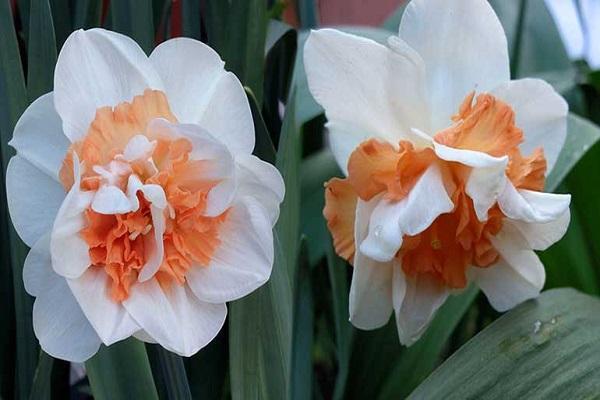
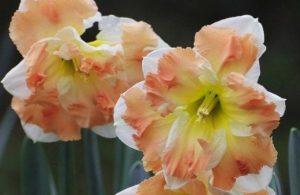
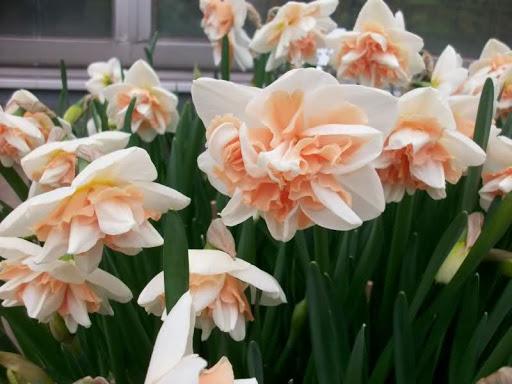
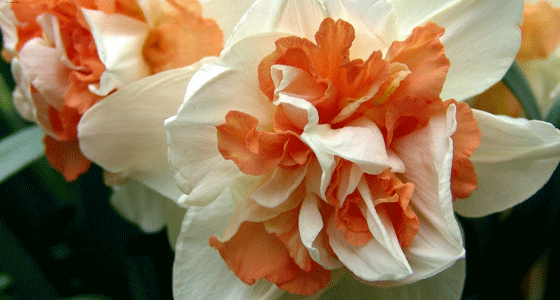
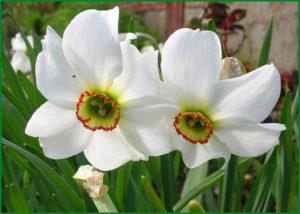
The double daffodil, a Delnashaugh selection from England, begins blooming in mid-April, its velvet-like flowers delighting the eye until early May. This daffodil grows up to 45 cm tall. A single flower features alternating pink and white petals, reaching 15 cm in diameter. One or two buds are borne on a single stem. The bulbs overwinter in the ground and, with the arrival of spring, produce stems. The lifespan of a single plant is approximately five years.
Advantages and disadvantages of using in landscape design
Before purchasing daffodil bulbs, consider all the pros and cons of the plant. Despite its striking appearance, the Delnasschaugn variety does have its drawbacks.
The advantages of white and pink daffodils include:
- A long period of life in one place.
- A decorative type of flower that resembles a white and pink cloud.
- A subtle, barely perceptible aroma that does not cause dizziness.
- Possibility of using the variety for cutting and forcing.
Among the disadvantages of a narcissist are:
- Intolerance to wetlands.
- Short flowering period.
- Without prevention, there is susceptibility to fungal diseases.
Growing conditions requirements for Delnasho
The Delnasho narcissus variety has few growing conditions, but they must be met to ensure the plant remains disease-free and maintains its attractive appearance.
Planting and care
Before planting, select a suitable location, prepare the soil, and prepare the bulbs. Further care for the daffodil is straightforward.
Site selection and preparation
An area that receives full sun throughout the day is ideal for daffodils. Otherwise, plant the plant in partial shade. Insufficient sunlight will affect the daffodil's decorative appearance. The area where the flower will grow should be protected from strong winds, which can damage the delicate buds.
If the area has a high groundwater table, a small mound is constructed and the daffodil planted on it. Excessive humidity around the bulb can lead to the development of fungal diseases.
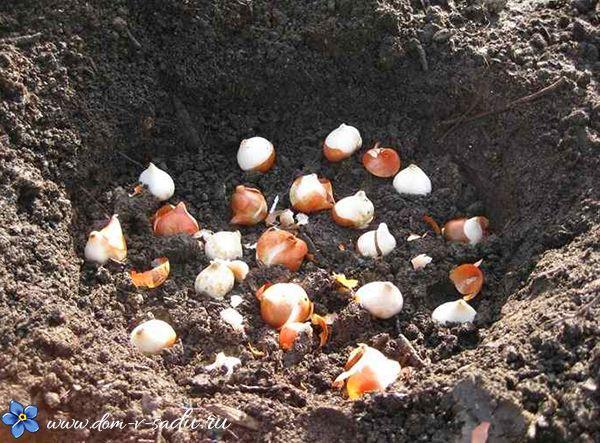
Regarding soil composition, loamy soil with a moderate acidity is preferred. If the soil in the chosen area is heavy and poorly draining, add a little river sand. Before planting daffodils, dig the soil and remove any weed roots.
Planting dates and patterns
The best time to plant bulbs is September and October. They will have time to root before the first frost and will survive the winter without any problems.
Planting of bulbs is carried out according to the following algorithm:
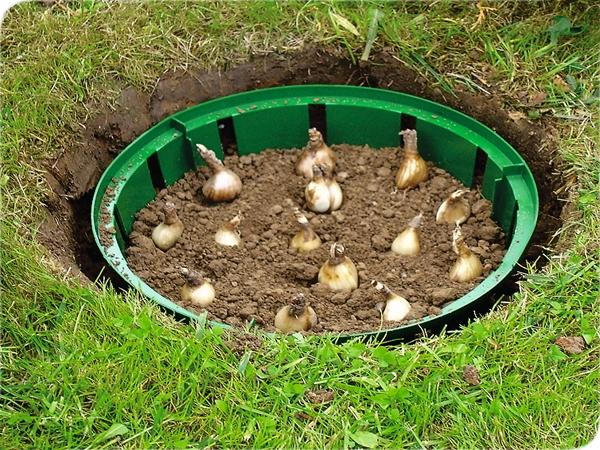
- Dig holes 20-25 cm apart, and their depth should be about 12-13 cm.
- Carefully place the bulb on the bottom of the hole and cover with soil.
- The soil is compacted slightly and covered with a layer of mulch.
Important! If you don't follow the recommended spacing between daffodils when planting, the bulbs will develop poorly and you won't be able to grow a spectacular plant.
Watering
As soon as the first warm weather of spring arrives, the bulbs need to be provided with the required amount of moisture. However, care must be taken to avoid stagnant water, which can cause bulb rot.
Determining when to start watering is easy. Insert your finger into the soil to a depth of about 3 cm; if it's not damp, begin watering. Use settled water with a temperature no lower than the outside air temperature. Daffodils need to be watered both during and after flowering. This is when the bulbs are preparing for winter and need moisture.
Regularity of flower fertilization
Without proper nutrition, you won't be able to achieve spectacular blooms and beautiful, large daffodil buds. For plant nutrition, we recommend using mineral fertilizers containing phosphorus, nitrogen, and potassium.
The first application is made when the bulbs are planted in the soil. The second application is made during bud formation. To ensure better absorption, the components are dissolved in irrigation water. The third application is made during flowering; nitroammophoska is the best choice during this period.
After each application of fertilizer, the soil around the flowers is loosened.
Flowering and care after
During the flowering period, caring for daffodils involves fertilizing and watering. Weeds, which rob the flowers of their nutrients, are also removed. After the flowering period is over, the buds are carefully pruned. Before preparing for winter, trim off all dried leaves and cover the bulbs with a layer of mulch.
Protection from insects and diseases
If you follow proper plant care guidelines, diseases and pests rarely affect crops. Among the most dangerous are:
- Penicillium rot. This disease is caused by high humidity and poor drainage. As a preventative measure, spray copper sulfate on daffodils.
- Fusarium wilt. Causes include high nitrogen levels in the soil and poor watering. Unfortunately, there's no cure for the affected plant, so it's dug up and burned outside the garden.
Transfer
If it becomes necessary to transplant a plant to another location, proceed as follows:
- Moisten the soil around the daffodils.
- Carefully dig out the bulb.
- They treat it with a fungicide and transplant it to another flower bed.
Methods of reproduction
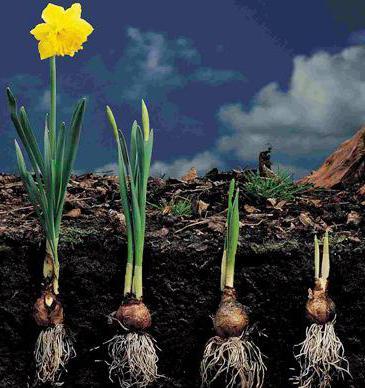
There's only one way to propagate this variety of daffodils. Over time, the bulb will produce daughter plants, which are carefully separated and transplanted to another location. This is recommended in early fall.
At first, the planted bulbs are covered with mulch to prevent moisture evaporation and protect them from winter cold.
Potential problems in cultivation
If agricultural practices are not followed, certain problems arise:
- Slow growth. Cause: improper spacing between bulbs during planting.
- Loss of ornamental appearance. Development of diseases, failure to adhere to the fertilizing schedule.
- Lack of flowering. High humidity, lack of nutrients.
Reviews of the variety
Antonina Mikhailovna Kochetova, 39, Lipki: "Last year, I planted the Delnasho daffodil in my flowerbeds. By the 20th of April, I was already admiring its gorgeous blooms. The main advantage for me is that the plant doesn't have a strong, irritating odor."
Valeria Andreyevna Orlenko, 58, Samara: "I've been growing Delnasho daffodils on my property for several years now. They're incredibly beautiful during flowering and don't cause any problems. The key is to avoid overwatering, as this affects the plant's resistance to fungal diseases. To ensure large buds, I fertilize them three times a season."
Related posts:
 Characteristics and descriptions of the most beautiful types of daffodils, names of the best varieties
 Description and characteristics of the Erlichir narcissus variety, planting and growing rules
 Description and characteristics of the Obdam double daffodil, planting and care
 When and how to plant tulips in the Urals in autumn and care for them outdoors
 Description of shallot varieties, cultivation and care, when to harvest
 Description and characteristics of the Ice King daffodil variety, planting and care instructions
 Description and characteristics of the Avalon daffodil variety, planting and care instructions
 Description and characteristics of the Irene Copeland daffodil variety, planting and care instructions