
- History of variety selection
- Description and characteristics of the Golden Ducat variety
- Examples in landscape design
- Growing daffodils
- Preparing the bulbs and the area
- Preparing the bulbs
- Soil preparation
- Planting dates and patterns
- Watering mode
- Addition of nutrients
- Weeding
- Protection from pests and diseases
- Preparing for winter
- Methods of reproduction
- Potential difficulties when growing
- Gardener reviews of the Golden Ducat daffodil
Plants of the genus Narcissus belong to the Amaryllidaceae family. The genus includes both garden varieties and wild species. Narcissus have been cultivated for several centuries. Today, they are among the most popular primroses. According to modern garden classification, flowers are divided into 13 groups. The Golden Ducat daffodil belongs to Group 4, which includes plants with double flowers.
History of variety selection
The first double-flowered daffodil varieties appeared in the 16th and 17th centuries. These varieties became especially popular in the 20th century. The Golden Ducat variety was registered as early as 1946.The rights to it belong to the Dutch flower company "Speelman&sons." Old English varieties and hybrids of unknown origin were used in its development:
- Maximus;
- Emperor;
- King Alfred.
It has been repeatedly awarded at international flower exhibitions.
Description and characteristics of the Golden Ducat variety
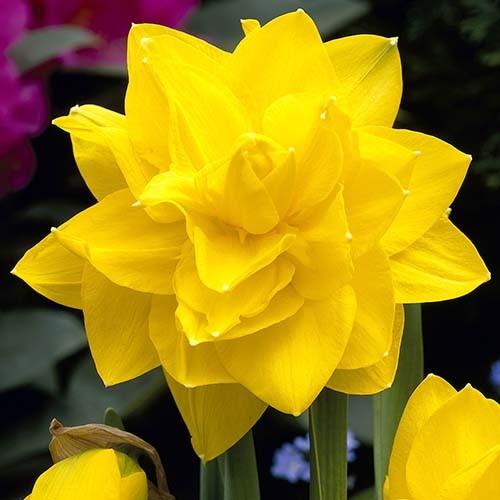
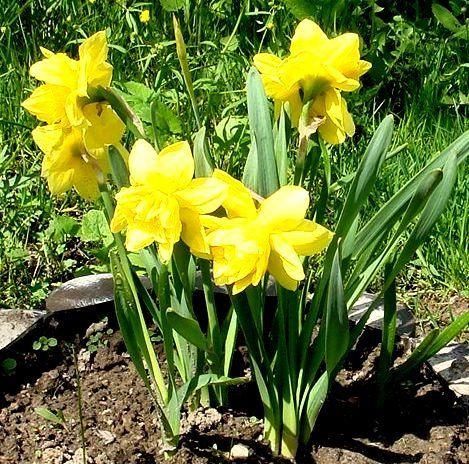
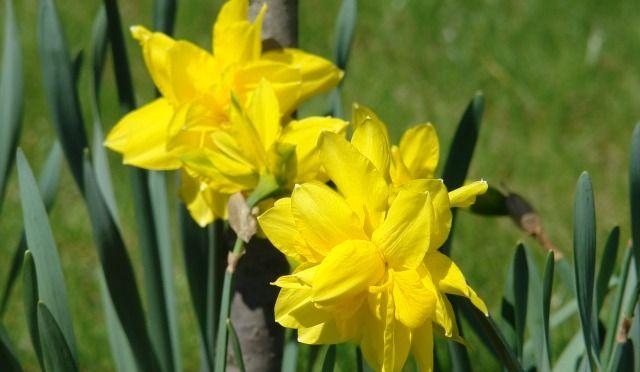
A distinctive feature of the plant is the pointed shape of the perianth petals. As flowering progresses, the lower portion of the petals bends back. The color is bright yellow. The corona is often absent, replaced by inner petals, although some specimens have both a low corona and additional perianth segments.
The flowers are large, ranging from 8 to 11 cm in diameter. Their almost spherical shape resembles dahlias. They have a pleasant, subtle scent.
The flower stalks are 45-65 cm tall, each bearing up to 3-4 flowers. Flowering begins in early May and lasts for two to three weeks. This variety is suitable for both forcing and outdoor cultivation.
Examples in landscape design
This beautiful early flower is a beautiful addition to any landscape. It can be used in landscape design:
- for mono-planting in small groups;
- as a border plant;
- to fill the space between trees;
- for mixed flower beds and flower gardens;
- for arranging rockeries.
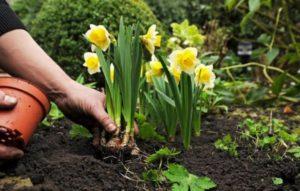
Double daffodils are combined, first of all, with other primroses:
- hyacinths;
- muscari;
- tulips;
- crocuses;
- freesias.
They look great with pansies, daisies, and forget-me-nots. They are suitable for planting in pots, containers, and vases.
Growing daffodils
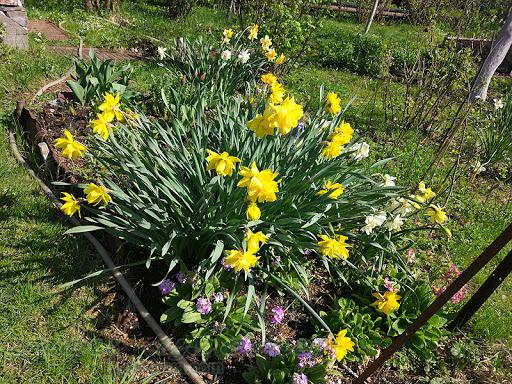
Growing daffodils is a fascinating endeavor. It all starts with choosing a location. When planting daffodils in your garden, it's best to choose a south-facing location. To protect the delicate flowers, it's important to provide protection from the wind. For growing daffodils, it's best to purchase large, healthy bulbs weighing at least 27 grams.
Preparing the bulbs and the area
Success in growing daffodils yourself begins with preparation. This applies to both the planting material and the soil in which the flowers will grow.
Preparing the bulbs
Inspect the bulbs before planting. Separate the offspring from the mother plants. High-quality planting material should be firm, free of mold, rot, or pits at the base. Disinfect the bulbs. Soaking them in a pink solution of potassium permanganate for half an hour is an option. Specialized disinfectants, such as Fitosporin, are also suitable.

Soil preparation
For growing daffodils, choose a site with loamy, neutral or slightly acidic soil. A sunny or partially shaded area with at least half-day light is ideal. Dig the selected bed to the depth of a spade. Add lime to acidic soil at a rate of 5-6 kilograms per square meter during digging. Wood ash and dolomite flour are also suitable for reducing acidity. For very heavy soil, add a bucket of sand per square meter. For poor soil, add 5-10 kg of humus, compost, or peat per square meter, along with 2 tablespoons of complex mineral fertilizer.
Planting dates and patterns
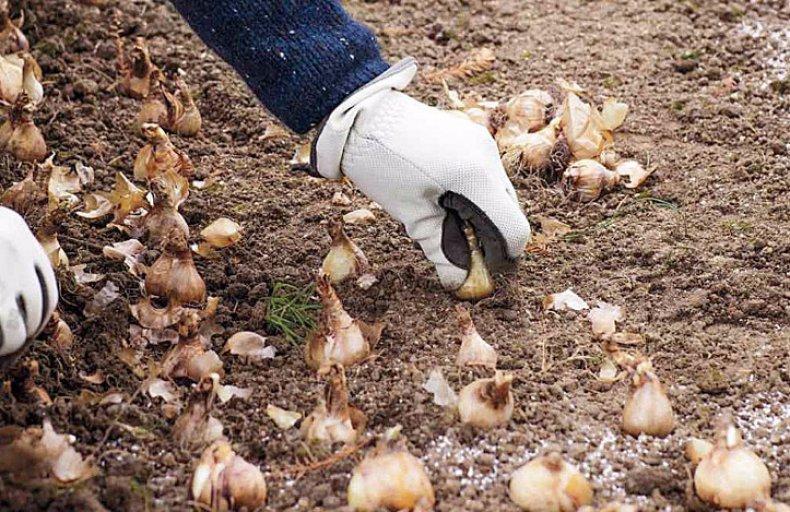
The optimal time for planting bulbs in the ground is the third ten days of August or the first half of September. In exceptional cases, daffodils can be planted in early spring, after the soil has thawed to a depth of 20 cm.
Important! Time the planting so that the bulb has time to root securely but not begin to grow.
The depth of the holes depends on the size of the bulbs; ideally, they should be planted at a depth of 15-20 cm. Large bulbs should be planted at a depth of 22-25 cm, while smaller bulbs should be planted at a depth of 10-15 cm. The bulbs should be spaced in a 10x15 cm pattern. After planting, water the bulbs generously.
Watering mode
Daffodils need watering immediately after the snow melts. The plant should be watered while the flower stalks are growing and buds are forming. If the flower lacks moisture, the buds may dry out without ever opening. After flowering, continue watering every three to four days until the above-ground parts have completely lodged and dried out.
Addition of nutrients
Plants are fertilized three times per season. The first time is immediately after the green shoots emerge. The second time is when buds form, and the third time is when the flowers open. Any complete fertilizer mixture for bulbous plants, such as Kemira, can be used for fertilizing.
Weeding
Typically, the above-ground parts of the plant emerge before the weeds. At this stage, it's enough to gently loosen the soil around the flower. Subsequently, weeding and removing weeds should be done 2-3 times per season. This can be done by hand or with specialized gardening tools.
Protection from pests and diseases
To grow healthy and beautiful plants, you should protect them from the following diseases:
- Fusarium wilt most often affects bulbs planted too shallowly and stored improperly. To prevent this, destroy any suspect soft bulbs and replant healthy ones. Do not store planting material at temperatures above 17 degrees Celsius.
- Botrytis develops in cold, damp weather. To treat it, dig up the bulbs, inspect them, remove any diseased ones, and soak healthy ones in a fungicide, such as Topaz, before planting.
To prevent disease, daffodils are replanted in the same spot every five years. Nematodes are a pest threat to daffodils. They can be controlled by soaking the bulbs in warm water (43.5°C/110°F) for three hours. Dust the plantings with wood ash to combat large and small narcissus flies. In severe cases, insecticides are used.
Preparing for winter
Narcissus bulbs do not require annual removal from the soil. In the fall, the area where the daffodils are planted is cleared of all plant debris.
After this, before the onset of sustained frost, the surface is covered with mulch. Dry leaves, sawdust, and straw are used for this.
Methods of reproduction
Narcissus are propagated by seeds and vegetative parts. Seed propagation is not suitable for hybrids. It is most often used to develop new varieties. For amateur propagation, vegetative parts of the plant are used, such as bulbs that have produced offspring. These are dug up from the ground every four to five years. Small offspring are separated from the mother plant and planted in separate holes.
The plant is also propagated by dividing the bush. To do this, carefully dig up the bush at the end of the season. Rock the offspring by hand, breaking it off. Plant the divided bushes in new holes. If a wound forms during the break, sprinkle it with ash.
Potential difficulties when growing
The main difficulty in growing the Golden Ducat variety is its oversized flowers. Their weight causes the stems to droop heavily toward the ground. Strong winds can break them, and rain can damage already opened flowers, resulting in an unsightly and unkempt appearance.
Gardener reviews of the Golden Ducat daffodil
Many daffodil lovers consider the Golden Ducat variety one of the best for cut bouquets. To achieve this, plant the bulbs at least 20-25 cm apart. If the flower stalks are cut at the bud stage and done in dry weather, the plant will last 7 to 10 days in a bouquet.
Related posts:
 Description of shallot varieties, cultivation and care, when to harvest
 Planting and caring for daffodils in open ground, the best time and growing rules
 Description of the best varieties of onions, planting and care in open ground
 When is the best time to plant tulips in open ground? Timeframes by region and rules.
 Description and characteristics of the Dick Wilden daffodil variety, planting and care instructions
 When and how to plant tulips in the Urals in autumn and care for them outdoors
 Description and characteristics of the Ice King daffodil variety, planting and care instructions
 Description and characteristics of the Calgary daffodil variety, planting and care instructions