
- Plant characteristics
- The most beautiful varieties and types
- Benefits of using in garden design
- Features of planting operations
- Soil composition requirements
- Site selection and preparation
- How to prepare the bulbs
- When to plant daffodils
- In Siberia
- In the Urals
- In the Moscow region
- Planting patterns and optimal planting density
- Further care
- Watering and fertilizing
- Loosening the soil and removing weeds
- Insect protection
- Diseases of Culture
- Transfer
- Principles of proper wintering of daffodils
- How do flowers reproduce?
- Common mistakes and tips for beginning gardeners
Daffodils are flowers in the Amaryllis family. They are native to southern Europe, Asia, and the Mediterranean. There are approximately 60 species of daffodils in the wild. Selected hybrids vary in flower shape and color and adapt to both warm and cold climates. To ensure the bulbs thrive, it's important to follow the correct planting times and care guidelines.
Plant characteristics
Daffodils have an unusual structure of roots and flowers:
- the dense bulb is covered with thin scales;
- long leaves are formed at the roots;
- the stem is oval or flattened, covered with an oily coating;
- in the center of the bud a socket is formed, from which petals extend;
- faded plants shed buds and stems;
- bulbs can be oval, ovoid, round;
- in autumn the bulbs are divided into parts - babies;
- the roots live for 10 months and die off;
- Plants produce fruits - seed pods.
Narcissus buds are traditionally two-toned: the petals are white, and the corolla is yellow. Hybrid varieties are more vibrantly colored, with speckled and striped petals. Their edges can be smooth, wavy, or fringed.
The most beautiful varieties and types
The classic variety is the trumpet daffodil, with white or yellow petals and a trumpet-shaped opening. Through selective breeding, more original varieties have emerged:
- large- and small-crowned - with wide triangular petals and one flower on the stem;
- terry - decorative varieties with terry petals and a center;
- tazetta - frost-resistant flowers with rounded buds and a cup-shaped trumpet;
- poetic - varieties with milky-white petals and small bulbs;
- bulbocodium - bell-shaped hybrids.
Beautiful varieties for the garden:
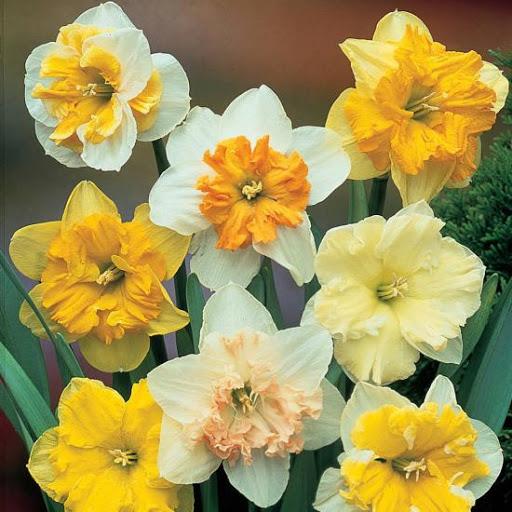
- Ice King - is distinguished by large white buds with a lush, double yellow center;
- Mount Hood is a tubular variety with large white buds up to 13 centimeters in diameter;
- Rosie Cloud is a double variety with a wavy, soft pink center and triangular white petals with slightly green edges.
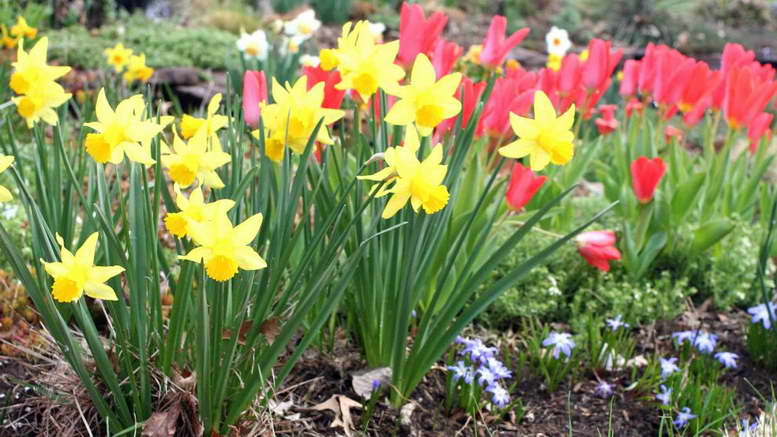
The lemon buds of Spelbinders are simple yet beautiful. This tubular variety has a secret: the center turns from yellow to white two days after the flower opens.
Benefits of using in garden design
The benefits of growing daffodils:
- Terry varieties are used in spring compositions and to decorate borders;
- varieties with strong flower stalks are cut and placed in the house;
- White buds are suitable for decorating an alpine slide.
Growing early-, mid-, and late-blooming daffodils allows you to add variety to your flowerbeds with delicate yellow and white blooms. The garden will be filled with a pleasant fragrance all spring long.
Features of planting operations
Before planting, you need to prepare the area for daffodils in advance and select healthy bulbs.
Soil composition requirements
Soil suitable for daffodils:
- moderately loose;
- neutral acidity;
- loamy.
Daffodils grow well in soil that allows water and air to pass through well.

Site selection and preparation
A sunny spot with light shade at midday is ideal for planting daffodils in your garden. These spring flowers will receive sufficient nutrients from soil previously planted with peonies, beans, nightshade, and cucumbers. If you're planting daffodils in a new location or replacing chrysanthemums, tulips, and lilies, the soil should be tilled with compost. Bulbous flowers require a lot of nutrients. Acidic soil can be "corrected" by adding dolomite flour and wood ash.
How to prepare a site in spring:
- calculate the required amount of compost and nitrophosphate fertilizer - 60 grams of fertilizer is used per square meter of land;
- Dig up the area with fertilizers to a depth of 25 centimeters.
The area for fall planting of daffodils is prepared in the summer. Before digging, apply fertilizer at a rate per square meter of soil:
- peat, compost - 4 kilograms;
- superphosphate - 2 tablespoons;
- Agricola - 1 tablespoon.
Soil acidity and density are eliminated before fertilizing. Add half a bucket of river sand per square meter of clay soil, and clay to sandy soil. Then apply fertilizer. Dig the area to a depth of 15 centimeters and leave it until fall.
How to prepare the bulbs
Planting stock is purchased and prepared in the fall. After the stems fall, the bulbs are dug up, separated, and stored at a temperature no higher than 5°C (41°F). In winter, they should be inspected and any darkened or wrinkled bulbs removed. Disease from a damaged bulb will quickly spread to healthy bulbs. These bulbs will produce weak shoots, and the buds will be deformed.
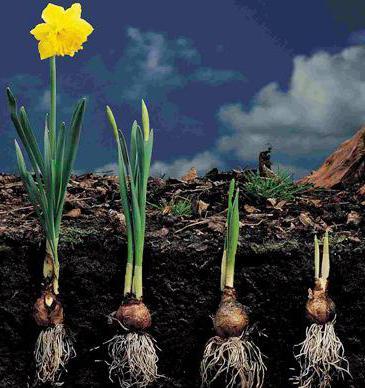
Before spring planting, bulbs are soaked in a manganese solution to protect the plants from disease. When purchasing planting material in spring and fall, it's important to select bulbs without defects:
- spots;
- sprouts;
- small babies around a large bulb.
What healthy bulbs look like:
- white or light yellow color;
- matte or slightly shiny smooth surface;
- hard to the touch.
In the fall, the bulbs are also soaked in manganese and planted in prepared soil.
When to plant daffodils
Daffodils bloom early, so they are considered a harbinger of spring. Spring planting is carried out after the onset of warm weather. The timing depends on the regional climate. The best time is after the snow has completely melted—in late March or early April.
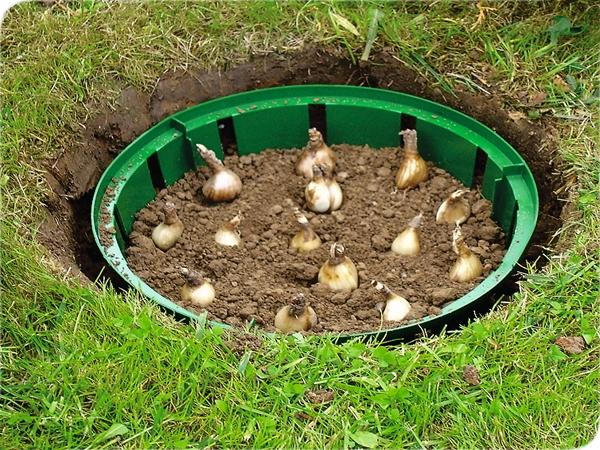
Daffodils are typically planted in the fall, from mid-August to mid-September. The bulbs should be planted before frost, provided the soil temperature remains stable at 7-10 degrees Celsius. If a sudden cold snap is expected, it's best to postpone planting until spring. The bulbs' roots won't have time to strengthen during the short warm period in the fall.
In Siberia
Fall flower planting begins in August. To grow them in harsh climates, you need to be more mindful of the weather. If autumn temperatures are variable, it's best to plant late-season varieties in the spring, after frost.
In the Urals
The best time to plant daffodils in the Urals is early August. If the autumn is warm, you can continue planting the bulbs in September and October. The key is to keep the soil temperature around 10 degrees Celsius for two weeks, as in the summer months.
In the Moscow region
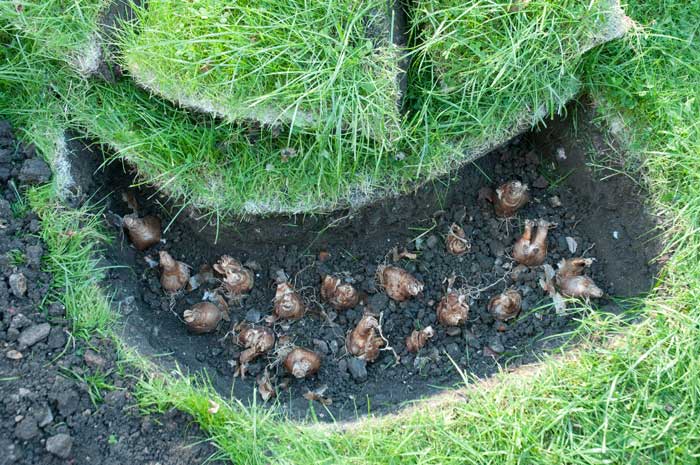
Due to late frosts, spring planting is out of the question. Sprouted bulbs freeze or dry out from rapid evaporation during sudden warming. Established plants will bloom only the following summer. Therefore, in temperate climates, daffodils are planted in August and September.

Planting patterns and optimal planting density
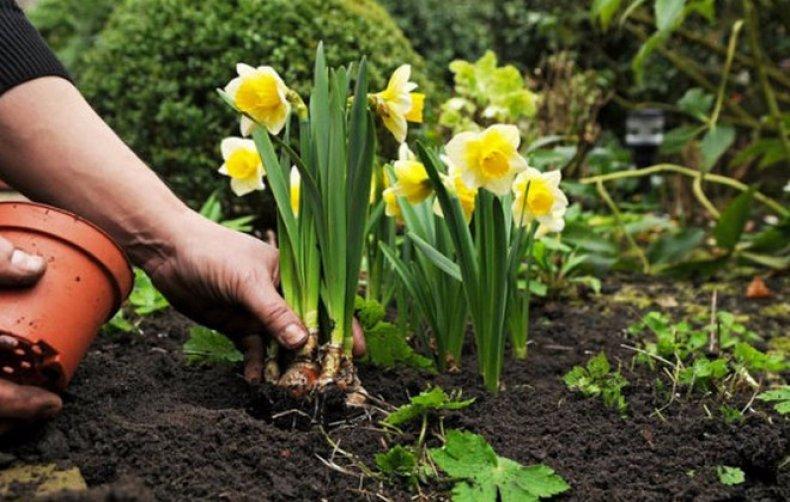
Before planting, dig holes for daffodils:
- for each bulb, select a hole depth equal to three of its diameters;
- a handful of fine sand is poured into the hole for drainage, two handfuls of wood ash;
- place the onion on top with the bottom down;
- the excavated soil is mixed with compost and the hole is filled halfway;
- a little water is poured into the depression;
- fill the hole completely and compact it.
Large bulbs should be planted in holes 25 centimeters deep and pressed lightly into the ground. After planting, it's recommended to cover the soil with mulch made from walnut shells, chopped straw, sawdust, or freshly cut grass. Mulched beds are easier to maintain, as the covering retains moisture longer and prevents weed growth.
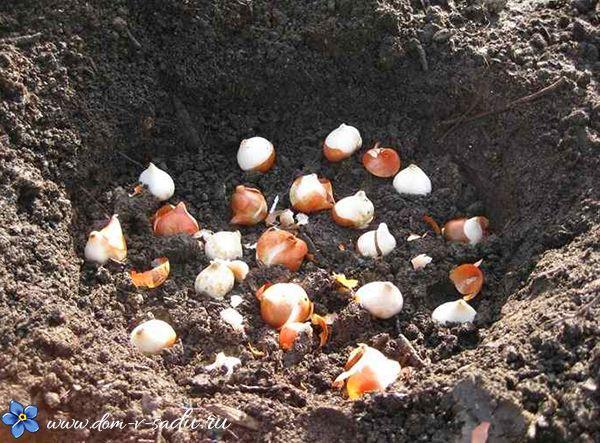
Daffodils grow very large, so the holes are dug 15-20 centimeters apart. If they are to be replanted in a year, the interval is reduced to 7-10 centimeters. Larger bulbs are best planted at a greater distance—15 centimeters.
Daffodils are planted in groups of 5-7 bulbs each. Group planting is used in rock gardens.
Further care
To properly care for daffodils, you need to maintain a regular watering and fertilizing schedule. You can protect the plants from diseases while preparing the bulbs for planting.
Watering and fertilizing
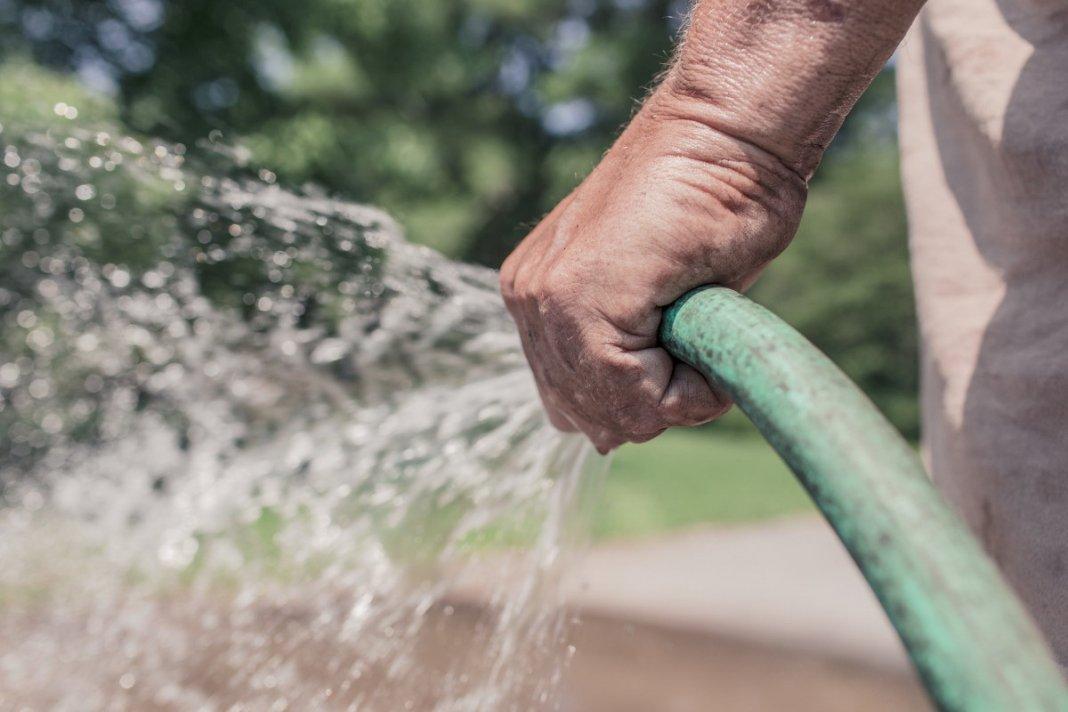
Moisture-loving daffodils require generous watering, but avoid dampness. Apply 20 liters of water per square meter. The watered beds are loosened to ensure even absorption and oxygen supply to the roots. After flowering, the plants are watered for 15 days. Then, stop watering.
Fertilizer is applied three times a year:
- in spring, after germination;
- at the stage of bud formation;
- after flowering.
In spring and summer, flowers are fed with a complex fertilizer. Seedlings require 30 grams per square meter, while buds require 20 grams. In autumn, plants require potassium and phosphorus in a 1:2 ratio. 50 grams of the mixture is used per square meter of beds. After applying the fertilizer, the soil is watered and loosened.
Loosening the soil and removing weeds
The soil is loosened after watering and fertilizing. The bulbs are planted close to the surface. The optimal loosening depth is 3-4 centimeters. Weeding and loosening the soil prevent pests from appearing in the beds. To prevent weeds from appearing in the flowerbed, it's best to cover the soil with a layer of mulch.
Insect protection
Daffodils attract mole crickets, narcissus flies, and root mites.
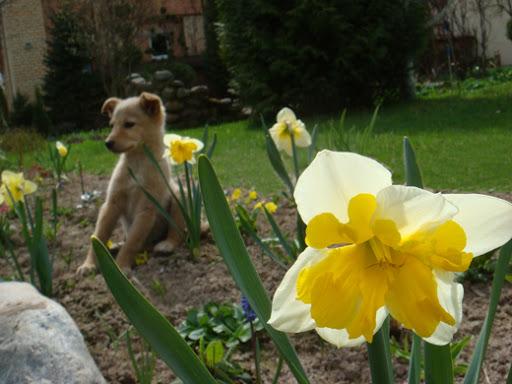
How to control pests:
- warm the bulbs before planting in water at a temperature of 43 degrees;
- Fufanon 2% solution is effective against narcissus fly;
- During the period of bud formation, flowers are treated with Fitoverm.
To combat nematodes, plants are sprayed with Nemaphos and Karbation.
Diseases of Culture
Daffodils suffer from fungal diseases:
- Fusarium - starts from the bulb and moves up the plant, a light pink coating appears;
- Botrytis - recognized by the gray coating on the back of the basal leaves;
- Penicillium wilt - develops in small bulbs in high humidity, as a result of which they do not germinate.
Less commonly, daffodils contract viruses such as yellow streak, ring spot, and mosaic. The plant wilts and cannot be saved. The bush must be removed from the garden bed before the disease spreads to the entire flowerbed.

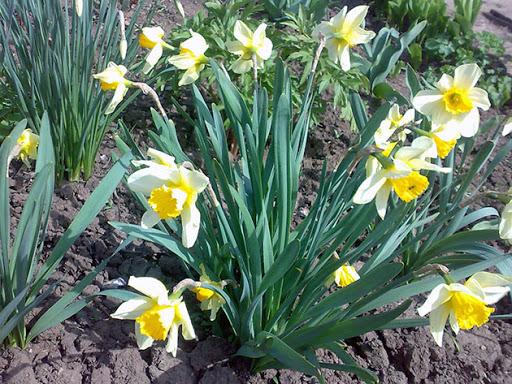
Preventive measures are used against fungus:
- treat the bulbs with potassium permanganate before winter storage and planting;
- sprouts grown in open ground are disinfected with Bordeaux mixture.
To protect plants from viruses, it is necessary to combat their vectors – garden insect pests, cicadas, whiteflies, nematodes, and mites.
Transfer
Daffodils grow in the same spot for five years. A vigorously overgrown bush with small flowers is a sign that baby bulblets have formed. The plant is repotted after flowering has finished:
- dig up the bulb after the stem has fallen;
- separate the children;
- transplanted to another place.
The small daughter bulbs are freed from stem and husk remains, disinfected in a potassium permanganate solution, dried, and stored in a cool place for two months. Daffodil bulbs should be stored at a temperature no higher than 17 degrees Celsius (63 degrees Fahrenheit). The bulbs are laid out on a flat surface in a single layer, ensuring they do not touch each other.
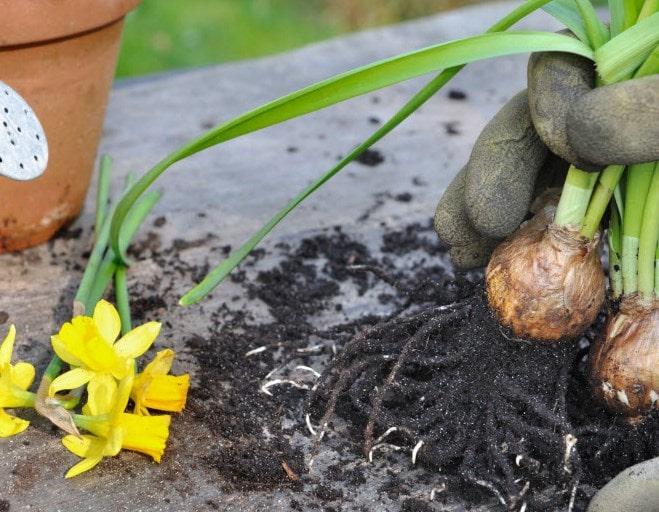
One mother bulb produces up to four daughter bulbs. Small bulbs are usually easily separated from the base. If they have to be broken off, sprinkle the broken areas with wood ash.
Principles of proper wintering of daffodils
Bulbs that remain in the ground over the winter are covered with mulch or a special material. The soil is loosened slightly and covered with peat, ash, and straw. The mulch layer is 15 centimeters thick. The bulbs are covered with agrofibre after the first frost. The organic and hard covering is removed in the spring, after the last thaw. Another way to overwinter the plants is in a cool cellar. They are dug up after the stems have dried, preserved in potassium permanganate, dried, and laid out on a flat tray.
How do flowers reproduce?
The main method of propagating daffodils is by dividing the bulbs. Growing from seed takes a long time. The bulb forms from the seed and strengthens over two years, and flowers appear after six years. Another disadvantage of growing from seed is the loss of the hybrid plant's varietal characteristics.
Common mistakes and tips for beginning gardeners
Signs of improper daffodil care include lack of flowers and dried-out leaves. Common mistakes can cause poor plant health:
- lack of additional feeding;
- oversaturation of the soil with nitrogen fertilizer;
- the flowerbed is located in a damp, shady place;
- neighboring plants take nutrients from the bulbs;
- early pruning of green stems.
Fading flowers are picked before seed pods form to promote bulb development. Stems can be cut after they have completely yellowed and dried out. Some varieties are sensitive to climate. Due to their adaptation, flowers appear on time during the first season, but the following year, the plants fail to bloom. Flowering problems also indicate the need to divide the bulbs. It is recommended to dig them up every two years, divide them, and then bury them or store them for the winter.
Related posts:
 Characteristics and descriptions of the most beautiful types of daffodils, names of the best varieties
 When and when can daffodils be repotted? Step-by-step instructions and care.
 Description and characteristics of the Dick Wilden daffodil variety, planting and care instructions
 Description and characteristics of the Cheerfulness daffodil variety, planting and care instructions
 Description and characteristics of the Calgary daffodil variety, planting and care instructions
 Descriptions of the best and most beautiful varieties of daffodils, ratings and selection tips
 Description and characteristics of the Ice King daffodil variety, planting and care instructions
 Description and characteristics of the Kum Laud narcissus variety, planting and care instructions