
- Plant characteristics
- Features of flowering
- White subspecies
- Yellow subspecies
- Examples in landscape design
- Planting Narcissus Cheerfulness
- Preparing the site and bulbs
- Planting dates and patterns
- Care instructions
- Watering and fertilizing
- Loosening the soil
- Protection from insects and diseases
- Transfer
- Preparing for winter
- Difficulties in growing
- Feedback from our readers
Daffodils are ephemeroids, plants whose growing season is limited to spring and the first month of summer. The Cheerfulness daffodil blooms in late April and delights the eye with large white or yellow buds until the end of May. This easy-to-grow ornamental plant is widely used in landscape design, forcing, and bouquets.
Plant characteristics
The Cheerfulness variety is a hybrid species of the genus Narcissus. Wild species grow primarily in southern Europe, where they are found in alpine meadows and at the edges of deciduous forests. Narcissus are herbaceous, bulbous plants. Ornamental species are divided into 12 groups.
According to garden classification, the Cheerfulness variety is classified as a double daffodil. The stem height ranges from 30 to 60 centimeters. The basal leaves are ribbon-shaped. The stem is bare, topped with 3-4 buds. The corolla diameter is 6 centimeters. The bulb is dense and perennial.
The outer corolla has six petals. The inner corolla (corona) is formed by fused petals, containing the stamens and pistil. The flower's fragrance can be detected from several meters away.
The flowering period is spring. The height of the flower stalks makes this variety suitable for bouquets. After the above-ground portion has finished growing, the bulb continues to develop in the ground. It forms the embryo for the future flower and accumulates the nutrients necessary for its growth.
Features of flowering
The period of emergence of shoots, buds, and flowers in daffodils is spring and early summer. Cheerfulness blooms from late April to mid-May. The stems and leaves persist until the end of June. In July, the stems and leaves turn yellow and dry out. The underground portion of the plant remains in the soil. The overwintered bulb produces new flower stalks the following spring.
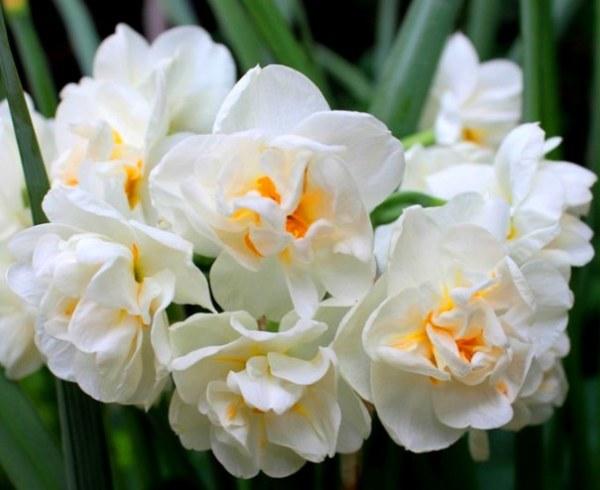
White subspecies
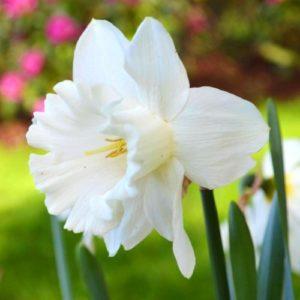
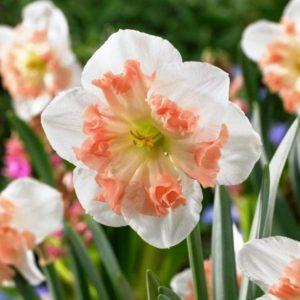
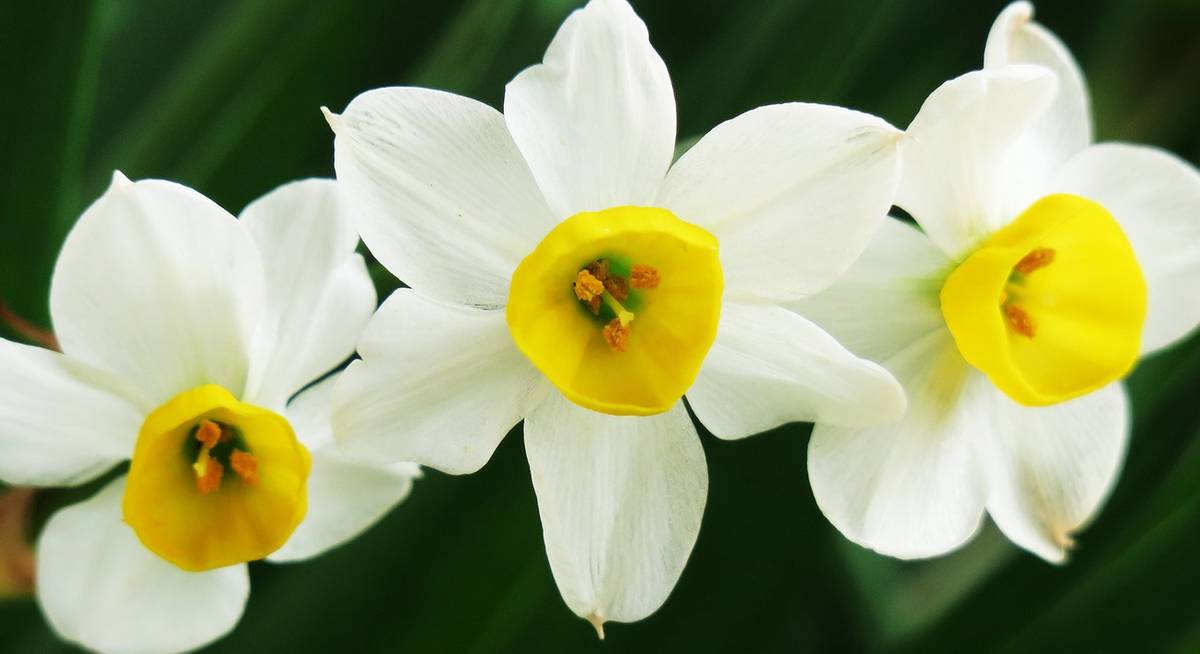
White Cheerfulness daffodils produce 3-5 buds on a single stem. The stem reaches 0.4 meters in height. The perianth is 6 centimeters in diameter. A yellow corona is located in the center of the snow-white corolla. The flowers emit a strong and pleasant fragrance.
Yellow subspecies
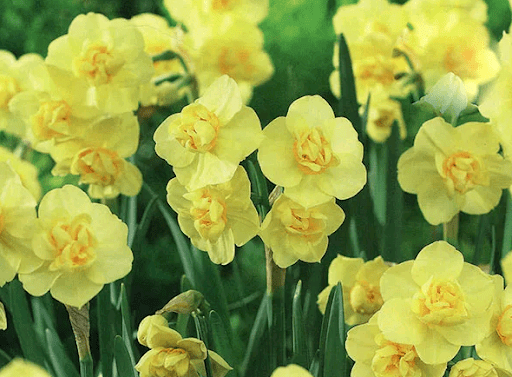
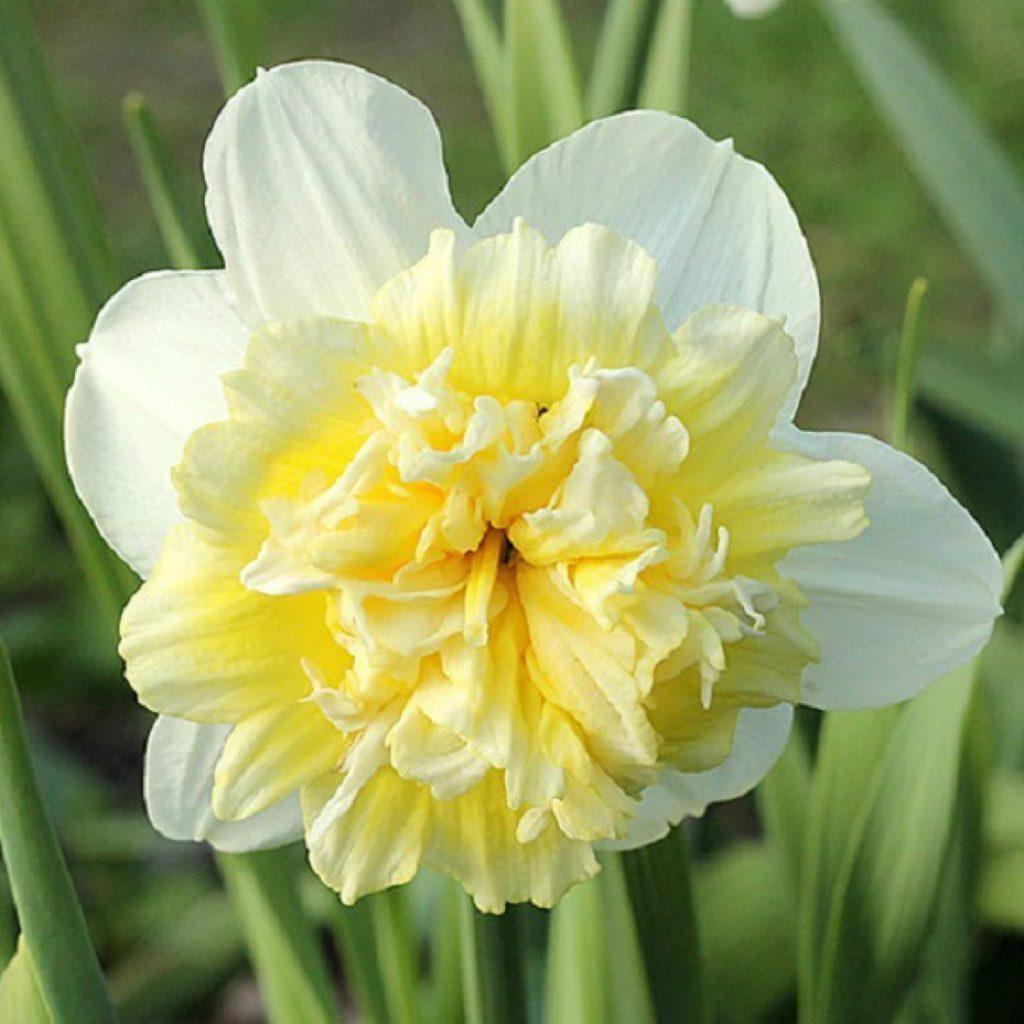
Yellow Cheerfulness blooms in April. Pale yellow, double, six-centimeter-long sepals, 2-5 in number, adorn each stem. Yellow Cheerfulness's solid-colored petals vary in shape: the outer ones are large and curved downwards; the inner ones are small and curled into a tube.
Examples in landscape design
Medium-sized plants with large, fragrant flowers combine well in color with other types of flowers that bloom in mid-spring:
- erythroniums;
- anemones;
- hyacinths.
Narcissus Cheerfulness can be used to decorate:
- curbs;
- flower beds;
- mixborders;
- rock gardens;
- rock gardens.
The flower looks good in flower beds and lawns.
Planting Narcissus Cheerfulness
Double-flowered daffodils prefer flat, well-lit sites. Bulbous plants grow poorly in clay or sandy soils or with a high water table (closer than 50 centimeters from the ground surface). The soil should be loose, humus-rich, and neutral. After planting the bulbs in an open area, the soil should be well-moistened. In autumn, cover the plants with a layer of peat/humus up to 3 centimeters thick. With the onset of frost, cover the daffodils with additional leaf or straw matting. Cheerfulness grows in one location for up to 6 years, after which it requires replanting.
To obtain planting material (babies), daffodils are replanted every autumn.
Preparing the site and bulbs
The area for growing daffodils is prepared in the spring. Two to three weeks before planting, the site is dug to maximum depth. Humus or compost (1-2 buckets per square meter), nitrogen fertilizers, and superphosphate (30 grams per square meter) are added with a spade. Clay soil is structured with sand and peat. The acidity is reduced by adding chalk or dolomite flour.
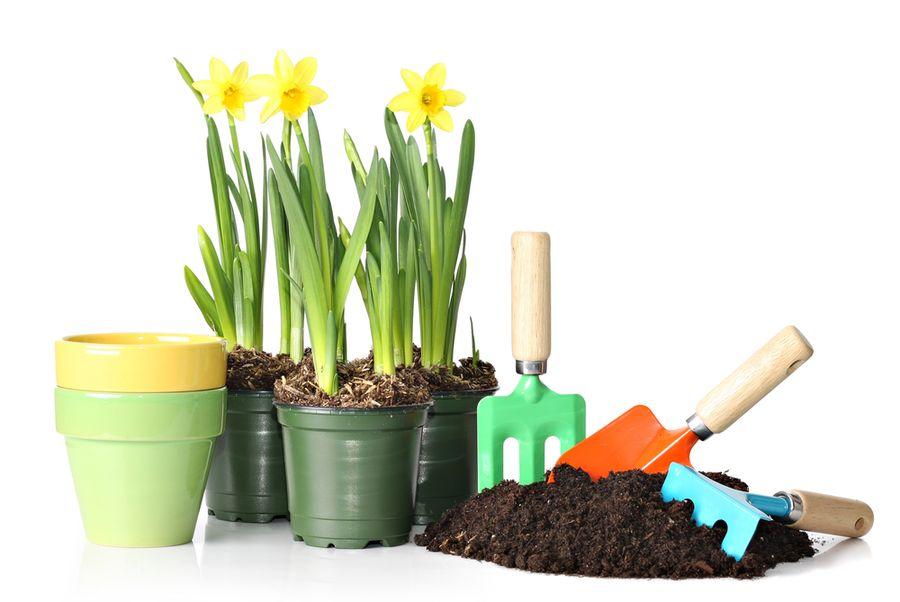
Planting material is prepared the previous summer. The bulbs are dug up in July, after the above-ground portion has dried. Cleaned and washed, the bulbs are dried on mesh trays at 20-25°C (68-77°F) for two weeks in a ventilated area. The conditions necessary for maintaining the bulbs' viability are 17-20°C (63-68°F) and 80% humidity.
Before planting in the ground, it is recommended to treat the bulbs with a disinfectant (manganese solution, Fitosporin) and soak them in a growth stimulator solution (Zircon).
Planting dates and patterns
Daffodil bulbs are planted in their permanent location in late summer, early fall, or spring. When planting in the fall, allow at least two weeks between planting and the first frost. This period is ideal for rooting. Daffodils planted just before frost will produce flower stalks within a year.
The depth of the hole depends on the type of soil and the size of the bulb:
- For large bulbs:
- 12 centimeter deepening in clay soils;
- 13-15 centimeters in loams;
- 17 centimeters in sandy loam.
- For small bulbs and babies, the planting hole should not exceed 10 centimeters.
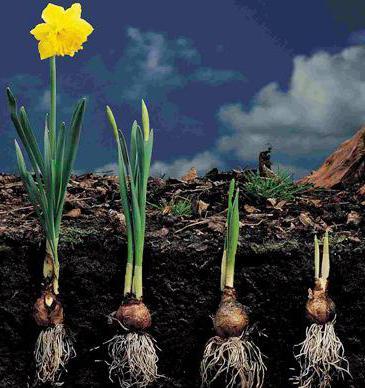
A 2-centimeter layer of river sand is placed at the bottom of the hole for drainage. The distance between the bulbs is 7 to 15 centimeters. The denser the planting, the larger the flowers will be. Planting them more widely will result in more bulblets.
Care instructions
Daffodils are easy-to-grow ornamental plants that don't require much time or effort to grow. Once the weather warms up and the snow melts, remove the protective cover from the daffodil plot. If the bulbs aren't dug up at the end of the growing season, remove any dried stems and leaves. Loosen and level the soil to prevent ground pests from reaching the bulbs.
Watering and fertilizing
Daffodils are fed with mineral fertilizers at least 3 times during the growing season:
- for the growth of flower stalks;
- support of budding;
- strengthening the bulbs.

In the spring, nitrogen fertilizers should predominate. Phosphorus is essential for bud formation and flower retention. Potassium is essential for bulb nutrition. Daffodils require watering, especially during flowering, hot and dry summer weather, and bulb formation. The greatest need for moisture occurs in August, when the bulb begins to develop the future shoot. The soil should be moistened four times over a period of 30 days.
Loosening the soil
Maintaining loose soil and removing weeds is necessary throughout the growing season: from April to mid-September.
Protection from insects and diseases
Unfavorable weather conditions, poor soil conditions, and improper storage of planting material are the main causes of daffodil diseases. Fusarium is a fungal infection of bulbs that causes rot, starting from the bottom. The pathogen is activated by dry and hot weather, which increases soil temperature, as well as storing bulbs at humidity levels below 70% and temperatures above 25°C. Symptoms of infection include stunted flower stalk growth, premature yellowing, and leaf dieback. Diseased plants are removed and destroyed.
The main methods of control are prevention:
- compliance with storage conditions;
- sorting bulbs before planting;
- transplanting healthy bulbs to another location;
- early digging of bulbs.
Gray mold is a fungal disease of bulbs that develops in damp and cool weather on heavy soils with an excess of nitrogen fertilizers.
Characteristic features:
- the appearance of mycelium on the bulbs;
- leaf rot;
- dwarfism and curvature of peduncles.
If diseased plants are discovered, they are removed and burned. Healthy daffodils are sprayed with Fundazole. Preventative measures include replanting the bulbs in lighter soil and treating the planting material with Fundazole. Mosaic: a viral disease of daffodils, identified by the appearance of light green spots and streaks on the leaves. Diseased plants are dug up and burned.
The most dangerous pests are nematodes, which damage the roots, bulbs, and stems of daffodils, as well as the narcissus fly. To prevent and control them, insecticides and copper sulfate are used.
Transfer
Plants can be kept in lawns and rock gardens for 5-6 years without replanting. To control bulb growth, they are planted deeper. To obtain the maximum possible number of bulbs, replant them annually.
Preparing for winter
In regions with cold winters, plantings are covered with insulating materials once temperatures drop steadily below freezing. Peat, straw, and spruce branches can be used as insulation.
Difficulties in growing
The Cheerfulness variety tolerates temperatures down to -17°C (-17°F) without additional cover, provided the snow cover exceeds 5 centimeters (2 inches). In winters with little snow and frost, overwintering daffodils require insulation. The climatic conditions of central Russia and Siberia create problems for growing ornamental hybrids, as there are no uniform agricultural practices.
Feedback from our readers
Valentina, Rostov-on-Don: "In my opinion, double daffodils are the most attractive of all daffodils. I've been growing White Cheerfulness at home for three years now, and every spring I rejoice at its first buds." Svetlana, Moscow: "A wonderful variety. Suitable for bouquets, flower beds, and hanging pots. Large flowers, with a strong yet pleasant fragrance."
Related posts:
 Planting and caring for daffodils in open ground, the best time and growing rules
 Description and characteristics of the Dick Wilden daffodil variety, planting and care instructions
 Description of the double daffodil Rosie Cloud variety, planting and care instructions
 Description and characteristics of the Calgary daffodil variety, planting and care instructions
 When and when can daffodils be repotted? Step-by-step instructions and care.
 Description of shallot varieties, cultivation and care, when to harvest
 Description and characteristics of the Pink Charm daffodil variety, planting and care instructions
 Characteristics and descriptions of the most beautiful types of daffodils, names of the best varieties