
- Why replant daffodils?
- Transplant timing
- In the fall
- In summer, after flowering
- In the spring
- Step-by-step instructions and nuances of the procedure
- Dividing daffodils
- Planting daffodils in open ground
- Transplanting a plant into a pot
- When you shouldn't replant a flower
- Further care
- Common mistakes and tips for beginning gardeners
When it comes to plants that impress with both their simplicity and beauty, the daffodil takes the cake. Caring for it isn't particularly difficult, but certain guidelines still need to be followed. Let's explore the key nuances of replanting vibrant daffodils and their subsequent care. What mistakes do inexperienced gardeners often make when working with these flowers?
Why replant daffodils?
Daffodils can coexist peacefully in the same garden bed with other flowers for several years, delighting the gardener with abundant blooms. So why transplant them at all? The following factors indicate that yellow flowers need repotting:
- daffodils are not blooming well;
- the number of flowers exceeds the area allocated to them;
- the appearance of dense thickets;
- reduction of the flowering period.
Note: Daffodils can remain in a garden bed or flowerbed for about 4-5 years without replanting. However, if the gardener has noted at least one of the factors listed above, replanting can be done sooner.
Transplant timing
Daffodils can be repotted at any time of year except winter. However, when choosing the right time to repot, it's important to consider a few nuances.
In the fall
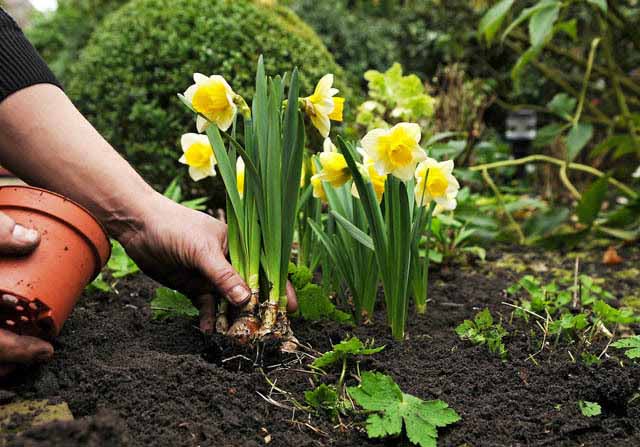
Daffodil bulbs can be planted in the fall so they can establish roots before frost but before sprouting. The best time is mid-August to mid-September. Prepare a hole 2-3 cm in diameter and 3-5 cm deep for the seedlings. It is recommended to add fine sand mixed with ash (3:1) and 1 teaspoon of mineral fertilizer to each hole. Water the holes thoroughly, and then plant the bulbs. For the winter, it is best to cover the plants with peat or fallen leaves.
In summer, after flowering
Many gardeners believe that the best time to plant flowers is late summer. Since daffodils are easy to grow, they can be replanted even during flowering, but it's best to wait until after flowering. The bulbs are planted in thoroughly dug soil, pre-amended with organic and mineral mixtures. The holes should be 12-17 cm deep, or 9-10 cm deep for heavy soil. It's best to plant the bulbs in groups or asymmetrically.
Transplanted plants are watered with water (preferably water that has been left to stand in the sun).
In the spring
Transplanting in spring is not much different from the same procedure performed in the fall. Generally, spring planting is used when transplanting in the fall was unsuccessful. The bulbs are transplanted into a pre-dug area with holes no more than 10 cm deep. It is recommended to fertilize the soil additionally (it's best to begin this in the fall).
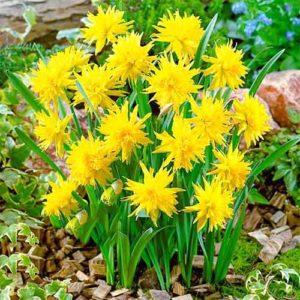
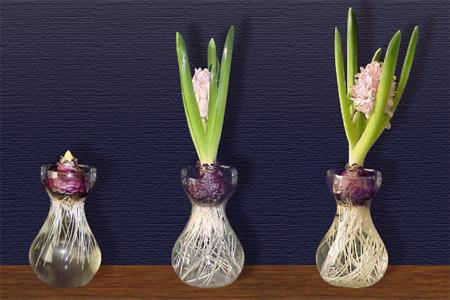
Advice: It's not recommended to plant blooming daffodils in the spring—there's a high risk of the flowers dying and the leaves turning yellow and wilting.
Step-by-step instructions and nuances of the procedure
So, the gardener has decided on the repotting time. Now it's time to learn the procedure for repotting the bulbs and how to care for the daffodils after repotting.
Dividing daffodils
Separating daughter bulbs from mother bulbs is a simple, but painstaking, task. You'll need a small shovel for the job. Here are the steps:
- Dig around the bush and carefully remove it from the soil (it's very important not to damage the bulbs). When working with daffodils, avoid any damaging actions.
- The family, freed from the soil, is shaken a little and the remaining soil is removed with a soft brush.
- Only those bulbs that separate easily need to be separated. If the babies are firmly attached to the mother bulb, there's no need to separate them. These bulbs need time to ripen in the sun, after which they will separate naturally.
- The fracture sites of separated babies are treated with special disinfectants. Crushed activated charcoal tablets or wood ash powder are suitable for this purpose.
- The selected material is soaked for half an hour in a weak solution of potassium permanganate. After this, the bulbs are allowed to dry for several hours.
The bulbs are stored until autumn or immediately planted in the ground.
Planting daffodils in open ground
You can transplant daffodils into open ground as follows:
- The area is carefully dug, shallow holes are made, and the planting area is watered thoroughly. The holes should be 10-15 cm deep (the looser the soil, the deeper the holes should be).
- Three bulbs are planted in each hole. The distance between the bulbs should be 8-10 cm. If you are planting different varieties of daffodils, you will need to increase the spacing—as the bulbs grow, they may become mixed.
- The planted plants are watered well and finally mulched with rotted sawdust or humus.
Transplanting a plant into a pot
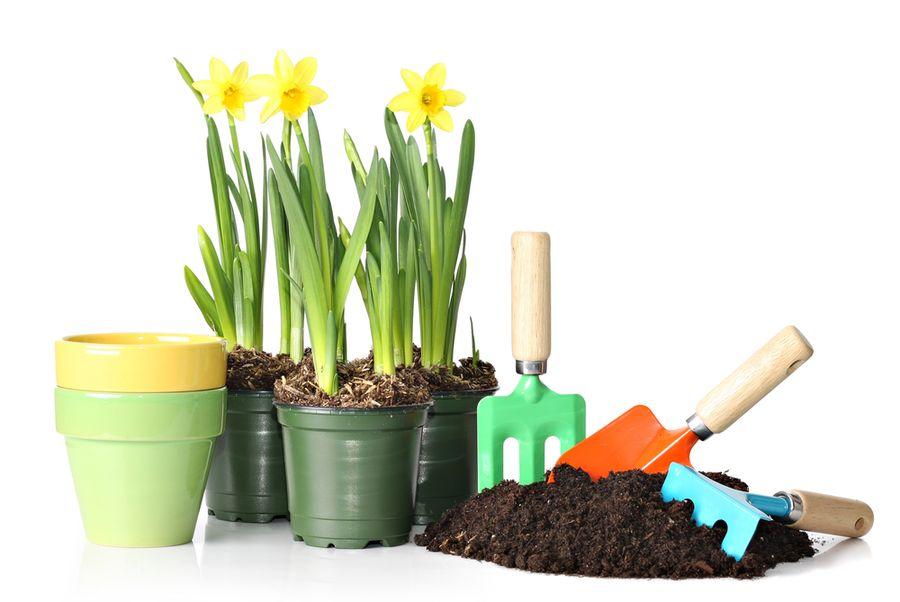
For daffodils that will be kept in a pot, there are specific rules for replanting:
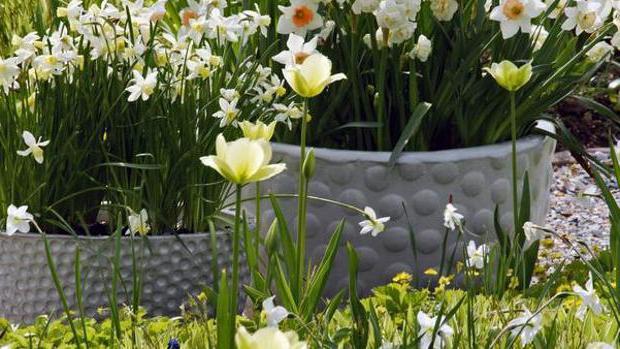
- Pot. Narcissus roots need room to grow and propagate. Therefore, the chosen container or pot should be at least 30 cm high and 15-20 cm wide. If you're planting smaller varieties of daffodils that don't grow taller than 15 cm, smaller containers are suitable. The container should be deep enough, but too much space can damage the plant, delaying its flowering. The repotting container can be made of wood, glass, or ceramic.
- Soil. It should be loose, soft, and not lumpy. It's helpful to dilute regular soil with dry clay and sand, adding wood ash, sawdust, and mineral fertilizers.
- Location. Once planted, daffodils should be kept away from other plants that can damage the yellow flower with the toxins they produce. Daffodils thrive in a slightly shaded or sunny location, but direct sunlight should be avoided.
- Temperature. After planting, daffodils benefit from a cold treatment at 3-9°C (during the first few days of bulb adaptation) and 10-12°C (during flowering). During the rest of the growing season, temperatures should not exceed 15-18°C.
- Humidity: It should be at least 70%. Daffodils should not be placed near heating appliances.
Stages of planting daffodils in a pot:
- A drainage layer about 2 cm thick (can consist of expanded clay or pebbles) is placed into the container.
- The bulbs are placed into the drainage, pressing them down with the roots and leaving a small distance between the bulbs.
- The top of each bulb should be one-third of the way out of the ground.
- The soil is lightly watered (avoiding contact with the roots). Mulch the top with sawdust or fallen leaves. Daffodils are watered regularly until seedlings emerge.
- Three bulbs, each 1 cm in diameter, are planted in a pot 10 cm in diameter.
When you shouldn't replant a flower
Although daffodils are the least capricious garden plants, there are certain periods when they should not be repotted:
- in spring, during flowering (replanting may lead to the death of the bulb);
- in June-July (flowers planted during this period encounter frosts at an unsuitable stage of development);
- late autumn (during this period the plants are in a state of dormancy, which is not recommended to be disturbed).
Further care
After planting, daffodils require some care. This includes:
- Fertilizer. Complex mineral fertilizers are good during the budding period. They can be purchased ready-made at a specialty store, or you can make your own. Dissolve potassium sulfate, superphosphate, and urea (1 teaspoon each) in 10 liters of water. Spread the solution over the soil at a rate of 5 liters per square meter. During the active flowering period, it's best to provide a fertilizer containing nitrogen, phosphorus, and potassium. To prepare the mixture, add 2 teaspoons of Agricol and 1 teaspoon of nitroammophoska to a bucket of water.
- Moderate watering. Consider the region here—in the south, rain can be absent for long periods, so it's important to water daffodils without allowing them to dry out. It's equally important to avoid overwatering the bulbs, as this can cause them to rot. In the central and northern regions of the country, daffodils usually thrive on natural moisture. They should be watered only during prolonged periods without rain.
- Weeding. Daffodils need protection from weeds. Weeds steal nutrients from the soil and can cause various plant diseases. Weeds should be removed from the flowerbed. Also, loosen the soil after each watering. This will improve nutrient absorption and allow the roots to breathe.
- Disease prevention. The most dangerous enemies of daffodils are considered to be soil bacteria and fungi (for example, gray mold, fusarium wilt, and bacterial scab). Diseases are best treated in the early stages. For example, with fusarium wilt, the plant's roots become covered with brown spots. The bulbs should be immersed in a 1% formalin solution for 6 hours and then sprinkled with Fundazol. Gray mold leaves spots on the stems and leaves, causing buds to wilt. It can be eliminated by spraying the plant with a 1% Bordeaux mixture. To combat bacterial scab (which leaves reddish, glossy spots on the bulb), remove all spots and sprinkle the cut surfaces with crushed charcoal.
Common mistakes and tips for beginning gardeners
The following recommendations will help novice gardeners avoid mistakes when replanting and caring for daffodils:
- The bulb's readiness for transplanting can be determined by its appearance and the condition of its leaves. Under no circumstances is it recommended to cut the bulb immediately after flowering has finished.
- Don't put off digging up the bulbs for too long. If the plant's leaves turn completely yellow, locating the bulbs in the soil without causing further damage will be difficult.
- Collected planting material should be stored in a cool place, at a temperature no higher than 18 degrees Celsius. Otherwise, the bulbs may begin to sprout.
Do not store bulbs in plastic bags. This will cause rotting not only of the individual bulbs but of the entire contents of the bag.
Related posts:
 Planting and caring for daffodils in open ground, the best time and growing rules
 Characteristics and descriptions of the most beautiful types of daffodils, names of the best varieties
 Description and characteristics of the Dick Wilden daffodil variety, planting and care instructions
 Descriptions of the best and most beautiful varieties of daffodils, ratings and selection tips
 Description and characteristics of the Cheerfulness daffodil variety, planting and care instructions
 Description and characteristics of the Calgary daffodil variety, planting and care instructions
 Do daffodils need to be dug up every year and when should they be done? Care instructions
 Description and characteristics of the Kum Laud narcissus variety, planting and care instructions