
- Selection and description of the variety
- Pros and cons of Pink Charm daffodil
- Examples in landscape design
- Planting and caring for the plant
- Preparatory stage
- Planting dates and patterns
- Watering rules
- Flower feeding
- Loosening and weeding the soil
- Protection from pests and diseases
- Breeding methods
- Difficulties in growing
- Gardeners' reviews of the variety
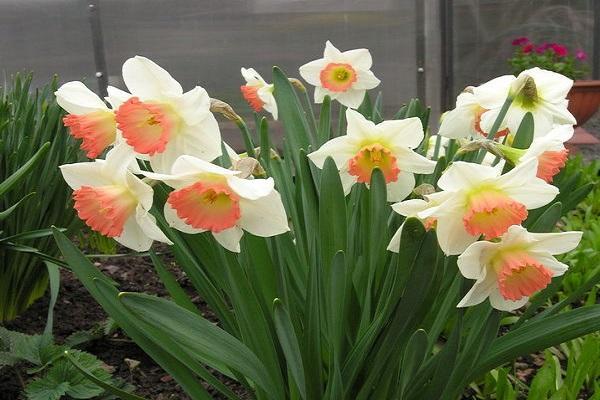
Among the stunning variety of ornamental bulbous plants, Pink Charm daffodil is one of the most popular. This graceful, elegant, and easy-to-care-for flower will appeal to novice gardeners. The distinctive feature of Pink Charm daffodil is the combination of snow-white petals and a large, delicate pink crown, making the flowerbed appear brighter than with other varieties.
Selection and description of the variety
The Pink Charm variety was developed by Australian breeders. Pink Charm is a large-crowned daffodil. This variety produces single flowers, the crowns of which are shorter than the petals, but make up at least a third of their length.
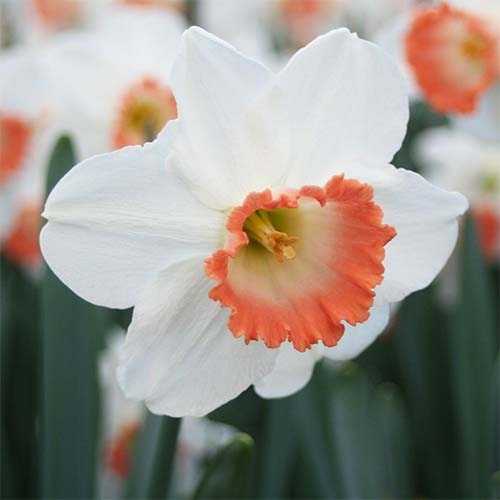
Pink Charm is a short daffodil, growing to 40 cm. The flower is large, reaching 12 cm in diameter, and exudes a light fragrance. The petals are wide, symmetrical, overlapping each other considerably, surrounding a beautiful pink corona with distinctively ruffled edges. The throat is pale pink, with a green center. The flower is perpendicular to the stem.
The plant is perennial and develops fully for five years without the need for repotting. Flowering occurs in April and May and lasts for about three weeks.
Narcissus Charm is frost-resistant, easily withstanding temperatures down to -25°C, is not affected by sudden temperature fluctuations, and is suitable for growing in various climatic zones.
Pros and cons of Pink Charm daffodil
The Pink Charm variety is valued by gardeners because it has many advantages:
- frost resistance;
- brightness and splendor of flowering;
- various applications in landscape design;
- unpretentiousness in care;
- can be used for making bouquets;
- long stay in one place without the need to change trains.
The Pink Charm variety has few disadvantages:
- susceptibility to putrefactive infections;
- the possibility of reproduction only by vegetative means.
Examples in landscape design
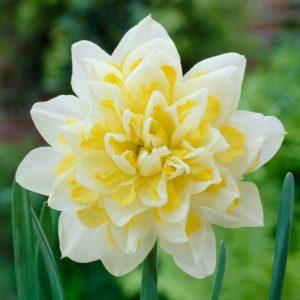
Pink Charm is an early-blooming variety used for spring landscaping. It looks harmonious in both single and group arrangements. Pink Charm looks wonderful in flowerbeds and borders, and it can be planted in individual patches on lawns and near shrubs. Daffodils are ideal for creating "streams" in rock gardens and along garden paths. Because Charm daffodils are short, they are best planted in the foreground when creating arrangements.
Planting and caring for the plant
Daffodils prefer a moderately sunny, well-drained site away from strong winds. The Pink variety tolerates any soil—from loamy to sandy loam—as long as it's fertile, moisture-retentive, and breathable. The preferred soil pH is 7.
Preparatory stage
First, you need to prepare the soil on the site. If it's heavy and clayey, add peat moss and half a bucket of sand per square meter.2, dig it up. And if it's sandy, then add black soil at a rate of 15 kg per 1 m2They also enrich the soil with a mineral complex.
To reduce soil acidity, lime or ash is added, and alkaline soil is neutralized with dolomite flour, taken in the amount of 3 cups per 1 m2.
Pink Charm daffodils grow well in raised beds. To create them, prepare the soil by mixing black soil, peat, river sand, and rotted manure. The resulting mixture is used to create raised beds. Add mineral fertilizer: one tablespoon of potassium per 1 m2.2, the same amount of phosphorus.
Next, prepare the bulbs for planting. They should be medium-sized, about 6 cm in diameter, heavy, with a smooth surface, and free from signs of infection or pests. Prior to planting, the selected bulbs are stored in a fabric bag filled with perlite. Before planting, they are treated with a fungicide solution.

Planting dates and patterns
The optimal time for planting the Pink Charm perennial is August and early September. This period allows the bulbs to root before the fall frosts. Pink daffodil bulbs are planted 15-20 cm deep, with 10-12 cm between plants.
After planting, the soil is mulched to prevent the plants from freezing. A mixture of peat and humus is used as mulch. After the autumn frosts, the beds are further covered with straw and fallen leaves, and in the spring, the thick layer of mulch is removed to prevent it from interfering with the bulbs' germination.
Watering rules
If the winter was snowless, daffodils will need to be watered frequently and generously in the spring. Watering should be done regularly from the beginning of the active growing season, but even after flowering, the plants require plenty of moisture to ensure proper bulb propagation.

Flower feeding
During the growing season of Pink daffodils, several additional feedings are carried out:
- The first feeding is done when the bulb begins to grow and produce new foliage. Use a complete fertilizer for bulbous plants according to the instructions.
- The second feeding is done during the budding phase. Use a superphosphate solution, add a potassium supplement, and urea at a rate of one tablespoon per bucket of water.
- The third feeding is done after flowering has finished, to encourage the mother bulb to produce offspring. Use a potassium-phosphorus mixture or a store-bought fertilizer with a similar composition.
Loosening and weeding the soil
The soil is loosened after each watering to prevent a crust from forming, which would prevent the plants from receiving oxygen. Weeds are removed regularly, otherwise they will rob the daffodils of moisture and nutrients. Mulching is used to reduce the likelihood of weeds appearing in flower beds.

Protection from pests and diseases
Pink Charm, like other daffodil varieties, is susceptible to blight, fusarium, nematodes, narcissus flies, onion hoverflies, slugs, and root mites. The plant loses its immunity if improperly cared for.
To prevent diseases, Charm daffodils are treated twice per season:
- Before the bud formation phase, insecticides and acaricides are used according to the instructions.
- After flowering, treat with copper sulfate. Use 100 g of solution per 10-liter bucket of water. The recommended dosage is 10 m3.2 – 2 l. You can also use the fungicide Hom, take 40 g per 10 l of water.
Breeding methods
The Pink Charm variety is propagated exclusively vegetatively. One mother bulb produces up to four bulblets, which can be separated as early as the second year.
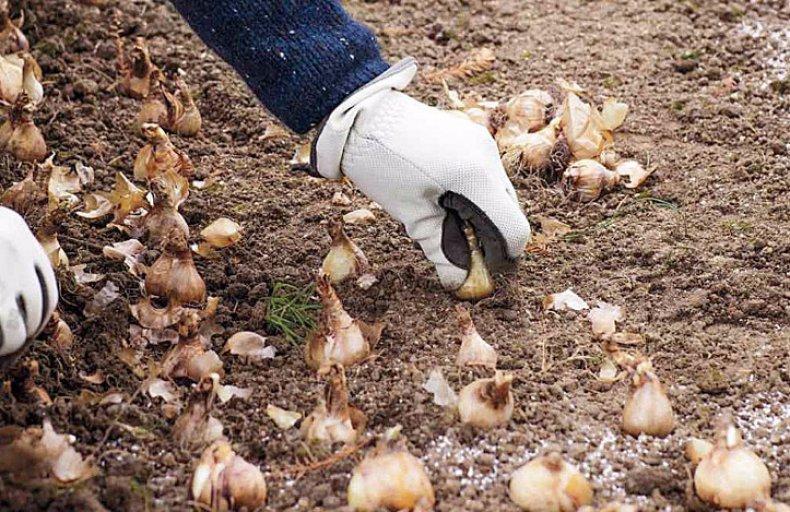
To artificially stimulate division of the bulb, make a shallow cut and store it in a cool, ventilated area. After 2-3 months, the bulb will produce shoots. The following season, the bulb can be planted in the ground along with the shoots. A year later, the shoots are separated.
Difficulties in growing
Pink Charm daffodils are easy to grow, but some rules should be followed to ensure the plants remain healthy and bloom profusely:
- The ideal lighting for Charm daffodils is the delicate partial shade created by tall trees. Direct sunlight will burn the foliage, and daffodils bloom poorly in the shade.
- Pink Charm should not be planted after other varieties of daffodils and bulbous plants.
- Daffodils shouldn't be planted where the groundwater is close to the surface. Excess moisture will cause the roots to rot and the plants to become diseased.
- Don't fertilize daffodils with fresh organic matter. It will burn the roots.
- After 4-5 years, Pink Charm daffodils must be repotted, otherwise they will produce small and sparse flowers, or even stop blooming altogether.
- The planted Pink variety acclimatizes within 1-2 years, during which time it flowers sparingly. Normal flowering only returns after two years.

Gardeners' reviews of the variety
Nina, 44, Saratov: "I have several varieties of daffodils growing near my house, but I consider Pink my best choice. It's easy to grow and blooms profusely. My flowerbed is a luxurious blanket of pink and white."
Alexandra, 38, Belgorod: "Daffodils are my favorite flowers. And they're really easy to grow. Pink Charm ones are especially beautiful, brightening up the spring mood and smelling wonderful. I cut them and put them in a vase at home."
Victor, 62, Moscow region: "My wife and I have been growing flowers for several years now. Last year, I bought pink 'Charm' daffodils. A year later, I received gorgeous, large blooms. They look presentable and are suitable for both sale and gifts."
Related posts:
 Description and characteristics of the Pink Paradise F1 tomato variety, yield and cultivation
 Description and characteristics of the Pink Wonder daffodil variety, planting and care
 Planting and caring for daffodils in open ground, the best time and growing rules
 Description and characteristics of the Dick Wilden daffodil variety, planting and care instructions
 Characteristics and descriptions of the most beautiful types of daffodils, names of the best varieties
 Description of the pink tomato Pink Impression and similar hybrids
 Description of the Elematis Pink Fantasy variety and pruning group, planting and care
 Description and characteristics of the Cheerfulness daffodil variety, planting and care instructions