
- What are the benefits of sea buckthorn: why is it worth growing?
- Habitat
- Features of flowering and fruiting of the crop
- What is needed for growing
- Climate conditions
- Location and illumination of the site
- Suitable soil
- Favorable and unfavorable neighbors
- How to choose a plant for planting
- How to distinguish male from female sea buckthorn
- Landing rules
- Deadlines
- Preparing the site and planting hole
- Technology and schemes for planting seedlings
- We organize competent care
- Watering
- Fertilizer
- Loosening, weeding, mulching
- Trimming
- Preparing the tree for winter
- Diseases and pests: treatment and prevention
- Endomycosis
- Gray and brown rot
- Stegmina (scab)
- Blackleg
- Black crayfish
- Moth
- Fly
- Aphid
- Gall mite
- Reproduction
Gardeners value sea buckthorn for its high yield, early maturity, consistent fruiting, undemanding growing conditions, and the unique value of its fruits. The plant is cultivated both as a fruit tree and as an ornamental plant for creating beautiful hedges. Growing sea buckthorn is easy; the key is to know how to plant it correctly and properly care for it in the open ground.
What are the benefits of sea buckthorn: why is it worth growing?
Sea buckthorn is a plant belonging to the Elaeagnaceae family. It is a tree or shrub up to 10 meters tall with a thorny trunk, elongated foliage, and medicinal fruits that are widely used in medicine, cosmetology, and by traditional healers and culinary practitioners.
The health benefits of berries stem from their chemical composition, making them invaluable in the treatment and prevention of various illnesses. Their use has been associated with improved health and rapid recovery, as:
- strengthen the immune system, increasing the body's resistance to colds and various types of infections;
- stimulate the work of the heart and blood vessels;
- lower the level of bad cholesterol in the blood;
- activate metabolism, optimize the activity of the intestines and digestive system;
- slow down the aging process;
- improve mood and calm the nervous system, stimulating brain function.
This range of beneficial properties makes sea buckthorn berries indispensable in the diet, as well as in the home medicine cabinet.
Habitat
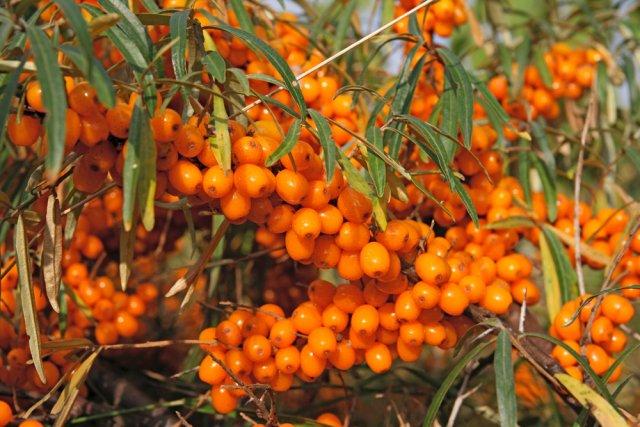
Sea buckthorn adorns sandy and pebble riverbanks and grows on mountain slopes, forming dense thickets. This plant can be found in Transbaikalia, Central Asia, the Caucasus, the USA, and Canada. It has also become established in the Moscow region and central Russia. Sea buckthorn is planted in the southern forest and steppe zones of Siberia.
Features of flowering and fruiting of the crop
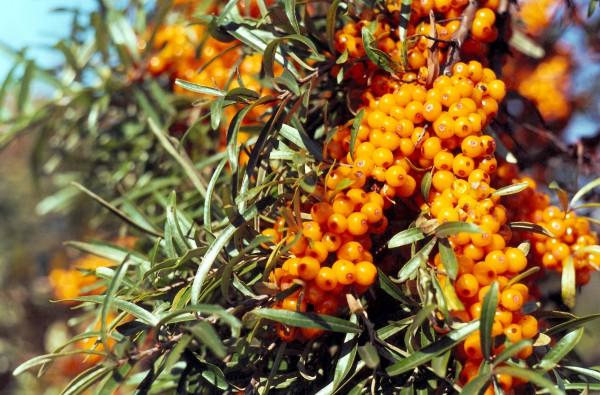
Sea buckthorn forms buds on the current year's growth. It blooms in April or May. The flowers form along with the foliage. The plant's fruit is a juicy drupe, orange or reddish in color, with a brown stone with a longitudinal stripe.
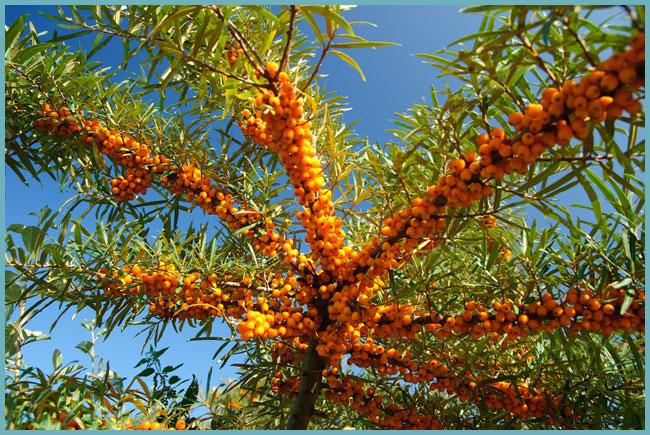
The berries ripen in August-September and are cylindrical in shape and orange-red or brown in color. The medicinal fruits have a bitter-sour taste and a distinctive aroma.
The crop begins to bear fruit at the age of 4-6 years.
What is needed for growing
To ensure that sea buckthorn grows and bears fruit normally in open ground, it is necessary to satisfy the plant's biological requirements for growing conditions whenever possible.
Climate conditions
Sea buckthorn grows in a wide range of climates, from Asia to Siberia. The plant is resistant to severe frosts and is also adapted to drought thanks to its robust root system.
Location and illumination of the site
Sea buckthorn is a sun-loving plant, so it should be planted in a sunny location. Shade slows growth and reduces yields. It should also be protected from strong winds, which are harmful to it. The plant thrives on the southern edge of the plot, along fences and buildings.
Suitable soil
Sea buckthorn prefers neutral, alkaline soil. Avoid planting it close to the groundwater table. Acidic soils are best limed with slaked lime, while heavy loamy soils should be mixed with sand, humus, and supplemented with substances such as superphosphate and potassium salt to improve air permeability.
Favorable and unfavorable neighbors
Medicinal herbs such as chamomile and oregano are considered good neighbors for sea buckthorn. This berry crop does not thrive with raspberries, black currants, and strawberries, as the plants' roots are at the same level in the soil and will compete for moisture and nutrients. Solanaceae plants are undesirable neighbors for sea buckthorn.
How to choose a plant for planting
The plant seedlings should be 50 cm high, 5-7 cm in diameter, have 5-8 skeletal roots, and be free from damage and disease.
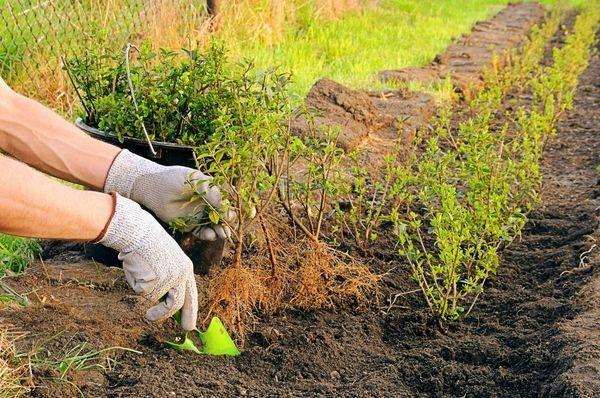 To obtain varietal material for planting, select a grafted seedling. Sea buckthorn grown from seed or root suckers does not inherit the characteristics of the parent plant.
How to distinguish male from female sea buckthorn
Sea buckthorn is a dioecious tree, divided into male (staminate) flowers, which do not produce fruit but serve for pollination, and female (pistillate) flowers, which produce fruit. Without male sea buckthorn, there will be no berries, so the bushes must be planted close together, as they are pollinated by the wind. One male plant for every 5-7 female seedlings is sufficient.
Knowing the biological characteristics of sea buckthorn will allow you to correctly identify the sex of the plant:
- Female specimens have small double buds, while male specimens have large buds covered with 3-5 scales.
- The foliage varies in shape and color. Female sea buckthorn has green, concave, trough-shaped leaves, while male trees have smooth, glaucous leaves with a prominent central vein.
- Male seedlings are larger than female ones.
Using these tips, you can easily distinguish female sea buckthorn bushes from male plants.
Landing rules
By following general planting guidelines, you can grow sea buckthorn and reap a harvest of its medicinal berries. To do this, determine the planting time, properly prepare the site and planting hole, learn the technique, and know the planting pattern for sea buckthorn seedlings.
Deadlines
Sea buckthorn is recommended for planting in summer and spring, in late March or early April. Planting at this time will allow the plant to adapt to the conditions and gain strength before the cold weather sets in.
For sea buckthorn seedlings in a closed system, autumn planting is optimal. This period ranges from late September to October. Planting should be done after the leaves have fallen, allowing the young plant to devote its energy to establishing itself in its new location rather than to the natural process.
Preparing the site and planting hole
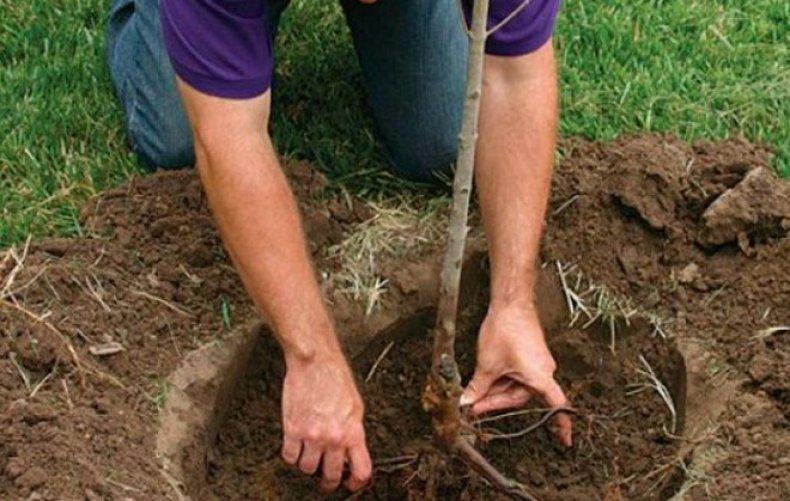
Site preparation involves digging the soil and removing the rhizomes of perennial weeds. Also, dig a planting hole measuring 50 x 60 x 50 cm in advance and add compost, humus, and mineral fertilizer.
If the soil is acidic, add lime or ash.
If you have heavy loamy soil, be sure to place drainage at the bottom of the hole and enrich the soil with fertilizers such as sand and peat.
Technology and schemes for planting seedlings
Even a novice gardener can easily plant sea buckthorn. Planting the plant in the garden involves the following steps:
- At the bottom of the prepared hole, form a mound by filling the hole 1/3 full with soil mixture.
- Place the young seedling on the mound, carefully spreading the roots, and cover it with soil, compacting it slightly. Deepen the root collar by 5-7 cm to encourage additional root growth.
- Place a wooden stake nearby for reliable support and tie the seedling to it.
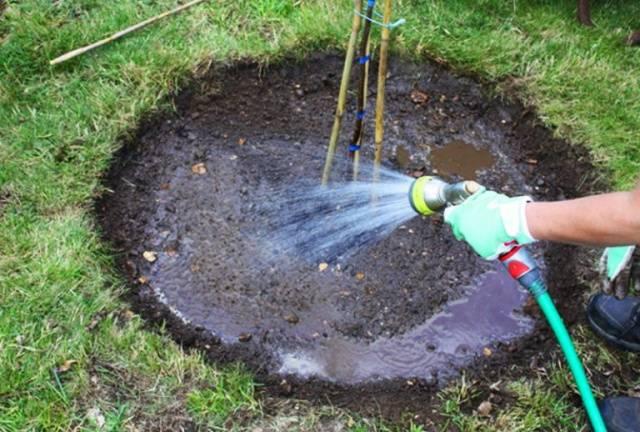
- Water at the rate of 2 buckets of water per plant.
- Mulch the soil around the plant trunk using sawdust and peat.
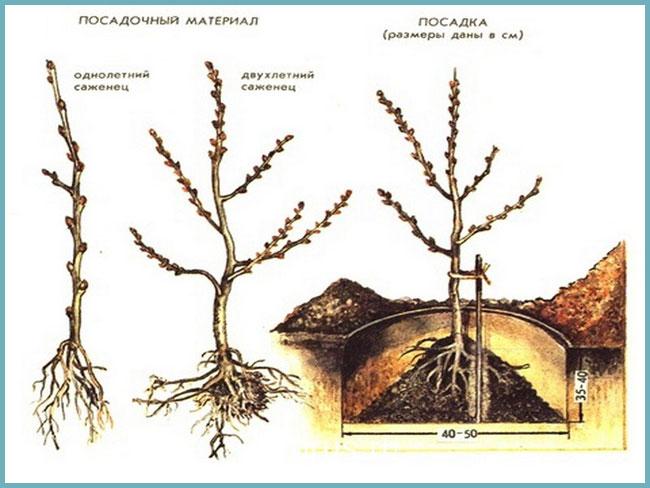
To ensure that seedlings take root in your garden, you need to water them at least once a week for 1-2 months.
Important! When planting sea buckthorn, maintain a distance of 2.5 m between trees and up to 4 m between rows.
We organize competent care
To grow a healthy, strong tree that yields a bountiful harvest of medicinal berries, it requires proper care. Cultivation practices should include a range of measures aimed at ensuring the plant's survival after planting and creating favorable growing conditions.
Watering
Sea buckthorn's high yield depends on irrigation. The plant's moisture requirements increase just before flowering and during fruit formation and development. During the dry season, frequent watering is necessary. At harvest time, it is recommended to thoroughly water the plant and rinse the fruit on the branches.
The water consumption rate for young non-fruit-bearing trees is 8-12 liters, for fruit-bearing plants 12-15 liters.
Fertilizer
Sea buckthorn requires no fertilizer or supplements; its long roots provide its own nutrients. For best growth, in the second year after planting, in March and in early June, feed with nitrogen, using 15 g of urea or 20 g of ammonium nitrate per square meter. In the third or fourth year, fertilize the plant in the fall with phosphorus and potassium.
Loosening, weeding, mulching
Loosen the soil carefully to avoid damaging the roots. Damaging the root system will weaken the berry plant and encourage the growth of numerous root suckers. Weeds should be removed by mowing, not by pulling them out. Timely mulching will retain moisture, provide the plant with additional nutrition, and prevent pest larvae from emerging from the soil.
Trimming
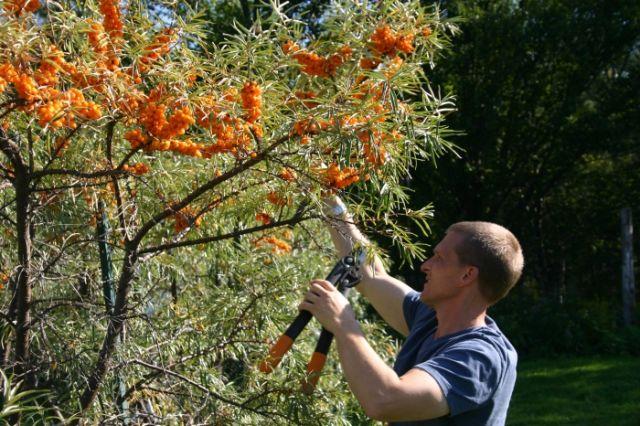
Sea buckthorn care includes pruning the plant in its fourth or fifth year. This promotes full crown development. Before bud break, remove any branches growing parallel to the trunk, damaged branches, and fruiting shoots, as too many berries on the tree will adversely affect its development.
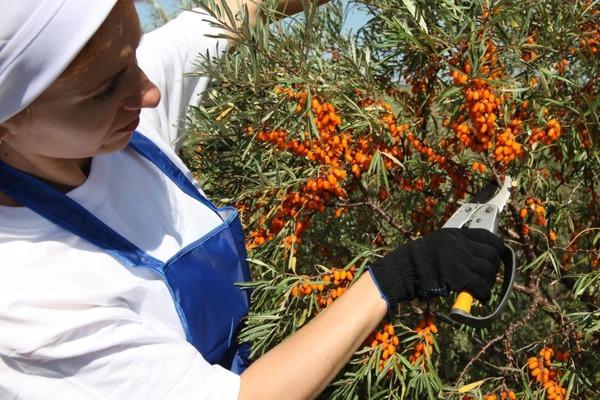
In the fall, perform sanitary pruning of the plant by removing dry, diseased stems, clearing away wilted leaves and dried berries.
All cut areas should be treated with garden varnish.
Preparing the tree for winter
After harvesting, it's important to prepare the sea buckthorn for winter. This winter-hardy plant can withstand severe frosts, so it doesn't require shelter. To mitigate the harmful effects of sudden temperature changes, water the plant in November while the ground is still frozen, then mulch it with peat.
Diseases and pests: treatment and prevention
Sea buckthorn demonstrates resistance to diseases and pests, but there is a risk of infection and insect damage, especially if the plant is not properly cared for and in cold, rainy conditions.
Endomycosis
A fungus that appears on the plant in early August causes the sea buckthorn berries to become soft and flaccid, filled with a gray slime. Eventually, the berries' shells rupture, releasing the contents onto nearby fruits, infecting them with endomycosis.
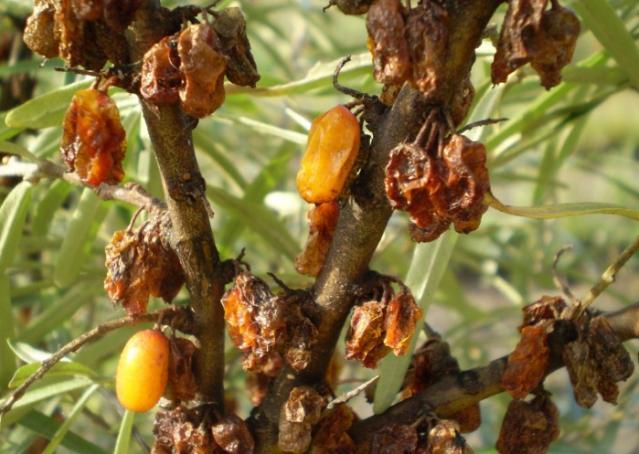
Treatment involves a two-stage application using a 1% Bordeaux mixture. These procedures are performed after the plant has finished flowering.
Gray and brown rot
These diseases are observed on plants in July during rainy weather. Gray mold can be diagnosed by wrinkled and wilting fruits, and brown mold by the presence of dark spots on the berries.
Control measures: destroy infected sea buckthorn bushes, cut out and burn diseased parts of the plant.
Organize proper care for the plant, including high-quality watering, adding nutrients, and loosening the soil.
Stegmina (scab)
In hot, humid weather, sea buckthorn berries become covered with shiny, black, round spots with distinct edges. Over time, these spots enlarge and form a pink or yellow mucus, which leaks when the skins are broken. Eventually, the berries turn black and dry out. Black spots appear on shoots and foliage. The disease can destroy up to 50 percent of the crop.
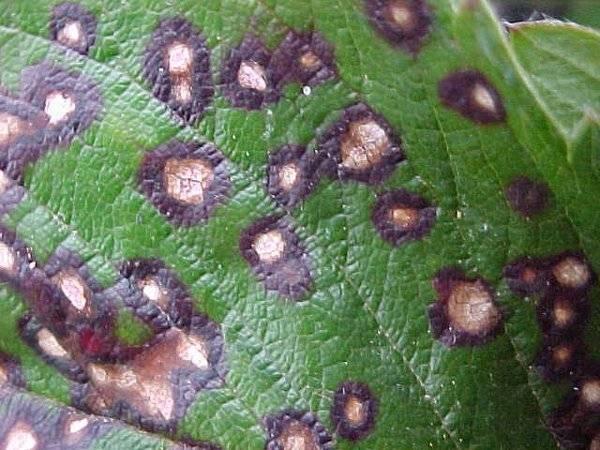
To protect sea buckthorn from scab, perform autumn pruning and burn damaged parts, spray with an effective preparation such as Bordeaux mixture, but no later than 20 days before harvesting.
Blackleg
A soil-borne fungus that thins sea buckthorn plants where the seedling's hypocotyl meets the soil. The seedlings subsequently die.
To prevent the development of black leg, young sea buckthorn trees should be planted in a soil mixture consisting of turf soil and river sand.
As a preventative measure, treat the plant seedlings with potassium permanganate. This should be done once every 4-5 days.
Black crayfish
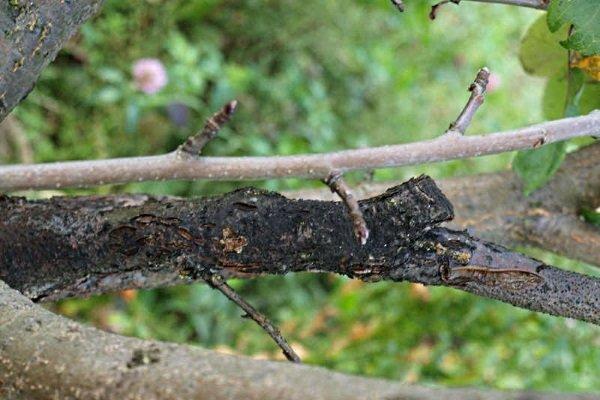
The appearance of dark spots on sea buckthorn branches indicates the development of black bark cancer, which causes the bark to blacken, become cracked, and the wood to darken and rot.
Control measures: remove bark and wood from infected parts of sea buckthorn branches and spray with copper sulfate.
Moth
Caterpillars invade buds and consume them from the inside. In summer, they build nests, covering six leaves at the tops of stems with webs. Pupation occurs in the topsoil. In August, the butterflies emerge, and in September, the bark at the base of the trunk is covered with egg masses.
How to fight: spray the bushes with chlorophos before the buds begin to open.
Fly
The fly can ruin the harvest. It emerges in late June, and its larvae invade the berries and consume their flesh, causing them to wrinkle, darken, and fall off.
How to fight: sea buckthorn needs to be treated with chlorophos in July.
Aphid
Insects that prefer the juice of sea buckthorn leaves and shoots settle at the bottom of the leaf blade, which subsequently turns yellow, curls up and falls off.
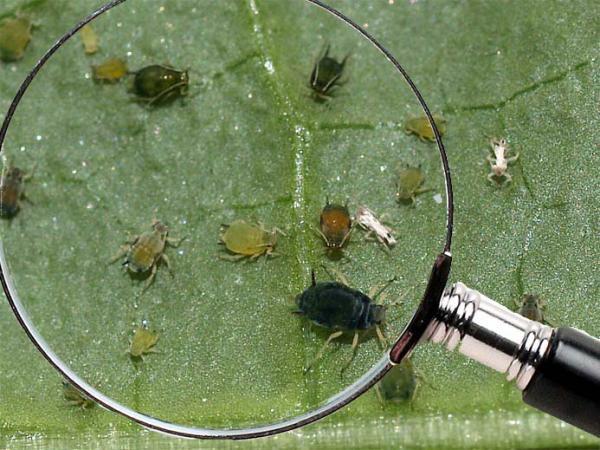
How to combat: A folk remedy made from onion peels is a weapon against a small number of aphids. If the insects multiply, you should resort to insecticides, applying them to the sea buckthorn when the leaves begin to unfurl.
Gall mite
A small insect that feeds on the juice of sea buckthorn leaves, causing flat swellings to appear on their surface, after which they change shape and fall off.
How to fight: use the same techniques as with aphids.
Reproduction
To increase the number of sea buckthorn trees in the garden, there is no need to buy seedlings; there are many methods for propagating the crop:
- using seeds;
- using root suckers;
- layering;
- using green, woody cuttings.
Gardeners choose the most suitable option for themselves. All methods require a little time and effort, but at the same time, they are a pleasant and rewarding endeavor that will reward you with a harvest of valuable and indispensable berries.
Related posts:
 Description and characteristics of the 60 best sea buckthorn varieties, how to choose depending on the region
 Causes and symptoms of sea buckthorn diseases, methods of pest control
 14 Best Step-by-Step Recipes for Preparing Sea Buckthorn for Winter
 How to quickly harvest sea buckthorn with your own hands and the basic tools
 Simple recipes for sea buckthorn jam and confiture at home for the winter, with or without cooking
 Timing and rules for pruning sea buckthorn for beginners
 Rules for propagating sea buckthorn by cuttings, shoots, and seeds at home
 Top 10 easy recipes for making sea buckthorn jam at home for the winter