
- Harvesting time for winter and spring garlic in 2025
- What does the lunar calendar say?
- Signs of garlic ripening
- Consequences of untimely cleaning
- What to do if garlic is overripe
- How to properly dig up the heads
- Preparation for long-term storage
- How to store the harvest
- In the boxes
- In the nets
- In salt
- In paraffin
- In a glass container
- In vegetable oil
- In cling film
- In sawdust
- In a cloth bag
- In the ground
- Braiding
- Potential problems when storing garlic
- Premature root growth
- Drying
- Mold
Almost every garden plot has a bed of garlic. Gardeners are faced with the challenge of not only growing a high-quality harvest but also preserving it. To preserve the flavor and medicinal properties of this healthy vegetable, it must be harvested promptly, when it reaches full maturity. When should garlic be harvested in 2025? Let's take a closer look.
Harvesting time for winter and spring garlic in 2025
The timing of harvesting garden crops depends on their variety, cultivar, and prevailing weather conditions. On average, garlic bulbs mature within 100 days from germination. If the summer is hot, winter crops are harvested in late July or the first week of August. Spring varieties take slightly longer to germinate, so harvesting begins in late August and ends in mid-September.
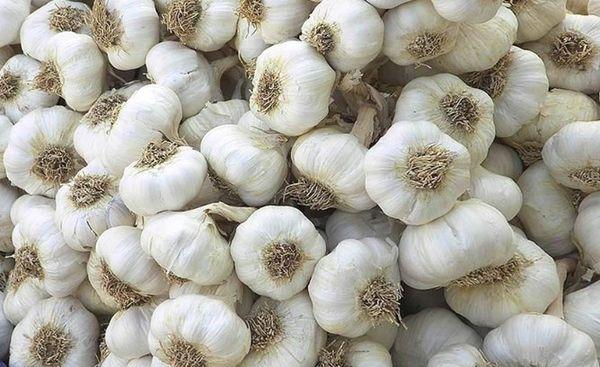
Harvesting times are determined by recording the head's maturity when dug from the ground. Ripe garlic should have a firm bulb with easily separated cloves.
You can speed up the ripening time of garlic heads by raking away the top layer of soil above them.
What does the lunar calendar say?
Many gardeners determine when it's time to dig up garlic by consulting the lunar calendar. A dry moon during the waning moon is favorable for harvesting.
According to the lunar calendar, the favorable dates for 2025 are:
- in July – from the 5th to the 7th, 15th, 16th, 19th, 20th, 23rd, 24th;
- in August – 1st-3rd, 11th, 12th, 15th, 16th, 29th, 30th.
Signs of garlic ripening
It is important to regularly check the ripeness of garlic, as this determines the timing of harvesting, and therefore the success of preserving the resulting crop.
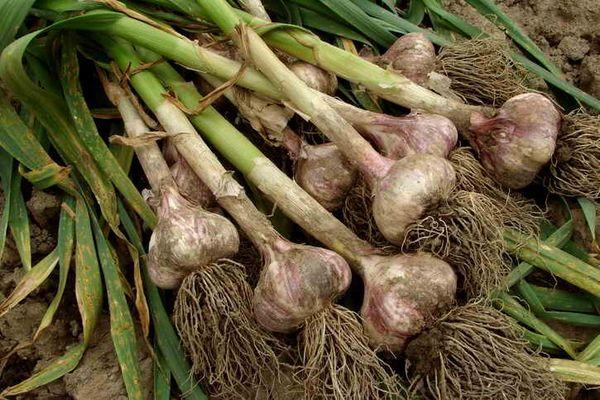
The maturity of the heads can be determined by the following signs:
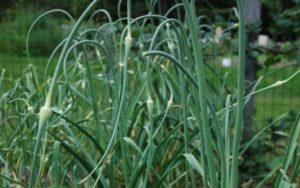
- cracking of the integumentary membrane of the bulbs on the arrow;
- yellowing of lower leaves;
- drying out and bending of tops;
- thinning of the husk;
- the emergence of young roots.
The quality of the cloves is crucial, as if they are picked too late, they lose their shelf life. Unripe garlic has tender, soft flesh. Overripe garlic, on the other hand, will naturally break apart into individual cloves.
Consequences of untimely cleaning
Untimely harvesting and improper drying of the crop lead to a significant reduction in shelf life, as unripe or overripe heads begin to rot and spoil quickly.
- An overripe bulb breaks into cloves, which can regrow. Cracked and fallen scales are a common cause of cloves drying out, having lost their protective barrier.
- The soft, unripe flesh of unripe cloves is also difficult to store for a long time.
Spoiled heads must be separated from the main crop, removed and subsequently consumed.
What to do if garlic is overripe
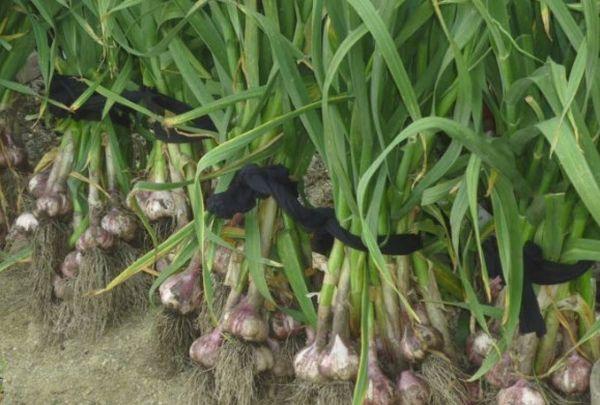
Overripe garlic cannot be stored for long. New shoots appearing on the cloves will damage the outer layer, making them susceptible to pathogenic bacteria and rot. After cutting off the damaged parts, they should be consumed as soon as possible—within the next month.
How to properly dig up the heads
Harvesting is divided into two stages: preparatory and main. Before digging, the plants are thoroughly prepared: a month before the planned harvest, watering is stopped. Drying the soil reduces the risk of fungal and bacterial infections of the garlic bulbs.
At the same time, the stalks are broken off, which stimulates the vegetable's rapid ripening in the garden. Several of the largest specimens with ripe seeds are selected to renew the planting stock.
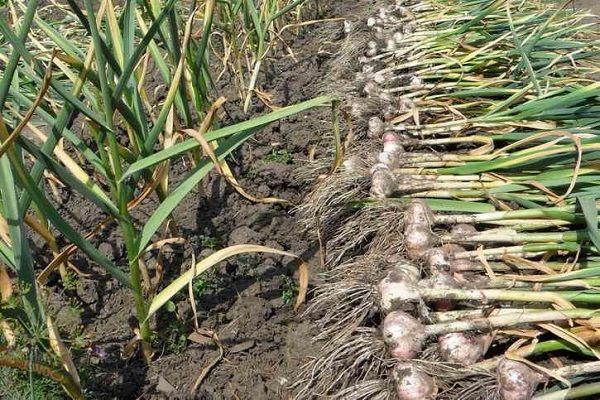
To improve yield, pinching off the tops of the plants prevents the emergence of new foliage. This ensures that nutrients flow to the roots of the plants rather than to the above-ground parts. This is done to ensure that large, robust heads are harvested.
Harvesting is recommended in the morning or evening, in warm, dry weather. To harvest, hold a shovel vertically and dig up the soil in several places at a depth of 30-40 centimeters.
Carefully remove the garlic head, shake it off with your hands and remove any stuck pieces of soil, and put it away to dry.
Preparation for long-term storage
The harvested bulbs are dried for several days outdoors or in a warm, dry room. The roots and tops are trimmed, leaving at least 5 centimeters. If you plan to store the garlic in braids, it is recommended not to remove the tops. The nutrients still remaining in the upper part of the plant will be transferred to the bulbs, improving their flavor and micronutrient content.
Additionally, before storage, the harvest is sorted. Damaged tubers are used immediately, followed by smaller specimens. Large garlic bulbs have the best shelf life, so they are stored for long periods.
Take a look Also
![When should you dig up garlic in the Moscow region in [year]?](https://harvesthub.decorexpro.com/wp-content/uploads/2018/07/kogda-vykapyvat-chesnok-v-moskovskoj-oblasti-9-300x200.jpg)
How to store the harvest
The optimal conditions for storing the harvest are as follows:
- Cool temperatures are preferred. Winter crops are best stored at 2 to 4 degrees Celsius, while spring crops thrive in warmer conditions.
- Humidity should be between 60 and 80 percent. At these levels, the tubers will not dry out and are also less likely to rot prematurely.
- Good air exchange is essential. Poor ventilation is a common cause of disease and rot.
- It is recommended to store garlic in a place protected from light.
There are many storage methods, all of them are quite good and reliable.
In the boxes
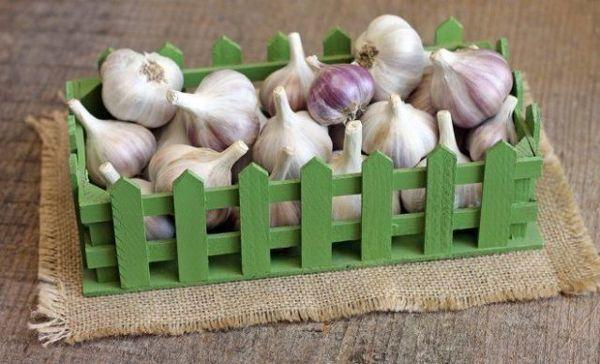
Once the bulbs are well-dried, cut the stems short and place them in baskets or wooden boxes with ventilation holes. Cover with a thin cloth. Store in a dry, well-ventilated area.
In the nets
The bulbs with their stems cut low are placed in fine mesh nets and hung in a specially designated place.
In salt
Salt is a good preservative and protects against moisture. Bulbs placed in containers and sprinkled with salt will stay fresh and healthy for a long time.
In paraffin
This method requires some preparation. Several pieces of paraffin are placed in a bowl and melted in a double boiler until they become liquid. Each garlic head is then dipped into the liquid and held for a few seconds. As it hardens, the paraffin coats the head, effectively protecting it from the elements.
In a glass container
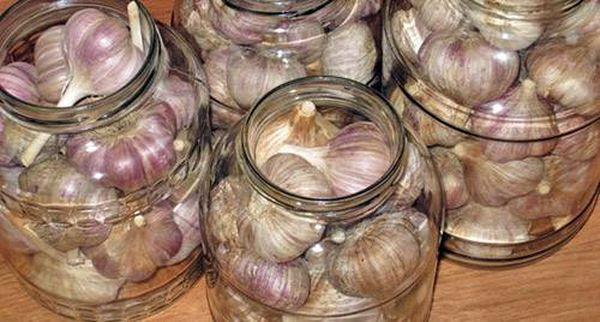
This method allows you to preserve ripe garlic bulbs for several years. They are placed in sterilized jars, first baked over a gas stove. Another option is to layer the bulbs with coarse rock salt. The jars are covered with cheesecloth or cloth and stored in a dark, dry place.
In vegetable oil
Place the cloves in a sterilized jar and cover them with any vegetable oil. Store the jar in the refrigerator.
In cling film
Wrap each head tightly in one or two layers of cling film. This will reliably protect them from drying out and spoiling.
In sawdust
Place the garlic heads in layers in a box or cardboard box and sprinkle them thickly with dry wood sawdust.
In a cloth bag
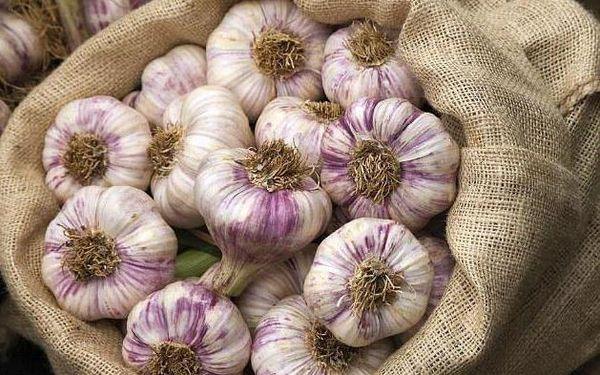
This storage method is suitable for well-dried bulbs. They are tightly packed into a bag made of any natural material, first dipped in a saturated salt solution. A small amount of rock salt can also be sprinkled on the bottom.

In the ground
The harvest is scattered into plastic bags, which are buried 30-40 centimeters into the soil. They are then carefully covered with sawdust, then covered with dry soil. Only storage areas with no groundwater should be chosen.
Braiding
The method involves braiding the heads of the long stems together. Twine or wire is attached to the main, longest stem to ensure stability. A loop is made at the top of the braid, which is then hung in a cool, dry place.
Potential problems when storing garlic
If garlic isn't stored properly, you may notice the cloves starting to rot, mold, sprout, or dry out. You should immediately sort through the cloves, removing any spoiled ones, to stop the process.
Premature root growth
Overripe garlic can regrow. The emerging shoots destroy the bulb's skin. If roots are sprouting, this process can be prevented by burning the remaining roots before storing.
Drying
Clean cloves that have lost their scales are usually the ones that dry out. To prevent this, ensure that the garlic doesn't overripe and store it properly.
Mold
Garlic can become moldy or rotten if exposed to moisture. Spoiled bulbs are placed in the sun to dry. Then, trim off the unsuitable parts and use them as food, as they cannot be stored.
A good preventative measure against mold is to treat the bulbs before storing them: briefly place each bulb in an oil disinfectant solution (half a liter of vegetable oil is heated over a fire for 2 hours and mixed with 10 drops of iodine).
The shelf life of garlic also depends on its variety. Only mid- and late-ripening varieties are suitable for long-term storage. Early-ripening varieties are grown for immediate consumption.
Related posts:
 When can spring garlic be harvested in 2025? Harvesting from the garden and storage
 The best varieties and types of early and winter garlic with descriptions and names
 Garlic harvesting dates in the Urals in 2025, cultivation and care
 When to dig up garlic in the Moscow region in 2025
 When to harvest winter garlic in Siberia, planting and storage times, varieties
 How to properly grow and care for spring garlic in open ground and when to tie it into knots
 How to properly dry winter garlic after digging and where to store it at home
 Features of planting and caring for family garlic, description of varieties, pest control