
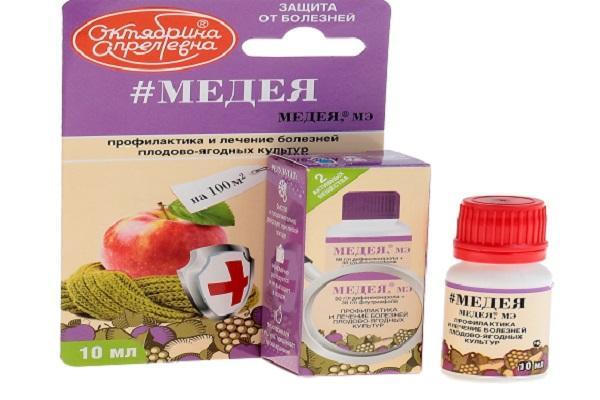
Fruit orchards and vineyards often suffer from fungal diseases, which negatively impact the yield and appearance of the fruit. To protect the plants and kill pathogens, gardeners use fungicides. These not only treat the plants but also prevent re-infection. The instructions for the fungicide "Medea" recommend purchasing the product for both single-use applications and tank mixes.
Composition, existing forms of release and purpose
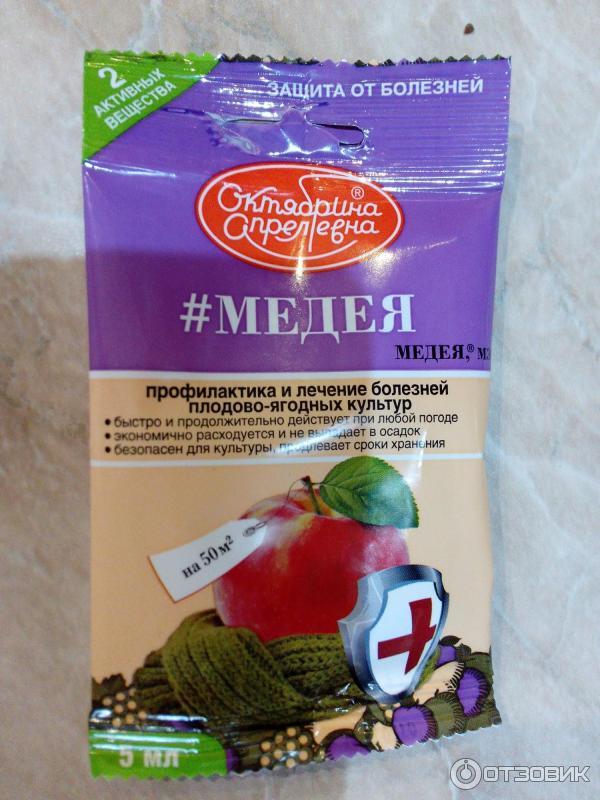
The combined systemic fungicide "Medea" contains two active ingredients: difeconazole, 50 grams per liter, and flutriafol, 30 grams per liter. This combination allows the chemical to quickly combat diseases and provide long-lasting protection after treatment.
The fungicide is available commercially as a microemulsion, packaged in 5- and 10-liter canisters. This chemical is intended for both the treatment and prevention of major diseases of fruit crops, as well as sugar beet and sunflower crops. The list of diseases effective against which Medea is effective includes:
- black spot;
- gray and white rot;
- mildew;
- anthracnose;
- oidium;
- powdery mildew;
- sooty mold;
- scab;
- leaf spot;
- moniliosis;
- rust.
Also, after treatment with the preparation, fruits are less likely to be affected by storage diseases such as moniliosis and late blight.
Mechanism of action
Thanks to its two-component composition, this fungicide exerts contact, systemic, and fumigant effects on crops. Difeconazole disrupts the permeability of the pathogen's cell membrane, which inhibits further cell reproduction and kills the fungus.
Flutriafol has a fumigant effect, allowing the active ingredient to instantly penetrate plant cells and destroy pathogenic microorganisms. Due to its unique composition, it takes no more than an hour for the product to penetrate deeply into plant tissue and begin its action. The fungicide solution coats the leaves of the treated plant with a continuous, impermeable film.
Pros and cons
Calculation of consumption for different plants
In order for the fungicide to have the desired effect on cultivated plants, it is necessary to adhere to the application rates of the Medea preparation.
Used by:
- For grape plantations, apply 3 ml of the product per 10 liters of water. The working fluid consumption per hectare of plantings is 10 liters.
- For apple orchards: 2 ml per 10 liters of water. The working solution consumption per tree ranges from 2 to 5 liters, depending on the severity of the infestation.
How to prepare a working mixture
The working solution is prepared immediately before spraying to ensure it remains effective. Pour 5 liters of water into a bucket, add the appropriate amount of fungicide, and stir with a wooden stick until completely dissolved. Then, add the remaining liquid and stir again.

Instructions for use
Plants are treated in dry weather, in the morning or evening. It is important that wind speeds do not exceed 4 m/s, as the product may spread to neighboring plantations.
Precautionary measures
When working with chemicals, pay attention to safety requirements. Wear protective clothing (overalls or gown) and a headscarf. Use a respirator to prevent inhalation of the fungicide.
Phytotoxicity
Cases of phytotoxicity have only been observed when plants under stress were sprayed.

Possible compatibility
The fungicide "Medea" is often used in tank mixes with other products. However, before preparing the solution, it is recommended to conduct a compatibility test using a small amount of each product.
Storage rules and shelf life
If stored properly and the packaging is not compromised, the fungicide has a shelf life of 2 years. Keep the area where the chemical is stored out of the reach of children and pets. The recommended temperature is 15 to 30 degrees Celsius.
Similar means
You can replace Medea with a chemical such as Vintage, it is the only analogue.
Related posts:
 Instructions for use and composition of the fungicide Fitosporin-M, application rates
 Instructions for using Falcon fungicide for treating grapes
 Instructions for use of the fungicide Topaz for plants, composition and analogues
 Instructions for use and composition of the fungicide Raek, application rates and analogues
 Composition and instructions for use of the fungicide Kumulus, application rates and analogues
 Instructions for use and composition of the fungicide Oxyhom, application rates
 Instructions for use and composition of the fungicide Kurzat, application rates and analogues
 Instructions for use and composition of the fungicide Zato, application rates and analogues