
- Composition, existing forms of release and purpose
- Mechanism of operation
- Advantages of fungicide
- Calculation of consumption for different plants
- Preparation of the working mixture
- Instructions for use
- Precautionary measures
- Degree of toxicity
- Is there resistance?
- Possible compatibility
- Storage rules
- Analogues
To protect fruit bushes and trees, many gardeners use broad-spectrum fungicides that prevent fungal diseases and ensure bountiful harvests. In some cases, two treatments per season are sufficient to maintain the health of crops. The fungicide "Zato" contains a single active ingredient and effectively combats fungal pathogens on trees and grapevines.
Composition, existing forms of release and purpose
This fungicide, manufactured by Bayer, is a single-component chemical used both industrially and in individual garden plots to protect fruit trees and shrubs, as well as grape vines, from fungal pathogens. Its sole active ingredient is trifloxystrobin, a member of the strobilurin class of chemicals.
The fungicide "Zato Plus" is used not only to treat affected trees and shrubs but also as a preventative measure. The active ingredient is effective against diseases such as phyllostictosis, powdery mildew, scab, moniliosis, various types of rot, early blight, black spot, and powdery mildew. If fruit trees are treated before harvest, the fruit will keep well throughout the winter. The fungicide preparation "Zato" is produced in the form of water-dispersible granules, packaged in 1 kg bags.
Mechanism of operation
The active ingredient is characterized by mesosystemic action, allowing the product to adhere to the surface of crop leaves and fruits. Also, thanks to its translaminar activity, trifloxysitrobin provides long-term protection for trees and shrubs, regardless of weather conditions. The active ingredient affects pathogenic fungi by inhibiting mitochondrial respiration. This inhibits the growth of the microorganisms and ultimately kills them.
Advantages of fungicide
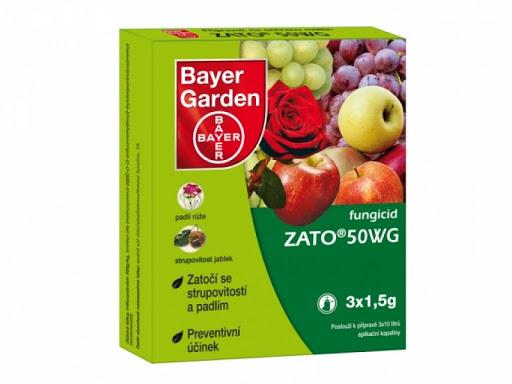
Over the course of using the fungicide "Zato", amateur gardeners and farmers have identified several advantages of this product.
Calculation of consumption for different plants
The rate of use of fungicide for the treatment and prevention of diseases of fruit crops is presented in the table:

| Culture | Disease | Norm of the drug | Number of treatments |
| Pear | Powdery mildew and scab | 0.14 kg/ha | Twice with an interval of 2 weeks |
| Apple | Alternaria and moniliosis, powdery mildew and scab, sooty spot | 0.14 kg/ha | Twice with an interval of 14 days |
| Vine | Oidium | 0.15 kg/ha | Twice with an interval of 3 weeks |
| Apples, pears, grapes | Storage diseases | 0.15 kg/ha | Double treatment 4 and 2 weeks before harvesting |

Preparation of the working mixture
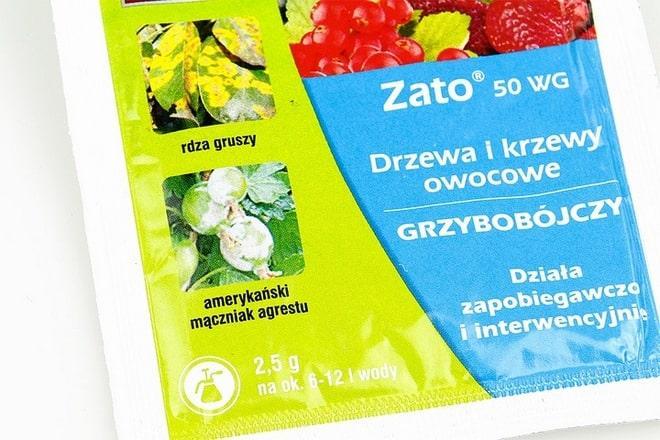
For a fungicide to be effective, it must be prepared properly. It is recommended to prepare the working solution immediately before use to preserve its effectiveness. Take 10 liters of lukewarm water and dissolve 1.4 or 1.5 grams of "Zato" in it. Stir with a wooden stick until the fungicide granules are completely dissolved. Spray fruit crops immediately afterward.
Instructions for use
Fruit crops are treated on a dry, sunny day, preferably without strong winds. The working solution is poured into a spray bottle and applied to the trees, using 800 liters per hectare of cultivated trees.
Precautionary measures
When using any chemical to treat agricultural crops, it is essential to follow the instructions and take safety precautions. Spraying should only be done while wearing protective clothing to avoid the fungicide coming into contact with exposed skin. It is advisable to tuck your hair under a headscarf, and protect your respiratory tract with a respirator.
The container used to prepare the working solution should not be used for household purposes or for feeding pets. It is best to dispose of it along with any remaining fungicide outside the garden.
If the drug accidentally gets into your eyes or on mucous surfaces, rinse them with plenty of water and consult a doctor.
Degree of toxicity
The systemic fungicide "Zato" is classified as moderately hazardous. It quickly breaks down when released into water and soil. It poses little risk to warm-blooded animals, including humans, for the respiratory system and skin.

Is there resistance?
No cases of resistance have been recorded from the use of the fungicide, but experienced gardeners recommend alternating "Zato" with other chemicals.
Possible compatibility
"Zato" can be used in tank mixes with most known fungicidal and insecticidal plant protection products. The only exceptions are highly acidic and strongly alkaline chemicals.
Storage rules
The shelf life of this broad-spectrum fungicide is 2 years from the date of manufacture. Store the granule package in a dark, low-humidity area. Keep the storage area out of the reach of children and pets.
Analogues
If the store doesn't have the fungicide "Zato," you can substitute it with any similar fungicide that has a similar effect on plants. For example, "Strobi" or "Delan."
Related posts:
 Instructions for use and composition of the fungicide Fitosporin-M, application rates
 Instructions for using Falcon fungicide for treating grapes
 Instructions for use and composition of the fungicide Teldor, application rates
 Types of garden fungicides and descriptions of the top 24 best, instructions for use
 Composition and instructions for use of the fungicide Kumulus, application rates and analogues
 Instructions for use and composition of the fungicide Raek, application rates and analogues
 Instructions for use and application rates of the fungicide Horus for different crops
 Instructions for use and composition of the fungicide Discor, application rates and analogues