
- Composition, existing forms of release and purpose
- Mechanism of action
- Advantages and disadvantages
- Calculation of consumption
- How to prepare a working mixture
- Soybeans
- Sunflower
- Corn
- Instructions for use
- Safety precautions during processing
- Degree of toxicity
- Possible compatibility
- Storage rules and shelf life
- Similar means
Harmful microorganisms cause significant damage to crops. To help their crops resist infestation, many farmers use chemical pesticides to boost their immunity. For soybean, corn, and pea fields, the fungicide "Optimo" is recommended. It has a contact action and destroys a broad spectrum of pathogens after the first spray.
Composition, existing forms of release and purpose
This innovative fungicide contains one active ingredient, pyraclostrobin, a recently developed strobilurin. One liter of Optimo fungicide contains 200 grams of the active ingredient.
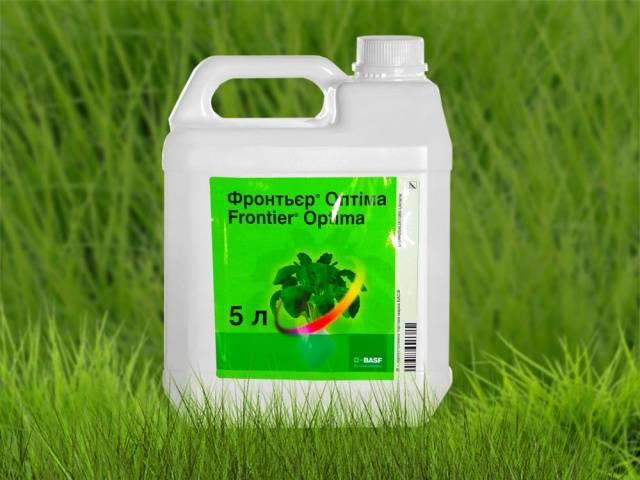
This chemical pesticide is available as a dark yellow emulsion concentrate, packaged in 5-liter plastic canisters. The fungicide is manufactured by the German company BASF. The instructions for use indicate that the product is suitable for the treatment and prevention of diseases in crops such as sunflower, corn, peas, and soybeans. Optimo is effective against pathogens such as ascochyta leaf spot and various types of rot, fusarium leaf spot, alternaria leaf spot, phomopsis leaf spot, and helminthosporiosis.
Mechanism of action
After spraying plants, some of the active ingredient penetrates the tissues of the crop and is evenly distributed. The remaining component remains on the leaf surface, forming a protective film that prevents pathogenic microorganisms from penetrating.
The active substance works by inhibiting the respiration of fungal pathogens. It also disrupts the pathogens' vital functions and halts their development. After a short time, the microorganisms are completely destroyed. The protective effect on treated plants lasts for 60 days.

Advantages and disadvantages

In the process of using the fungicide on their fields, farmers identified several advantages of the chemical.
As a rule, the price is justified by the high effectiveness of the drug.
Calculation of consumption
When treating crops with a new-generation fungicide, it's important to review the application rates. Using a lower dosage than indicated in the instructions will reduce the solution's effectiveness and fail to kill pathogens. Exceeding the recommended dosage will damage the crop due to its toxic effects. Use 0.5 liters of emulsion concentrate per hectare of treated crops, regardless of the crop.
How to prepare a working mixture
Prepare the working solution immediately before applying the fertilizer to the fields; otherwise, it will lose its effectiveness. You'll need an industrial sprayer and a small container for mixing the Optima with water.
Soybeans
Soybean fields are often affected by fungal pathogens, so chemical treatments are essential. The fungicide "Optimo" boosts the crop's defenses and destroys pathogens that have already penetrated the plant.
Take a look Also

If ground spraying is chosen, 18 to 20 ml of fungicide per bucket of clean water is required. Add the solution and stir thoroughly until completely dissolved. Pour the resulting solution into a sprayer tank filled 2/3 full with water and turn on the agitator. Add water to fill the tank and stir again. For aerial spraying, increase the dose fivefold. Spraying can be continued throughout the growing season.

Sunflower
Sunflower crops are threatened by diseases such as gray mold and rust. Use 20 ml of the solution per 10 liters of purified water. The preparation process is the same as for soybeans.
Corn
If corn crops aren't treated promptly, there's a risk of losing half the harvest if the disease occurs. Therefore, preventative field spraying is a part of every farmer's schedule. To protect plants and strengthen their immune system, 15 ml of the product per 10 liters of water is sufficient. For aerial treatment, 100 ml of the fungicide is used.
Instructions for use
The instructions for use recommend spraying crops once during the growing season. This should be done either in the morning or evening, at minimum wind speeds (no more than 4 m/s) and without rain, to allow the product time to create a protective film on the leaf surface. It's important to time the application so that at least two weeks remain before harvest, otherwise this product may be harmful to human health.

Safety precautions during processing
To prevent chemicals from causing harm to your health, follow basic safety precautions when working with the product. Be sure to wear a thick suit and gloves, as well as a headscarf or cap. To prevent inhalation of the working fluid vapor, use a respirator or mask.
After finishing field work, be sure to shower with soap to remove any accidentally spilled solution. Wash clothes and hang them outside to air. If the solution accidentally comes into contact with mucous membranes or eyes, rinse with plenty of water and seek emergency medical attention, showing the doctor the fungicide label.
Degree of toxicity
Since the Optimo product belongs to toxicity class 3, it poses a danger only to aquatic life, so under no circumstances should any remaining working fluid be poured into a river or lake.

Possible compatibility
To prevent resistance from developing, Optima is alternated with other chemicals. The fungicide can be used in tank mixes with other pesticides, with the exception of acids and oxidants.
Storage rules and shelf life
The product's shelf life, when stored according to the manufacturer's recommended storage conditions, is 3 years from the date of manufacture. The storage area where the fungicide is stored should be protected from sunlight, and the temperature should not exceed 30 degrees Celsius.
Similar means
If necessary, the fungicide can be replaced with preparations such as “Oxyhom” or “Harmony”.
Related posts:
 Instructions for using Falcon fungicide for treating grapes
 Instructions for use and composition of the fungicide Fitosporin-M, application rates
 Instructions for use and composition of the fungicide Teldor, application rates
 Instructions for use of the fungicide Topaz for plants, composition and analogues
 Instructions for use and composition of the fungicide Raek, application rates and analogues
 Composition and instructions for use of the fungicide Kumulus, application rates and analogues
 Instructions for use and composition of the fungicide Ferazim, application rates
 Types of garden fungicides and descriptions of the top 24 best, instructions for use