
The use of chemicals has long been commonplace in both farms and private gardens. Distinguishing one disease from another requires some experience. Most homeowners grow a variety of crops on their land. Therefore, a product that cures a wide range of diseases in almost all garden crops, such as the fungicide "Tsikhom," with clear instructions for use, is very appealing.
Composition, existing forms of release and purpose
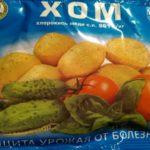
Tsikhom, a domestically produced fungicide for protecting vegetables, fruit trees, and berry bushes from diseases, is available as a wettable powder. The active ingredients of this fungicide are copper oxychloride and zineb. It also contains fillers and surfactants. When diluted with water, it forms a stable suspension. Agrorus packages Tsikhom in 10 kg bags.
Mechanism of action
The fungicide works on the surface, destroying pathogens attempting to invade beneficial plants. Copper oxychloride disrupts the decomposition and absorption of organic matter. Zineb inhibits carbon metabolism in pathogens and blocks enzyme activity in fungal cells.
Pros and cons
The downside of the fungicide "Tsikhom" is its high hazard to humans and extreme hazard to bees. Spraying with the product is prohibited during flowering. The product is washed away by rain.
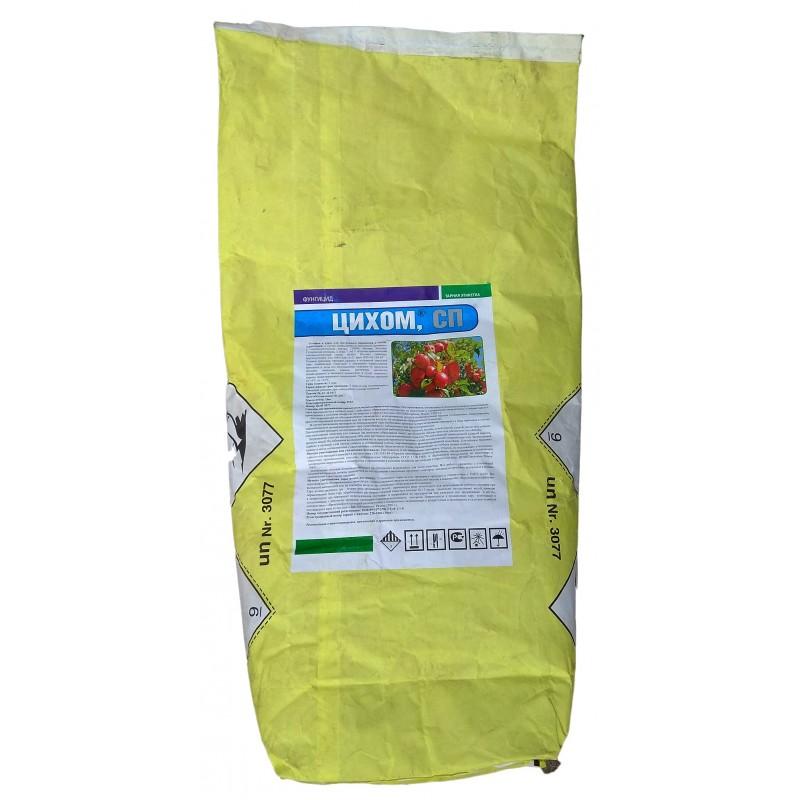
The use of copper oxychloride in combination with zineb reduces the risk of burns and increases the positive effects of each component.

Calculation of consumption
The fungicide "Tsikhom" treats nightshade and cucurbitaceae, sugar beets, fruit trees, and shrubs. The dosages listed in the table apply to plants of similar vegetative mass.
| Culture | Disease | Symptoms | The rate of the preparation (kg/ha) and working liquid (l/ha) | Spraying time | |
| Apple, pear, apricot | Scab | Brown-black, raised growths on the fruit. They often crack. Round, dark spots appear on the leaves. | 2.4 | 300-400 | The first one is before flowering; the next ones are 7-12 days after the previous one. |
| Currants, raspberries, gooseberries | 1. Anthracnose. 2. Septoria. |
1. Small yellowish-brown spots with a gray border on the leaves are growing. The leaves are drying up and falling off, starting from the bottom of the bush. Purple spots are appearing on the raspberry shoots.
2. Light spots with a black border on the leaves. |
3-4 | 600-800 | Before flowering and after harvest. |
| Grape | Mildew | Large, multicolored spots appear on the upper surface of the leaf, and white spores appear on the underside. The inflorescences are covered with a white coating. The berries turn brown and die. | 4-6 | 800-1000 | Before, after flowering and then at intervals of 7-10 days. |
| Potatoes, tomatoes | 1. Alternaria. 2. Late blight. | 1. Brown or gray-black circular spots up to 1.5 cm in size on leaves. On fruits, they are larger and expanding. Concentric circles are visible. 2. Brownish spots on stems, leaves, and fruits. They begin at the lower levels of the plant. On fruits, the spots are hard and extend into the flesh. | 2.4 | 300-400 | 12-15 days after planting seedlings or emergence. Repeat every 20 days in hot weather and every 5-7 days in rainy weather. |

Preparation of the working mixture
Fill the sprayer tank halfway with water. Prepare a concentrated solution of the fungicide "Cichom" in a container specifically designed for diluting chemicals. Pour it into the tank and stir for 7 minutes. Continue stirring while adding the remaining water. The water should be at room temperature.
Instructions for use
It's best to begin disease control at the seed selection stage. They are treated with the fungicide "Tsikhom." During the growing season, plants are treated by spraying the above-ground parts. Apply the solution especially carefully to the lower leaves, as it's easy to leave dry patches there, which will leave an open entry point for infection. Preventative spraying is carried out at intervals of 2-4 weeks. If signs of disease are detected, treatment with the fungicide "Tsikhom" should begin immediately at the frequency indicated in the table above.
Safety precautions during processing
The body and respiratory tract must be protected from droplets of the suspension during spraying. To do this:
- put on chemical-resistant gloves;
- closed clothing and footwear;
- respirator.

Before breaks and after finishing work with the fungicide "Tsikh," wash with plenty of water. Keep work clothes away from household items.
Pregnant women are prohibited from working with chemicals.
Degree of toxicity
The fungicide "Tsikhom" degrades in the environment within a month. It is toxic to insects to varying degrees. Bees should not be released from their hives during spraying and for up to 10 hours afterward. "Tsikhom" is a mild skin and mucous membrane irritant. Respirators should be worn in the areas for the first few days after spraying. "Tsikhom" can have a toxic and mutagenic effect on animals. It also affects the reproductive functions of birds and mammals.
Possible compatibility
"Tsikhom" combines well with organochlorine and organophosphorus substances. It is not recommended to mix it with alkaline preparations.

Storage terms and conditions
Store the fungicide "Tsikhom" in a tightly sealed container, away from food, water, and feed. Shelf life is 3 years. Keep away from heat and flame sources.
Similar means
It's advisable to frequently alternate antifungal and antibacterial medications with those that are similar in their effectiveness against pathogens. A list of possible substitutes for Tsikhoma is listed in the table.
| Culture | Disease | Medicines |
| Tomato, potato | Alternaria | "Kuproksat", "Polyram", "Acrobat". |
| Grape | Mildew | “Consento”, “Topaz”, “Abiga-Peak”, “Hom”. |
| Apple | Scab, moniliosis | "Gamair", Bordeaux mixture, "Horus". |
| Currants, raspberries, gooseberries | Anthracnose | "Topsin-M", "Zircon", "Fitosporin", "Epin". |
Related posts:
 Causes and treatment of eggplant pests and diseases, how to combat them at home
 Description and treatment of potato diseases, methods of control using folk and chemical means
 Description of tomato diseases and their treatment, how to process them
 How to propagate and grow peas, cultivation technology, and care in open ground
 Description of the Julian grape variety, planting and care instructions
 How to properly plant peas in a greenhouse and open ground
 Description of varieties of sowing peas and cultivation, to which family they belong
 Instructions for use of the drug Hom, the action and dosage of the fungicide