
- Composition, existing forms of release and purpose
- How does it affect plants?
- Advantages and disadvantages
- Calculating fungicide consumption for different plants
- Creating a working solution
- Instructions for use
- Precautionary measures
- Phytotoxicity
- Possible compatibility
- How to store properly and expiration date
- Similar means
When growing vegetables and fruits, home gardeners often encounter fungal diseases that ruin their harvests. In most cases, chemical treatments are necessary to preserve the crops. The fungicide "Zummer" effectively combats fungal pathogens that affect potatoes, apple trees, and grapes. Please read the instructions before using the product.
Composition, existing forms of release and purpose
The effectiveness of the fungicide "Zummer" is ensured by its new-generation active ingredient, fluazinam. Its concentration per liter is 500 grams. This contact fungicide is formulated as a suspension concentrate. It is sold in 5-liter canisters.
The fungicide "Zummer" is used to treat diseases such as:
- apple scab;
- potato late blight;
- Black spot and mildew of grapes.
How does it affect plants?
This chemical fungicide works by inhibiting the germination of fungal spores. "Zummer" also prevents the spread of pathogenic microorganisms throughout plant tissue. After treatment with a contact fungicide containing a new-generation compound, the likelihood of re-infection throughout the season is minimal, as the active ingredient prevents spore penetration into all parts of the plant.
Advantages and disadvantages
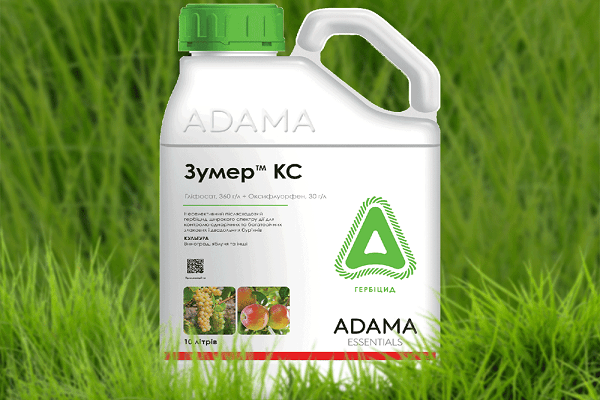
After using the contact fungicide "Zummer" on their plots, gardeners identified several advantages of the product.
In particular:
- Long-term protection of crops from pathogens causing fungal and bacterial diseases.
- No risk of resistance developing next season.
- Beneficial effect on the quantity and quality of the resulting harvest.
- Convenience of the dosage form and economical consumption.
- No toxicity to other crops.
- High resistance to precipitation and irrigation.
- Speed of action after plant treatment.
- No phytotoxicity.
- Reducing the likelihood of re-infection of potatoes with late blight under unfavorable weather conditions.
Among the disadvantages of the fungicide, gardeners note its ineffectiveness in the fight against powdery mildew and rust.
Calculating fungicide consumption for different plants
To ensure the solution fulfills its intended purpose, it is necessary to adhere to the manufacturer's recommended application rates. These are presented in the table.
| Cultivated crop | Pathogen | Consumption rate | Number of treatments |
| Grape | Mildew, black spot | From 500 to 750 ml per hectare of plantation | No more than 2 times per season |
| Potato | Late blight | From 300 to 400 ml per hectare of field | No more than 4 times per season |
| Apple | Scab | From 500 to 750 ml per hectare of garden | No more than 2 times per season |
Creating a working solution
Prepare the working solution before spraying the crops. Fill the tank one-third full with clean water. Add the recommended dose of the product and turn on the stirrer until the chemical dissolves completely. Then add the remaining water and stir again.

If any solution remains after processing, it is disposed of in accordance with safety recommendations.
Instructions for use
Spraying of plants is carried out in dry and clear weather. It is also important that wind speed does not exceed 4 m/s. The first treatment of potatoes is done at the row closure stage, with the next treatment 10 days later. Apple trees are treated for the first time at the pink bud stage, with a second treatment two weeks later. Vineyards are sprayed before flowering, with a second treatment 10 days later.
Precautionary measures
When working with a chemical, it's essential to protect your skin and respiratory tract. Wear a thick suit and a respirator, and wear a cap or scarf. After finishing work, wash all clothing and take a shower to remove any spilled solution.

Phytotoxicity
If you adhere to the manufacturer's recommended fungicide application rates and frequency of treatments, phytotoxicity will not occur.
Possible compatibility
"Zummer" is compatible with most chemicals in tank mixes. The exception is alkaline substances such as Bordeaux mixture.
How to store properly and expiration date
When stored properly, the fungicide "Zummer" retains its effectiveness for three years from the date of production. Store the chemical in a utility room where the temperature does not exceed 30 degrees Celsius. It is also important to prevent the fungicide container from being exposed to direct sunlight.
Similar means
The "Buzzer" can be replaced with security devices such as "Shirlan" or "Jeep".
Related posts:
 Instructions for use and composition of the fungicide Fitosporin-M, application rates
 Composition and instructions for use of the fungicide Kumulus, application rates and analogues
 Instructions for using Falcon fungicide for treating grapes
 Instructions for use and composition of the fungicide Teldor, application rates
 Instructions for use and composition of the fungicide Optimo, application rates and analogues
 Instructions for use and composition of the fungicide Zato, application rates and analogues
 Instructions for use and composition of the fungicide Raek, application rates and analogues
 Composition and instructions for use of the fungicide Thanos, application rates and analogues