
- Composition and existing forms of release
- Mode of action
- Advantages of the herbicide
- How quickly does it work?
- Calculation of consumption
- How to prepare a working solution
- Rules for using the Torch
- When to treat plants
- Safety precautions
- Degree of phytotoxicity
- Possible compatibility
- Storage conditions and shelf life
- Similar means
In garden plots and farm fields, weeds pose a major problem, choking out crops and robbing them of nutrients. If the garden is small, weeds can be controlled mechanically by periodically pulling them out of the soil. In larger fields, the only solution is chemical control. Many farmers are familiar with the herbicide "Fakel" and use it successfully to kill weeds.
Composition and existing forms of release
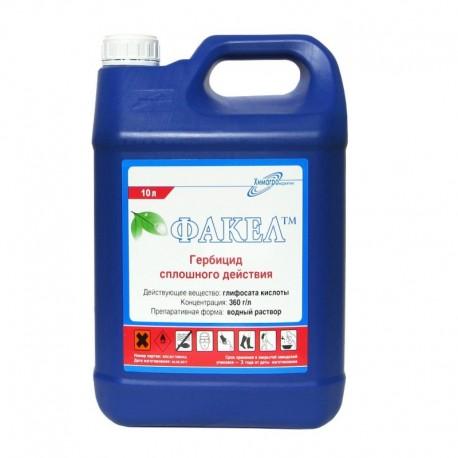
Fakel is a non-selective herbicide used on agricultural land to kill weeds. After treatment, the weeds are completely killed and do not regrow. The only active ingredient in this herbicide is isopropylamine salt (glyphosate). Glyphosate accounts for 36% of the product.
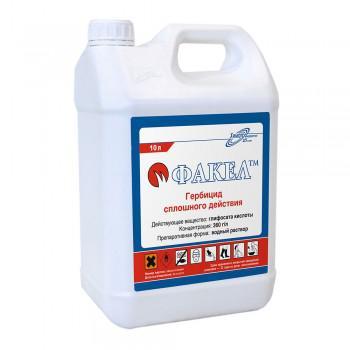
Fakel is produced by domestic enterprises and is sold in 10-liter canisters as an aqueous solution.
Mode of action
Once the herbicide hits weeds, it quickly penetrates their tissues and begins its destructive action. Its mechanism of action is based on disrupting protein biosynthesis. The herbicide also penetrates the root system through the leaves.
"Fakel" is used equally effectively in the fight against both annual and perennial weeds.
Advantages of the herbicide
Farmers who frequently use Fakel on their agricultural lands note the positive properties of this herbicide.
How quickly does it work?
After treating agricultural fields, weeds die within 5-10 days. In some cases, depending on the weed species and soil conditions, complete eradication can take more than 20 days. When treating, remember that herbicides do not affect weed seeds.
Calculation of consumption
For the herbicide to be effective, it is necessary to correctly calculate the amount of the preparation for the area of agricultural land being treated.

The consumption rates of "Fakel" are presented in the table:
| Cultivated crops and lands | Working fluid consumption | Weeds | Directions for use | Number of treatments |
| Farm fields intended for sowing late spring and winter cereals | From 100 to 200 l/ha, depending on the degree of weed infestation of the area | Annual dicotyledonous weeds | Field cultivation in autumn, after harvesting | One spray is enough |
| Vineyard plantations | From 100 to 200 liters per hectare | Annual and perennial weeds | Provided that cultivated plants are protected, treatment is carried out in May or June, during the growing season of weeds. | One treatment is enough |
| Couples | From 100 to 200 liters of working solution per hectare of field | Dicotyledonous and cereal annual weeds | Treatment is carried out during the period of active growth of weeds. | One spray is enough |
How to prepare a working solution
To prepare a working solution of the Fakel herbicide, dissolve 2 liters of the product in 2 liters of warm water, stirring until smooth. Then, stir the resulting solution in 10 liters of clean water and pour it into an industrial sprayer for field treatment.

Rules for using the Torch
Treat fields and vineyards only on clear days; the herbicide will not be effective and will not kill weeds in rainy weather. It is also important to keep wind speeds below 3 m/s to prevent the chemical from spreading onto neighboring fields containing crops.
When to treat plants
Most agricultural fields are treated with Fakel in late spring, during the active growth period of weeds. Autumn spraying is only used on soils intended for winter grains.
Safety precautions
When working with chemicals, safety precautions must be observed. The body must be protected by a special suit to prevent the herbicide from coming into contact with the skin. Respiratory protection should be provided by a respirator, and a headscarf should be worn.
Degree of phytotoxicity
During the use of the Fakel herbicide in the fields of farmers and large agricultural enterprises, no cases of phytotoxicity have been identified.
Possible compatibility
The instructions included with the herbicide recommend not combining Fakel with other chemicals. Other products can be used two weeks after applying the herbicide.

Storage conditions and shelf life
The chemical can be stored in sealed industrial packaging for up to 2 years. An opened canister should be used within a week. Store Fakel herbicide in utility rooms, away from sunlight and out of reach of children and pets.
Similar means
If Fakel herbicide is unavailable at a farm supply store, it can be substituted with a product with a similar effect. Roundup is considered the most suitable, but Smerch, Tornado, Glyphos, and Argument are also acceptable.
Related posts:
 Description of the Fakel tomato and characteristics of the fruit, cultivation and planting rules
 Instructions for use and composition of the herbicide Aksifor, dosage and analogues
 Instructions for use and composition of the herbicide Basis, application rates and analogues
 Instructions for use and composition of the herbicide Fabian, application rates and analogues
 Luger herbicide instructions for use, dosage, and analogues
 Composition and instructions for use of the herbicide Ballet, application rates and analogues
 Composition and instructions for use of the herbicide Pilaraund, application rates
 Instructions for use of the herbicide Ground against weeds, application rates