
- Composition, existing forms of release and purpose
- Mechanism of action
- How long does the effect last?
- How fast does it work?
- Advantages and disadvantages
- Preparation of working solution
- Instructions for use
- Precautionary measures
- How toxic is it?
- Is compatibility possible?
- Storage conditions and shelf life
- Similar means
Pre-emergent selective herbicides are used in agriculture to treat soil that will later be planted with crops. Let's look at the potential of the herbicide "Harness" for corn, soybeans, and sunflowers. We'll cover its purpose, composition, speed, and duration of action. We'll also explore its advantages and disadvantages, how to prepare a solution, and how to use it according to the instructions. We'll also discuss toxicity, shelf life, and storage conditions, as well as alternatives.
Composition, existing forms of release and purpose
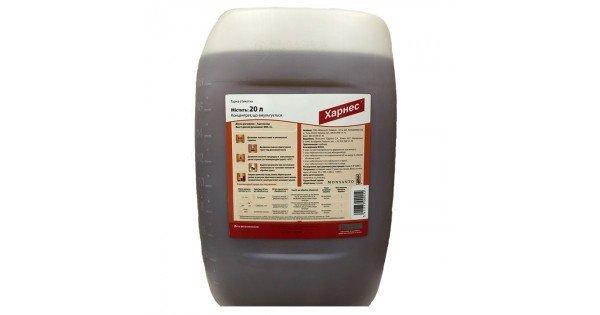
Harnes' active ingredient is acetochlor, a concentrated emulsion containing 900 g per liter. This herbicide is manufactured by Monsanto. It is a selective pre-emergent herbicide applied to the soil in corn, sunflower, and soybeans, controlling common first-year cereal and biennial weeds. The emulsion is available in 20-liter canisters.
Mechanism of action
After spraying, the herbicide penetrates the soil, reaching the top layer, and the solution is absorbed through the shoots and roots of weed seedlings. Acetochlor inhibits cell division and the movement of amino acids and acousins, resulting in the death of the seedlings.
How long does the effect last?
The treated areas remain free of weeds for 3-4 months, meaning that just one treatment with Harnes is enough for the plants to grow well throughout the growing season.

How fast does it work?
Destroys weed seedlings, completely stopping their growth. Effects occur quickly, within a few days.

Advantages and disadvantages
Advantages of the herbicide "Harness":
- destroys weeds before crops emerge;
- plants are protected from the initial stages of growth;
- minimizes costs for caring for agricultural crops;
- does not reduce the yield of cultivated crops;
- the action of the herbicide does not depend on the weather;
- The substance decomposes quickly in the soil and does not have a negative impact on plants that will be planted next season.
Disadvantages: allows processing of a limited number of crops.

Preparation of working solution
The Harness solution is prepared by first dissolving the preparation in half the volume of water, stirring, and then adding the remaining water to the tank and stirring again.
Instructions for use
The effectiveness of Harnes herbicide is reduced on clay or fertile soils. The maximum recommended dose should be used on such soils, while the minimum recommended dose should be used on sandy soils. The effect will be the same. To ensure effectiveness, apply the herbicide to moist, warm, and well-tilled soil, free of clods and debris from harvested vegetation. In cold, damp weather, the product may cause seedlings to become stunted and thin, and foliage to become deformed. The solution can be distributed evenly over the surface only if the soil is moist; 10-15 mm of rainfall is sufficient for the product to be effective.

According to the instructions, the soil should be treated before crop and weed emergence, 3-14 days before sowing, or immediately after, which is considered optimal. The solution is applied by spraying to normally moist soil, and incorporate into dry soil with harrows or cultivators.
The application rate for corn and soybeans is 2-3 liters per hectare, and for sunflowers, 1.5-2 liters. 200-300 liters of solution are required per hectare. This treatment is a one-time application, and should be administered at least two months before harvest.
Precautionary measures
When working with herbicides, wear protective clothing, gloves, a respirator, and goggles. Protective equipment is needed to protect the eyes, respiratory system, and skin from chemical contact.


How toxic is it?
Harnes is classified as toxicity class 2 for humans, 3 for bees and worms, and 4 for birds. Acetochlor decomposes in soil within 23-72 days and does not leach into the lower layers. In plants, it decomposes within 40-50 days. Symptoms of possible poisoning in humans include ataxia, salivation, tremors, and diarrhea. If these symptoms occur, consult a doctor.
Is compatibility possible?
Harness can be combined with pesticides and fertilizers in the same solution. For enhanced effectiveness, Roundup Max can be used in conjunction with it.
Storage conditions and shelf life
Harness is stored in a plastic canister, which protects it from temperature and UV radiation. Its shelf life is 3 years at temperatures from 0 to 35°C. Other pesticides and fertilizer mixtures can also be stored in the warehouse, but not food products, animal feed, or pharmaceuticals. After the expiration date, the herbicide is no longer suitable for use. The solution can only be stored for 1 day, so it should be diluted to the volume required for a day's work.
Similar means
The following herbicides are considered substitutes: Osnova, Sahara, Kratos, Greenfort, Hartus, Etalon, and Lancaster.
Harnes is an effective pre-emergent soil herbicide used to treat corn, soybeans, and sunflower fields against annual weeds and bicotyledonous species. The product has its own unique feature: it must be sprayed or incorporated into warm and moist soil. Its effectiveness is reduced in cold and dry conditions. Under normal application conditions, the herbicide kills germinating weeds before the crop sprouts. Thus, it protects young plants without negatively affecting them. Treatment does not affect subsequent development, much less yield. Acetochlor does not harm the soil, microorganisms, or worms, and does not disrupt crop rotation. Any crops can be sown or planted in the area the following year after treatment with Harnes.
Related posts:
 Hermes herbicide instructions for use, dosage, and analogues
 Instructions for use and composition of the herbicide Aksifor, dosage and analogues
 Instructions for use and composition of the herbicide Basis, application rates and analogues
 Instructions for use of the continuous herbicide Rap, its composition and dosage
 Composition and instructions for use of the herbicide Pilaraund, application rates
 Luger herbicide instructions for use, dosage, and analogues
 Instructions for use and composition of the herbicide Callisto, dosage and analogues
 The spectrum of action and instructions for use of the herbicide Agritox, its consumption