
- Composition, dosage form and purpose
- Operating principle
- How quickly does it work?
- How long does the effect last?
- Pros and cons
- Calculation of consumption
- How to prepare and use the working mixture
- Safety precautions
- Degree of phytotoxicity
- Is there resistance?
- Possible compatibility
- How to store it correctly and for how long
- Analogues
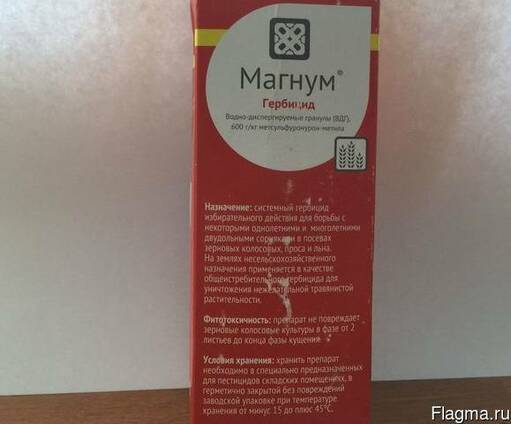
Magnum herbicide is a systemic product used to control unwanted vegetation. It penetrates the weeds and acts at the cellular level. It can be used in cereal and flax beds. Its active ingredient targets only weeds and does not harm crops. Furthermore, it can be combined with other chemicals.
Composition, dosage form and purpose
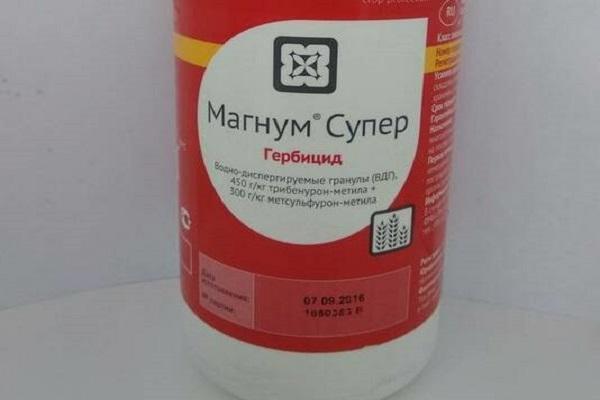
The product is available as water-dispersible granules. Its active ingredient is metsulfuron-methyl. One kilogram contains 600 grams of the active ingredient. There is also a product called "Magnum Super." This two-component product contains 300 grams of metsulfuron-methyl and 450 grams of tribenuron-methyl per kilogram.
Operating principle
The active ingredient in Magnum belongs to the sulfonylurea class. It penetrates weeds through their foliage and root system. The substance is absorbed and transported through the phloem and xylem of the plant.
The drug inhibits the enzyme acetolactate synthase, which helps stop the production of essential amino acids—leucine, isoleucine, and valine. This helps stop cell division and the growth of unwanted hair. Ultimately, this causes hair death.
How quickly does it work?
Weed growth slowdown after application begins within a few hours of absorption. During the active growth phase, noticeable effects appear after 2-3 days. When growth slows, this occurs later. A delayed effect is typically observed at low temperatures and in dry weather.

Noticeable signs of weed suppression with Magnum are observed within 5-7 days in warm, humid weather and within 12-15 days in cold, dry weather. Unwanted vegetation dies completely within 3-4 weeks.
How long does the effect last?
The product remains effective throughout the entire growing season. Its effectiveness is unaffected by climate conditions and soil characteristics.
Pros and cons
The main advantages of the drug include the following:
- destruction of a large number of annual and perennial dicotyledonous weeds - the product is effective even against sow thistle and field thistle;
- flexible timing of use on cereal plants – the composition can be used from the moment 2-3 leaves of the crop appear until the end of tillering;
- low consumption rates;
- low cost of processing 1 hectare of crops;
- a modern form of release that is easy to use.

The disadvantages of using the substance include the following:
- risk of developing resistance with long-term use of the substance;
- cannot be used on alkaline soil types due to its long half-life;
- destruction of sensitive vegetable plants located in the area of action of the drug;
- the impossibility of using the aerial method of treatment near fishery waters;
- the need for deep plowing when planning vegetable planting for the next year;
- the need to comply with crop rotation restrictions.
Calculation of consumption
"Magnum" can be used once per season. However, the application rate cannot exceed 10 grams per hectare. It should not be applied to cereals near legumes or forage grasses.

The dosage of the drug is given in the table:
| Culture | Consumption rate of the product, grams per 1 hectare | Weeds | Processing Features |
| Winter and spring wheat, oats, rye, millet | 10 | Annual and some perennial dicotyledonous plants | Spraying should be done in the spring, during the early stages of annual and perennial weed growth. The product can be applied from the 2-3 leaf stage until the crop has completed tillering. |
| Spring barley and wheat, millet, oats | 8 | Spray annual weeds at the 2-4 leaf stage and perennial plants at the rosette stage. The composition can be used from the 2-3 leaf stage until tillering. |

How to prepare and use the working mixture
The working solution must be prepared before use. First, form a stock solution of the herbicide. To do this, fill a bucket a quarter full with water and add the required volume of the product. Mix thoroughly and add water to fill it to three-quarters full.
Fill the sprayer tank 50% with water, turn on the agitator, and add the stock solution. Then, add water until the tank is full.
Safety precautions
When using Magnum by aerial methods, it cannot be sprayed in the area of fishery waters, at a distance of 500 meters from the flooded area at the maximum flood level and no closer than 2 meters from the existing banks.
The herbicide must be transported in its original packaging. All regulations for the transportation of hazardous materials must be observed. It is essential to wear personal protective equipment when using the substance.
Degree of phytotoxicity
If all application rules are followed, the substance does not harm cultivated plants.
Is there resistance?
No cases of resistance to the product have been identified. To avoid such problems, it is recommended to alternate Magnum with herbicides from other categories or use it in tank mixes.
Possible compatibility
The product can be combined with various fungicides, insecticides, and herbicides. A compatibility test is required before use.
How to store it correctly and for how long
The product must be stored in designated areas. This should be done in an airtight container at temperatures ranging from -15 to +45 degrees Celsius. The shelf life is 5 years.
Analogues
Effective analogues of the drug include:
- Terramet;
- "Grench";
- "Laren Pro".
Magnum is an effective product that helps control various types of weeds. It's important to follow the recommended dosage and safety guidelines.
Related posts:
 Nitrophoska composition and instructions for use of fertilizer, errors
 Instructions for use and composition of the herbicide Milagro, dosage and analogues
 The best eggplant varieties for growing in a polycarbonate greenhouse: planting and care
 Instructions for use and composition of the herbicide Euroland, dosage and analogues
 Hermes herbicide instructions for use, dosage, and analogues
 What is the best way to feed carrots? Fertilizers and preparations, using folk remedies.
 Instructions for use and composition of the herbicide Callisto, dosage and analogues
 Instructions for using green soap against plant pests and its composition
