
- What is it and what is it for?
- Design requirements
- DIY manual potato planter
- Necessary materials
- Manufacturing process
- Potato planter for a walk-behind tractor
- Assembling the bunker
- Wheels, rippers and their holders. Seeding device
- Homemade potato planter for a mini tractor
- Operating instructions
- Additional tips and warnings
Potato planters are often used for large plots of land. You can purchase one or make your own from scrap materials. Making your own planters doesn't compromise their functionality or operating speed.
What is it and what is it for?
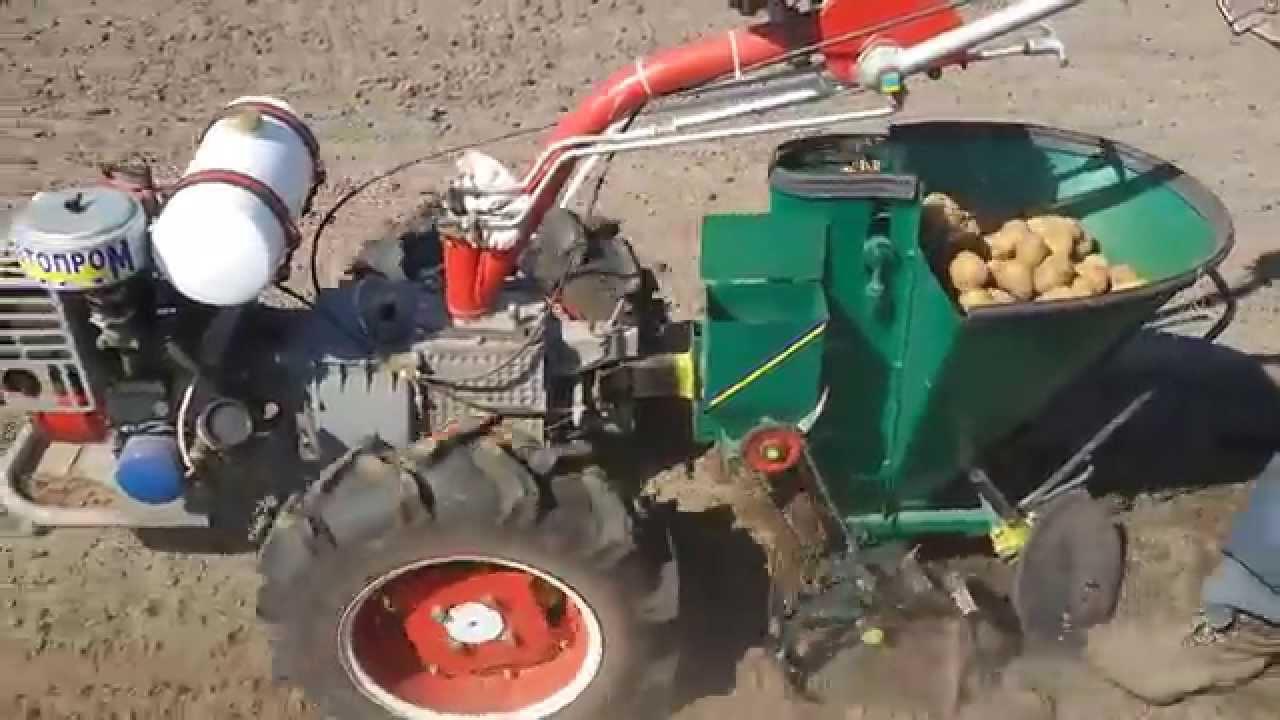
Using this type of planter, a gardener can plant a large quantity of potatoes in a short time without much physical effort. The device can be operated by a person or attached to a walk-behind tractor. With the latter option, the gardener only needs to operate the walk-behind tractor and regularly replenish the planting material. The potato planter automatically digs trenches and distributes the tubers in the required quantity.
Design requirements
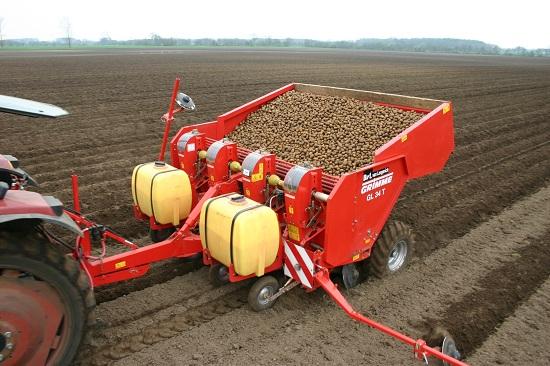
All potato planters have the same requirements. The device must contain the following components:
- the presence of a bunker where planting material is placed;
- the presence of a regulator for the immersion depth of planting material;
- the presence of wheels for moving the product around the land;
- the presence of discs that will rake the holes with potatoes and level the soil.
Many products have the ability to immediately hill up the beds.
Important: Use potato planters only on pre-prepared land.
DIY manual potato planter
Gardeners often create homemade potato planters from scrap materials. These designs offer the following advantages:
- do not require any costs for purchasing the device;
- cope with the assigned tasks efficiently;
- are made according to the individual preferences of the gardener;
- speed up the process of planting crops on the site.
The process of assembling a homemade potato planter does not take much time and can be assembled by a beginner.
Necessary materials
In order to make a product for planting potatoes, it is necessary, first of all, to prepare the following types of materials:
- a pipe with a diameter of 80 mm, at least 1 meter long, the pipe material must be lightweight;
- hinge or door hinge;
- a ready-made valve or a sheet of metal for its manufacture;
- metal corner;
- bucket or bicycle basket;
- handles or two pieces of metal-plastic pipe.

You also need to prepare a welding machine, tape measure and metal cutting shears.
Manufacturing process
To make the device yourself, you need to follow the following algorithm of actions:
- the metal pipe is cut at the bottom so that a slight bevel is created;
- a valve is cut out of a sheet of metal that will close the lower part of the pipe;
- a hinge is installed at the cut point and the valve is secured;
- having retreated 15-20 cm from the edge of the pipe, you should weld the leg;
- a corner is welded onto the top of the pipe, where a basket is attached, where the planting material will be placed;
- Control handles are installed on the sides.
This design is considered the simplest; tubers are planted as follows: The beveled, sharp end of the pipe penetrates the soil, the valve opens, and the tuber falls into the hole. After this, the gardener simply levels the soil.
Potato planter for a walk-behind tractor
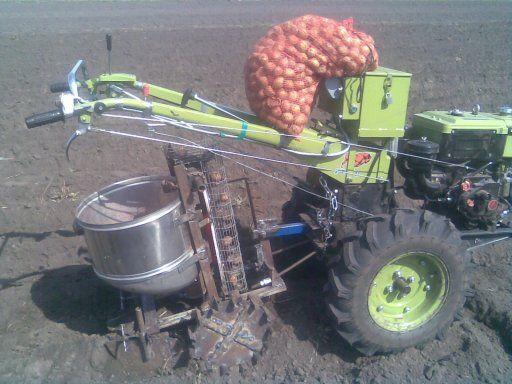
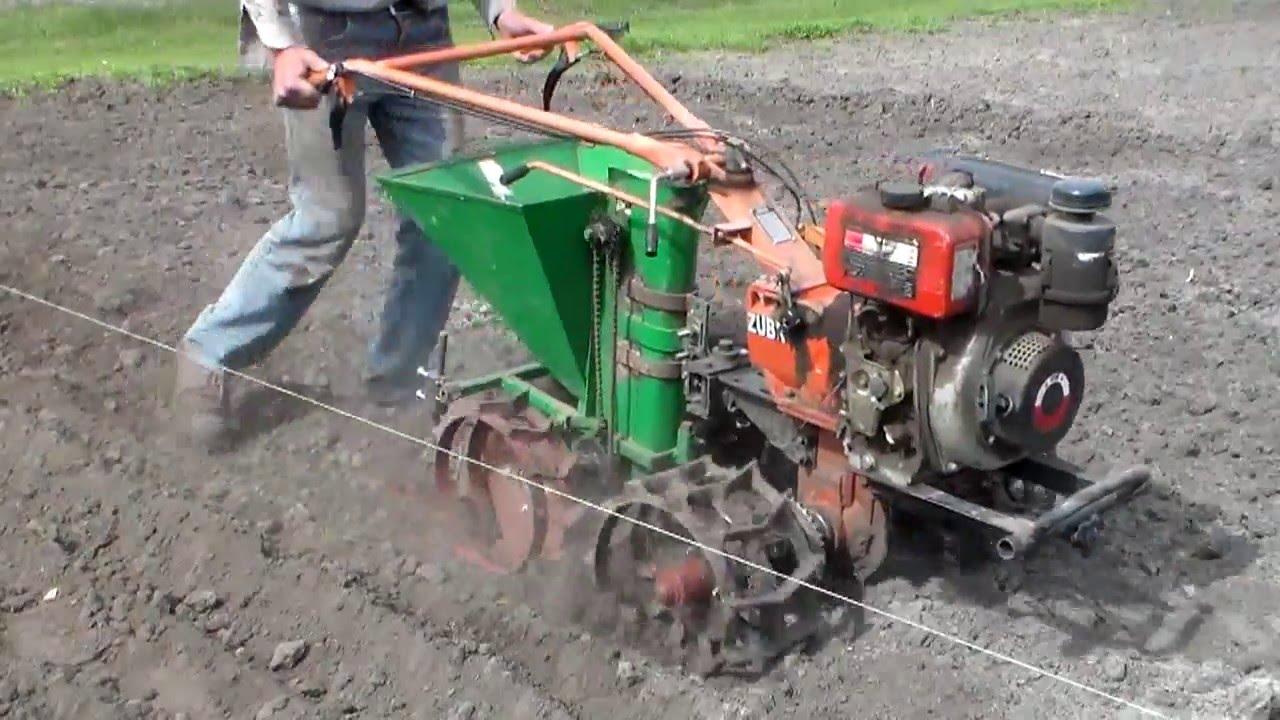
A two-row potato planter is most often used for self-propelled equipment. This type of potato planter has a more complex design and is attached directly to a walk-behind tractor.
The advantage of this device is that it allows gardeners to cultivate large volumes of soil in a short time. The self-propelled unit does all the work; the gardener simply controls the machine.
Assembling the bunker
Old tanks are most often used as bins. Tanks from old Soviet-era washing machines are considered the most suitable. Sheets of 1 cm thick metal can also be used for bins. The bin is assembled using metal angles. The bin's interior should be lined with rubber. This will reduce damage to the tubers.
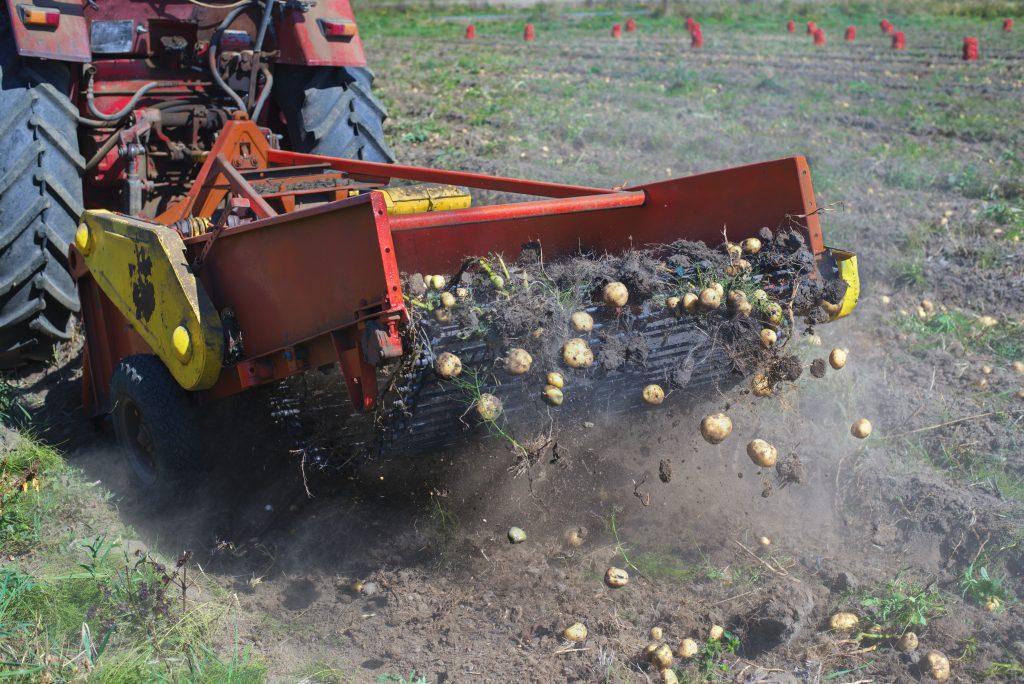
At the bottom, fasteners are attached to secure the basket to the frame. The fasteners on the bin can be made from a rubber hose or a metal bracket. Pipe troughs are installed in the center of the bottom, through which the tubers are transported.
Wheels, rippers and their holders. Seeding device
Wheels should be moderately wide to avoid leaving marks on the ground. Homemade devices can be made from a cylinder. However, metal-based wheels, which can withstand heavy loads, are most often purchased.

The holders are made from angle iron, which is welded into a square shape. The cultivators are welded to the holders and secured to the main frame. The cultivator can be a metal fan-shaped device that loosens the soil as it moves.
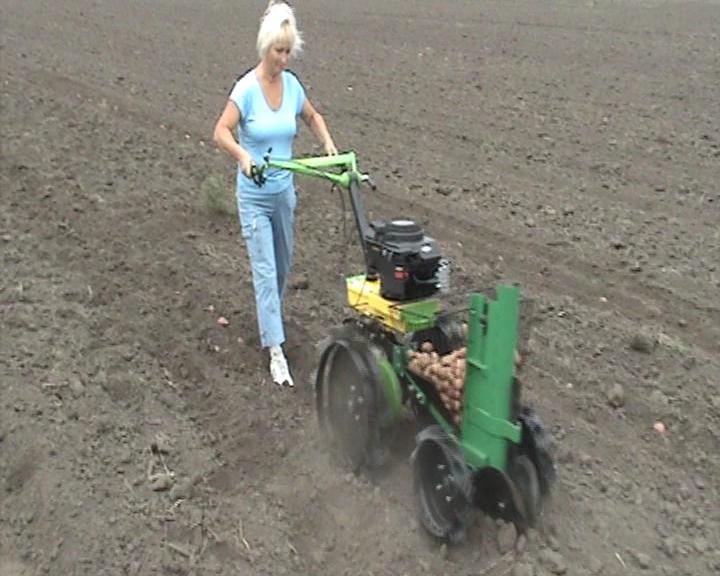
The seeding device consists of a trough through which the tubers move. The trough has a shutter that opens at regular intervals. Potatoes placed in the hopper fall into a special hole designed for one tuber. Once in the hole, the soil is leveled using a disk or a special device shaped like a small plow.
Homemade potato planter for a mini tractor
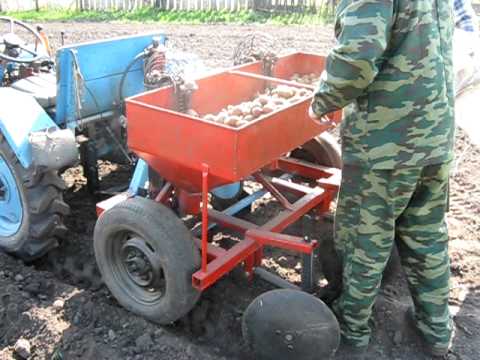
A potato planter for a small tractor is most often designed to process two rows at once. This type of device is unique in that it forms several rows at once, speeding up the planting process. To build such a device, you will need:
- make a strong frame from a metal corner;
- an axle with wheels is attached to the bottom of the frame;
- two bunkers (or one if desired) are installed for distributing planting material;
- special bipods are welded on, with the help of which ditches are dug;
- a trench is made on the side, where planting material is fed through special fasteners with cups;
- On the back of the device there are discs for leveling the soil.
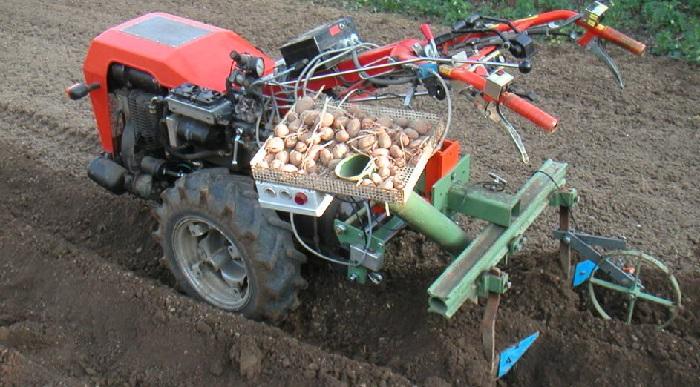 The use of a tractor is most often recommended for large areas where manual planting is ineffective.
Operating instructions
To plant potatoes correctly using the device, you must follow these recommendations:
- plow and cultivate the area where the planting process will take place;
- apply the necessary types of fertilizers;
- measure the beginning of the first row;
- after the row has been completed, adjust the immersion depth if necessary;
- carefully go through the entire area, regularly adding planting material to the hopper;
- After work, check the condition of all fasteners;
- clean the device from dirt and clods of earth.
If the planter is no longer going to be used, the seeding device must be removed and the tire pressure must be reduced.
 Important: To ensure even distribution of the potatoes, maintain a speed of no more than 1 km/h.
Additional tips and warnings
To make the planting process easier, follow these tips:
- The potato feeder can be made from a chain with special cups; this design moves in a circle, moving the planting material evenly;
- In order to avoid wasting time on loading planting material, a mini-tractor can carry several bags of potatoes at once for replenishment during work;
- To avoid leaving marks on the ground from the walk-behind tractor, a special small-sized plow is additionally used.
Before starting work, it's necessary to adjust the row spacing. This is necessary for ease of crop care. It's also recommended to attach a weight to the self-propelled tiller to prevent it from tipping over.
Using a potato planter not only saves time but also allows you to achieve even beds. A plot planted with this device can be further cultivated with a walk-behind tractor without the risk of damaging the plants.
Related posts:
 A review of the best cultivators for inter-row tillage, and how to make them yourself
 How to plant grapes step by step, with a description of the process and care
 How to propagate and grow peas, cultivation technology, and care in open ground
 The pros and cons of digging potatoes with a walk-behind tractor: step-by-step instructions
 How to properly plant peas in a greenhouse and open ground
 Description of potato digger varieties and how to make one yourself
 How to control onion flies using natural and chemical methods
 How to properly hill potatoes with a walk-behind tractor: step-by-step instructions