
- Description and characteristics of the variety
- Advantages and disadvantages
- How to plant correctly
- Choosing a location
- Soil requirements
- How to select and prepare planting material
- Planting diagram
- Care instructions
- Watering
- Trimming
- Top dressing
- Treatment against diseases and pests
- Preparing for winter
- Bush formation
- Reproduction
- Cuttings
- Layering
- By dividing the bush
- Harvesting and storage
Gooseberries are a tasty and healthy fruit typically emerald in color. However, there is a variety with golden-amber fruit. This is the Russian Yellow gooseberry. Below is a description and characteristics of the variety, information on its advantages and disadvantages, planting, care, propagation, and harvesting and storage.
Description and characteristics of the variety
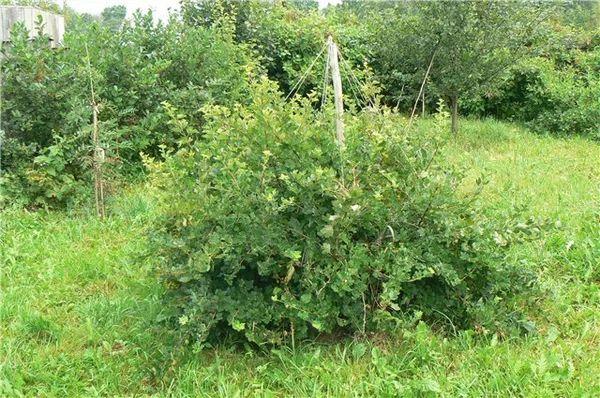
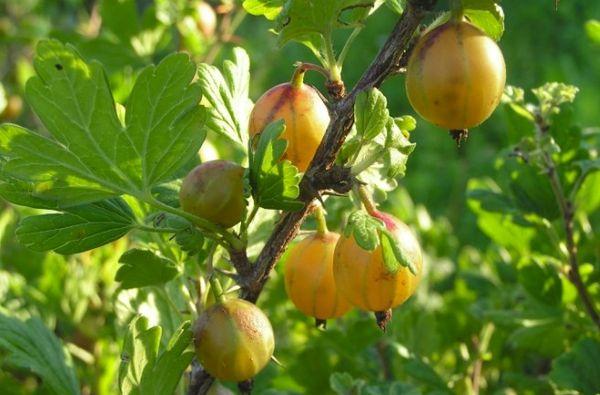
The shoots of the Russian Yellow gooseberry reach a height of 1-1.3 meters. When young, they are green, thin, and smooth; when mature, they become light gray, thick, and rough. Sparse thorns grow at the base of the branches. The crown of the gooseberry is gently spreading.
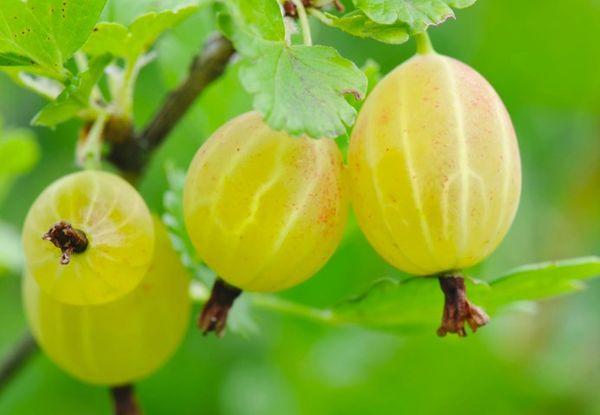
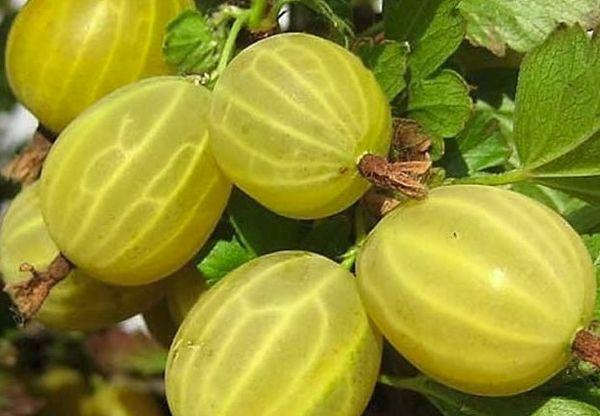
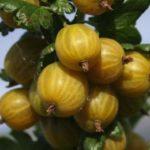
The berries are elliptical, yellow-amber in color, and weigh 5-6 grams. They are pubescent and covered with a light waxy coating. The skin is firm, and the flavor is sweet and sour. This variety is a mid-season crop, with fruiting lasting for about a month.
The Russian Yellow gooseberry can withstand winter temperatures down to -28°C. This variety is drought-resistant, but requires watering for abundant fruiting in the absence of rainfall.
The plant has good immunity and, if agricultural practices are followed, is practically not affected by diseases and pests.
Advantages and disadvantages
The positive characteristics of the Russian yellow gooseberry include the following qualities:
- winter hardiness;
- drought resistance;
- good immunity;
- high taste qualities of berries;
- suitability of fruits for transportation;
- versatility of berries;
The disadvantages of the variety include the presence of thorns on the shoots.
How to plant correctly
Gooseberries are planted in the spring, once the weather becomes consistently warm, or in late fall, but before frost sets in. To ensure healthy growth, practice crop rotation and avoid planting them after raspberries and currants. When planting, consider the spreading habit of the bushes and maintain a spacing of 1.5-1.8 meters between them.
Choosing a location
The planting area should be well-drained and protected from wind. The brighter the area, the higher the yield and sweeter the berries. Groundwater should not be too close to the soil surface, as excess moisture can damage the plant's root system with pathogens.

Soil requirements
Gooseberries prefer loamy or sandy loam soil. The planting site is prepared in advance: debris is removed, the area is dug over, and 10 kilograms of humus or compost are added per square meter. If the soil is acidic, lime is added.
How to select and prepare planting material
The Russian Yellow variety should be purchased from reputable sellers at nurseries or garden centers. The planting material should be 1-2 years old and have several well-developed shoots and a strong root system. Place the seedling in a bucket of water for 24 hours to saturate the roots.
Planting diagram
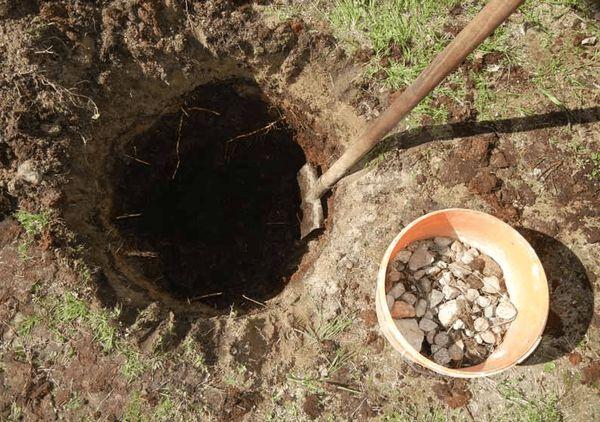
A hole for planting gooseberries is dug measuring 60 x 60 x 70 cm. If planting several bushes, space them 1.5-1.8 meters apart. Planting is done as follows:
- fertile soil is poured into the hole;
- the gooseberry bush is installed at an angle of 45°;
- the root system is straightened out and covered with soil;
- The tree trunk circle is watered generously.

Please note! To ensure as many shoots and roots as possible grow during the season, the root collar of the seedling is buried 10-15 centimeters deep.
Care instructions
Gooseberries require careful care throughout the spring, summer, and fall: watering, fertilizing, loosening the soil, and treating the plant for diseases and pests. To ensure a bountiful harvest, the crown is trained from the very first year.
Watering
The Russian Yellow gooseberry is a drought-resistant plant. However, to ensure the berries are firm and sweet, the bushes need to be watered periodically. Water the roots in the morning or evening once a week. A mature bush requires 40-50 liters of water.
Then, to prevent crusting, the soil is gently loosened with a hoe. Mulching helps retain moisture at the roots. In late autumn, a moisture-replenishing watering is applied, helping the gooseberries survive the frosty winter.
Trimming
During the spring and summer seasons, the bushes are inspected, removing diseased and dried-out branches. In the spring, frost-damaged stems are pruned. Shoots older than 5-6 years are removed completely, as they become unproductive. After pruning, the cuts are treated with special antiseptics to prevent the penetration of pathogenic microorganisms.
Top dressing
If gooseberries were planted in fertilized soil, they can go two years without fertilizing. Then, in the spring, water the bushes with an infusion of mullein diluted 1:10 or bird droppings (1:20). Use a bucket of fertilizer for each planting.
During flowering, currants are fed with phosphorus and potassium. To do this, dissolve 50 grams of superphosphate and 30 grams of potassium sulfate in a bucket of water. The same mixture is applied to the roots of the plants after flowering.
Treatment against diseases and pests
Gardeners recommend spraying gooseberries in early spring with boiling water containing a spoonful of baking soda dissolved in a liter. They claim this protects the bushes from bud mites, aphids, and pathogens.
In March, gooseberries are sprayed with a 1% solution of Bordeaux mixture. Biological preparations, such as Fitosporin, can also be used. Gardeners who advocate organic farming can use garlic or onion infusions.
Preparing for winter
The Russian Yellow gooseberry can withstand temperatures down to -28°C. If severe frosts are expected, the plants are mounded with compost in late autumn and covered with spruce branches. When snow falls, it is piled on the bush.
Bush formation
Formation begins when the gooseberry is planted. To do this, the branches are pruned, leaving 3-4 buds at the base of the plant. The following year, the five strongest new shoots are left, and the rest are pruned. By the end of the third year, the gooseberry should have 12-15 shoots of various ages.
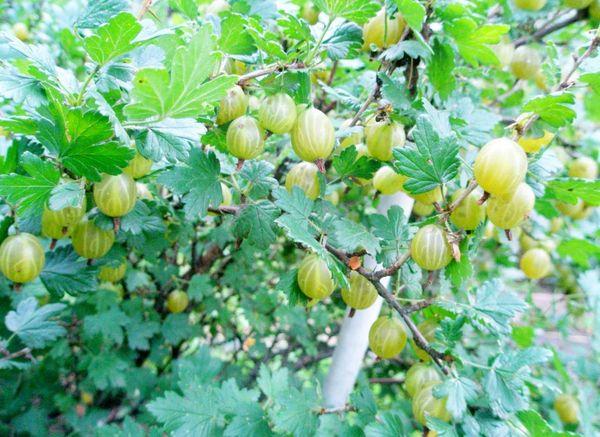
By the time a bush reaches five years of age, it has grown up to 30 branches, which is difficult to manage: the fruit becomes smaller, and the yield declines. The solution is radical: all shoots are pruned, leaving the five most fruitful ones. The gooseberry will gradually form a new crown.
Reproduction
A gardener can propagate the Russian Yellow gooseberry in a plot in several ways: cuttings, layering, and dividing the bush.
Cuttings
To propagate gooseberries using this method, cut 20-centimeter-long shoots and soak the lower cuts in a Fitosporin solution for two hours. The cuttings are then buried in a box filled with soil, which is then placed in the basement. In the spring, the shoots are planted in separate containers for further growth, and then, once the young bushes have developed, they are transplanted into the garden.
Layering
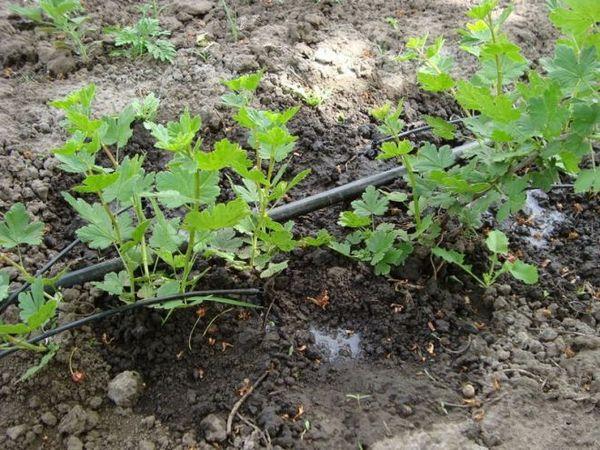
To propagate using this method, strong shoots are bent to the ground in the spring and secured with bent wire. The tops of the stems are hilled and watered. By autumn, roots and above-ground growth have developed on the layers, after which they are dug up and transplanted to their permanent location. For the winter, the young bushes are mulched with compost and covered with spruce branches.
By dividing the bush
To propagate gooseberries by division, dig up the bush and divide it into sections with a sharp tool. Each section should have 2-3 shoots and a developed root system. To prevent rot, dust the cut areas with charcoal. Then, plant each section in the prepared location.
Harvesting and storage
Gooseberries are hand-picked as they ripen. Because the berries have thorns at the base of the bush, it's best to wear long sleeves and cloth gloves when picking. The fruit is picked in dry weather.
Gardeners have come up with many tools to make the job easier, for example, cutting an aluminum mug crosswise, running the jagged edge along the underside of the branch, and all the berries easily end up in the container.
If gooseberries are transported, they are picked 2-3 days before they are fully ripe.
Picked berries can be stored for 4-5 days. At 0°C, the shelf life increases to 1-1.5 months. The berries are laid out in a thin layer. At subzero temperatures, the berries can be stored for 3-4 months. Besides freezing, they can be dried in a dry, warm place, laid out in a single layer.
Related posts:
 Description of 36 of the best sweet and large varieties of gooseberries
 Description and characteristics of the gooseberry variety Commander, planting and care
 Pests and diseases of gooseberries and their control using chemical and folk remedies
 Description of 34 best gooseberry varieties for Siberia and the Urals, cultivation techniques
 Description of the English Yellow gooseberry variety, planting and care
 Description of the Malachite gooseberry, varieties, planting and care
 22 Best Large-Fruited Gooseberry Varieties for the Moscow Region: Planting and Care
 Description of the Chernomor gooseberry variety, planting algorithm and care