
- History of the variety's development
- Description of the bush and berries
- Characteristics
- Productivity
- Drought resistance and winter hardiness
- Resistance to diseases and pests
- Ripening period
- Transportability
- Growing conditions
- Landing features
- Care instructions
- Support
- Top dressing
- Pruning bushes
- Reproduction
- Preparing for winter
- Pest and disease control
- Advantages and disadvantages
- Harvesting and storage
- Application areas
Gooseberries rightfully hold a place among the favorite fruit crops of gardeners, farmers, and vegetable growers. This berry bush is low-maintenance, climate-resistant, and easy to propagate. Its fruits not only have excellent flavor but also contain numerous beneficial vitamins and minerals. The Yantarny gooseberry variety is a time-tested berry crop that has been actively grown on farms and in garden plots for over 60 years.
So what's so special about this gooseberry variety that it hasn't lost its popularity after so many years? Let's find out.
History of the variety's development
The Amber gooseberry was bred using open pollination in the middle of the last century. The development of this new berry crop was initiated by M.A. Pavlova, a leading breeder at the Moscow Timiryazev Academy of Sciences.
The work involved the European berry variety English Yellow.
As a result of many years of experiments, scientists have achieved results and developed a frost-resistant, high-yielding gooseberry variety with increased immunity to diseases and excellent taste characteristics.
The fruit crop has not been officially registered with the state. However, nurseries continue to cultivate this berry bush, successfully growing it both commercially and in private gardens and vegetable plots.
Description of the bush and berries
To grow healthy and fruitful berry bushes, it is necessary to thoroughly familiarize yourself with the characteristics of the Yantarny gooseberry variety.
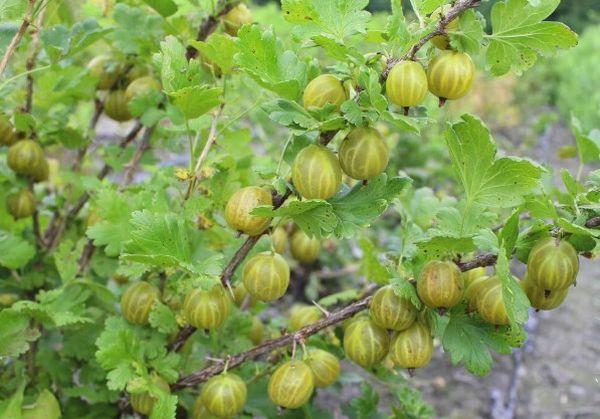
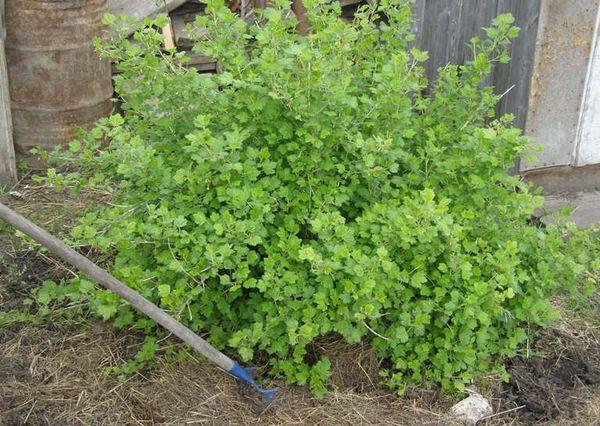
- The bushes grow powerful, spreading, dense, up to 1.8 m in height.
- Sharp thorns form on long shoots, which is typical for fruit crops.
- The leaf blades are small and rich green in color.
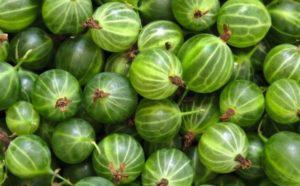
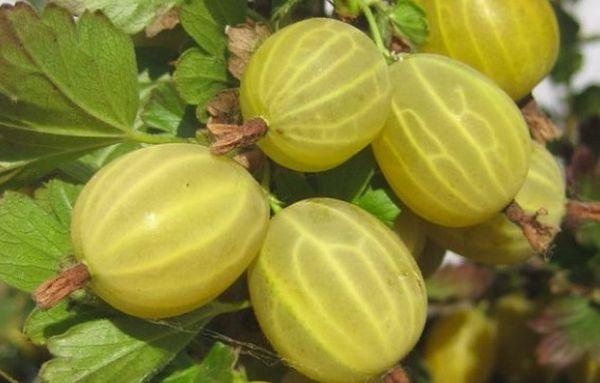
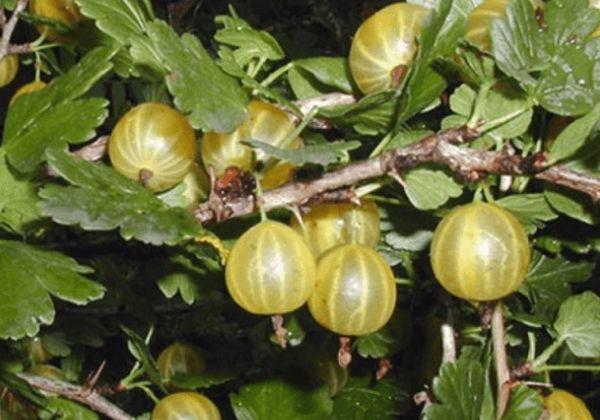
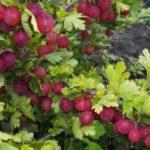
- The berries are large, up to 5 g, beautiful amber color with white inclusions, oval.
- The pulp is juicy, sweet, with a subtle honey flavor and aroma, hidden under a thin but dense skin.
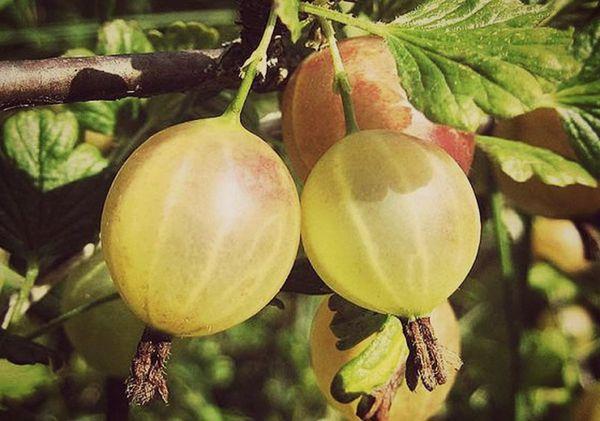 Important! The fruits do not fall off the bushes when ripe, significantly increasing the harvest time.
Characteristics
The Yantarny gooseberry is a dessert variety, recommended for fresh consumption. Thanks to the work of breeders, this variety has acquired the best properties and characteristics of the berry crop, making it suitable for cultivation throughout Russia and neighboring countries.
Productivity
The yield of fruit crops directly depends on climatic conditions, compliance with planting rules and subsequent care.
A single bush yields up to 8 kg of ripe, healthy berries. However, with proper farming practices, the yield can be increased to 10-12 kg per plant.
Important! The Amber gooseberry is a self-pollinating variety and does not require pollinators from nearby plants.
Drought resistance and winter hardiness
The berry crop is able to withstand both severe frosts and short-term drought.
In long, cold winters, the shrub's roots can survive temperatures as low as -40 degrees Celsius. If not properly protected, branches and shoots can freeze. Remove these in the spring, and the plant quickly recovers.
Gooseberries are moisture-loving plants; prolonged lack of rainfall and irrigation negatively impacts the yield and size of the berries.
Resistance to diseases and pests
When developing the Yantarny variety, breeders achieved enhanced resistance to fungal and viral diseases. The shrub is also rarely attacked by aphids.
Natural immunity can protect berry crops from diseases and pests only if they are properly and timely cared for.
Ripening period
The Yantarny gooseberry is an early-ripening variety. In southern climates, the first berries ripen in mid-June, while in northern regions, the harvest begins in the first half of August.
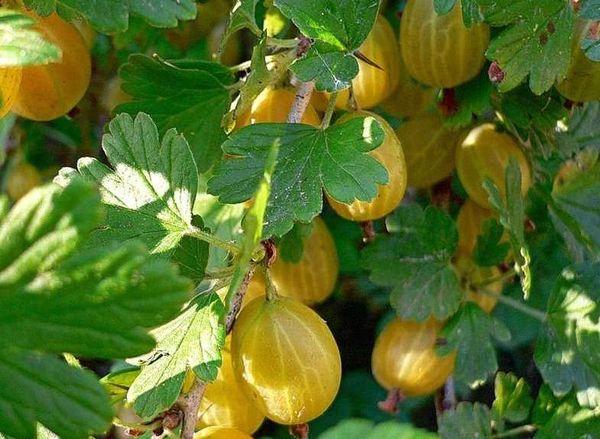
The bush begins bearing fruit in its second year of outdoor growth. Gooseberries are long-lived plants, and even 30- to 40-year-old bushes produce large, juicy, and delicious berries.
Transportability
When growing the crop on an industrial scale, harvesting begins 5-7 days before the fruits are fully ripe, which increases the shelf life of the berries and the possibility of long-distance transportation.
Growing conditions
For growing gooseberries, choose flat, sunny, dry plots of land protected from drafts and gusty north winds.
The berry crop prefers light, fertile soil with a neutral acid and moisture content.
It is not recommended to plant plants in lowlands and marshy soil, and the groundwater level on the site should be at least 1.5 m from the ground surface.
The timing of planting berry seedlings is determined by the weather conditions of the growing region.
The Amber gooseberry is an unpretentious plant; seedlings take root quickly in spring, summer, and autumn.
The difference between the planting dates lies in the beginning of the plant's fruiting period. If gooseberries are planted in the spring, the first harvest will not appear until a year later. However, after autumn planting, the berries are harvested in the summer.
Important! If the soil is oversaturated with moisture, unripe berries will crack and fall from the bushes.
Landing features
The first step to getting a high-quality and abundant berry harvest is choosing the right healthy and strong seedlings.
It's recommended to purchase planting material from nurseries or garden centers. When purchasing a seedling, pay special attention to the appearance of the plant and rhizome.
- The gooseberry stem should be straight, without obvious damage or compaction, and the presence of buds or leaves is mandatory.
- The roots are well moistened, without growths or broken parts, and well developed.
- It's best to purchase two-year-old seedlings. These plants quickly establish themselves, take root, and grow.
- 10-12 hours before planting in open ground, the plant roots are soaked in a container of water, then treated with antibacterial agents and a growth stimulant.
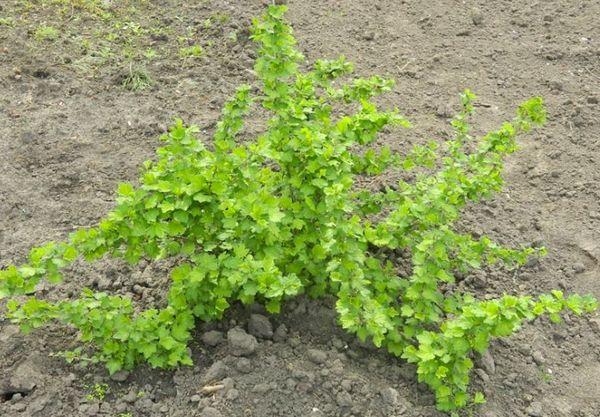
The land plot for gooseberries is prepared 3-4 weeks before the planned planting work.
- The soil is dug to a depth of 35-40 cm, while simultaneously removing weeds and roots.
- The bed is thoroughly loosened.
- Humus, organic and mineral fertilizers are added to the soil. Sandy soil is mixed with peat and humus, while clay soil is supplemented with river sand and compost.
- On the prepared area, planting holes are dug 35-40 cm deep and wide.
- The distance between plantings is maintained within 1.5 m, between rows from 2 to 2.5 m.
- I put a drainage layer at the bottom of the hole and add fertile soil.
- The seedling prepared for planting is placed in the center of the hole in a vertical position.
- The roots are evenly distributed in the hole and covered with soil.
- The soil under the planted bush is compacted and watered generously.
- After planting the gooseberry, the trunk circle is mulched with a mixture of sawdust and peat, or humus.
Important! Immediately after planting, prune the seedlings, leaving 4-5 buds on the trunk.
Care instructions
To ensure that a berry bush grows healthy, develops quickly, and bears fruit abundantly, the plant requires timely and competent agricultural practices.
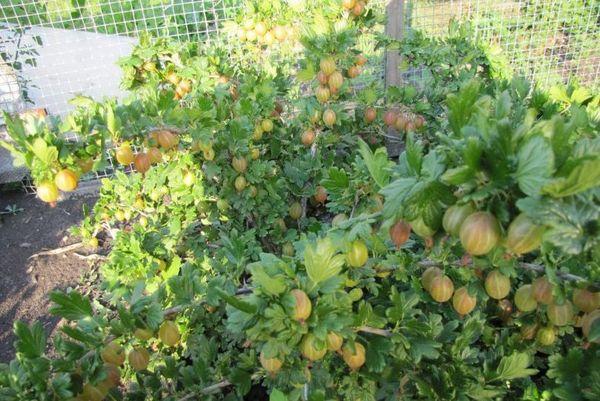
This berry crop requires watering during the fruit set and ripening period. During the rest of the year, the plant is watered as needed, once the top layer of soil has dried out.
Advice! Water gooseberries only with warm, settled water, at a rate of 30-40 liters per bush.
Along with irrigation measures, soil loosening and weeding are carried out.
Support
Gooseberry bushes grow quickly, with long, spreading branches and shoots. In the second or third year of growth, the berry plant requires additional support. To achieve this, stakes are driven around the plant and connected with wooden or metal planks, to which the bush is tied.
Top dressing
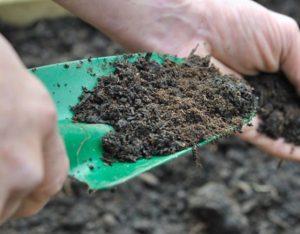
The first feeding of gooseberries is carried out in the spring, using organic and nitrogen fertilizers.
During the period of flowering and formation of ovaries, the bushes lack phosphorus and potassium.
In the autumn, berry crops are fertilized with organic and mineral fertilizers.
Important! Nitrogen fertilizers stimulate the development of green plant matter and suppress fruiting, so they are used only at the very beginning of the growing season.
Pruning bushes
To increase the yield of fruit crops, bushes are pruned annually.
The bush is shaped during the first 3-4 years of growth. In late autumn, all branches and shoots are shortened by approximately 2/3.
After the fifth year of gooseberry growth, only sanitary and rejuvenating pruning is carried out, removing all dry, broken, frozen and damaged branches and shoots.
After the pruning procedure, the cut areas are treated with special preparations or garden pitch.
Reproduction
To propagate berry bushes, vegetative methods are used to obtain seedlings.
The most common method of propagating the Yantarny gooseberry, according to gardeners and farmers, is propagation by rooting cuttings obtained from young shoots.
Also, fruit crops are propagated by layering.
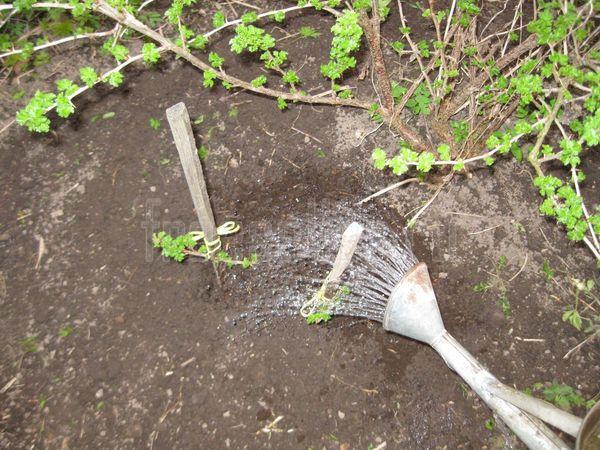
To do this, in early summer, select strong, healthy lower branches from a mature bush and bend them to the ground. The layers are secured and covered with soil, leaving the top of the plant above the soil surface. In early fall, the layer is dug up and separated from the mother bush, along with the roots that have formed. The finished seedling is placed as an independent plant in a separate planting hole.
Preparing for winter
With the onset of autumn, gooseberries begin to be prepared for winter dormancy.
The bushes are watered generously, sanitary pruning is carried out, the soil is fertilized with organic and mineral substances, the trunk circle is cleared of dry leaves, debris and mulched with a thick layer of humus or peat with sawdust.
As soon as the first snow falls, a high snowdrift is created under the bush.
In regions with cold winters, plants are additionally covered with a special material.
Pest and disease control
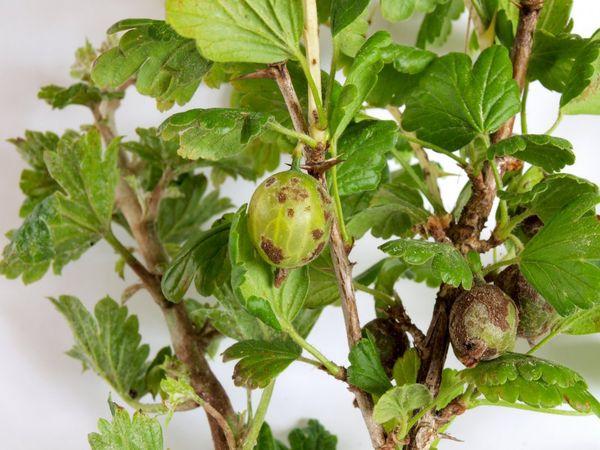
If care and agricultural practices are not followed, the Amber gooseberry is susceptible to certain types of fungi, viruses, and pests.
To avoid problems, in early spring, before the growing season begins, the bush is treated with fungicides and insecticides, and folk methods for combating diseases and pests are also used.
Planting garlic, onions, cereals, mint, or calendula next to the berry crop will help maintain the health and productivity of gooseberries.
Advantages and disadvantages
After a detailed description of the characteristics, planting, growing, and care instructions for the Yantarny gooseberry variety, you can clearly identify all the advantages and disadvantages of this fruit crop, and only then decide whether to grow it in your own garden.
Advantages:
- Extended fruiting period.
- Easy to care for.
- Ability to self-pollinate.
- Resistance to frost and sudden temperature changes.
- High yield rates of the variety.
- Increased immunity to diseases and pests.
- Long shelf life of technically ripe fruits and the possibility of long-distance transportation.
- Excellent taste qualities, universal purpose of berries.
Other advantages of the variety include the long lifespan of the berry crop and full fruiting even of old plants.
Flaws:
- Sharp thorns make plant care and harvesting difficult.
- Spreading bushes take up a lot of space, making it difficult to grow berries in small areas.
- When the air and soil are too humid, the leaves crack and fall off the bushes.
But even with these shortcomings, even a novice gardener, farmer, or horticulturist can manage to grow the Yantarny gooseberry.
Harvesting and storage
The harvest of the Yantarny gooseberry variety depends on the climatic conditions of the growing region.
In southern latitudes, work is carried out from late June to mid-July. In northern climates, berries are harvested in August.
When harvesting the fruit, be aware of the sharp thorns on the plant's branches and wear thick gloves.
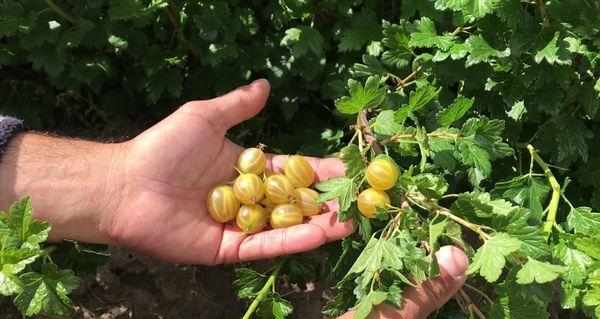
Fresh berries will keep for up to 5 days at room temperature, and up to 10 days in the refrigerator. To preserve gooseberries for a longer period, store them in spacious containers and freeze them.
Important! Freezing preserves all the vitamins and nutrients in fruits.
Application areas
This dessert variety of berry is recommended for fresh consumption.
Gooseberries are also used to make jams, preserves, marmalades, compotes, homemade wine, and liqueurs. Gooseberries are also added to confectionery, desserts, and dairy products.
Gooseberries contain a high content of minerals, macro- and microelements, vitamins and antioxidants, which are necessary for the proper functioning of the body.
Related posts:
 Description of 36 of the best sweet and large varieties of gooseberries
 Pests and diseases of gooseberries and their control using chemical and folk remedies
 Description and characteristics of the gooseberry variety Commander, planting and care
 Description of the Malachite gooseberry, varieties, planting and care
 Description of 34 best gooseberry varieties for Siberia and the Urals, cultivation techniques
 22 Best Large-Fruited Gooseberry Varieties for the Moscow Region: Planting and Care
 Description of the English Yellow gooseberry variety, planting and care
 Description of the Hinnonmaki gooseberry, varieties, planting and care