
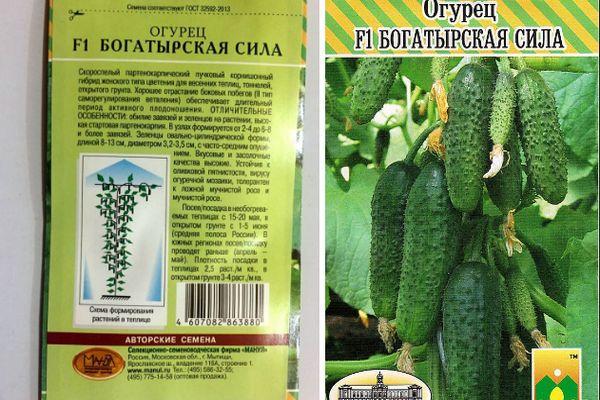
The Bogatyrskaya Sila cucumber was developed by Russian scientists. The plant thrives in greenhouses and open ground. This variety is grown not only in garden plots and on farms, but also on an industrial scale. Cucumbers are eaten fresh, sliced into vegetable salads, and preserved for the winter.
Some technical parameters of the culture
The characteristics and description of the Bogatyrskaya Sila f1 variety are as follows:
- The first fruits can be obtained approximately 40 days after sowing the seeds in the ground.
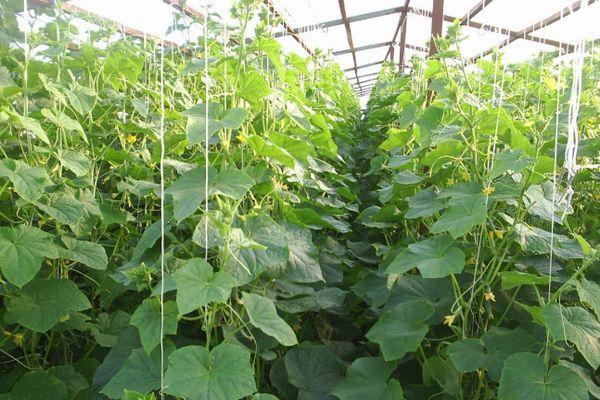
- The height of the bush of this variety ranges from 150 to 200 cm. For cluster hybrids, tying to a support made of mesh with mesh openings of at least 150 mm is required.
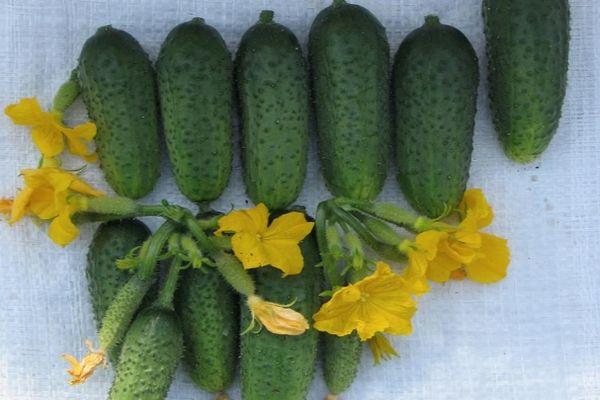
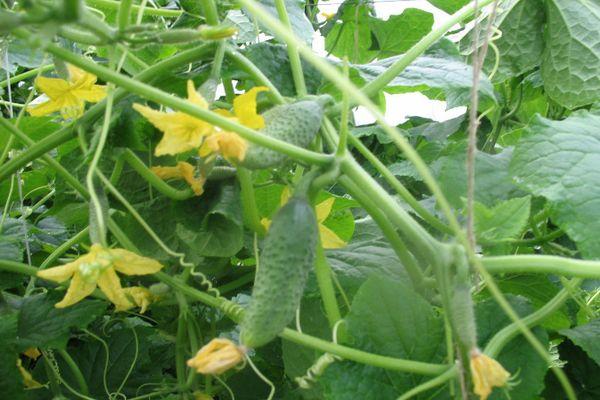
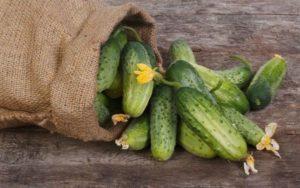
- Cucumbers grow from 80 to 150 mm in length and 3.5 cm in diameter. They are covered with dark green skin. The fruit contains a lot of juice but relatively few seeds. Cucumbers are not bitter when eaten.
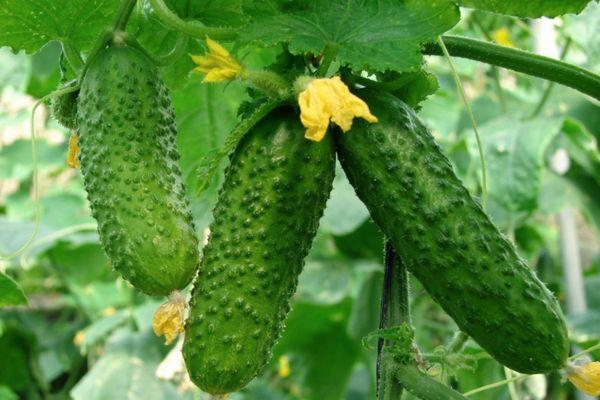
Farmer reviews indicate that it is possible to harvest 18-20 kg of cucumbers per plant. A positive characteristic of the Bogatyrskaya Sila cucumber variety is its resistance to diseases such as powdery mildew, cucumber mosaic virus, and olive spot.
The plant limits cucumber growth so that the newly grown vines don't rob the newly emerged cucumbers of nutrients. This improves the flavor of the harvested cucumbers.
The resulting harvest can be transported over any distance. The hybrid tolerates sudden temperature changes. In southern Russia, Bogatyrskaya Sila grows in open ground. If the farmer lives in the central part of the country, it is recommended to use plastic greenhouses for growing bunch varieties. In Siberia and the Far North, this variety can only be grown in well-heated greenhouse complexes and hotbeds.
Germination of seeds and obtaining seedlings
The planting material is treated with aloe juice and then stimulated with a honey solution. The seeds can be germinated on a damp cotton cloth. After roots appear, the seeds are distributed among pre-prepared pots filled with light soil. After sprouts emerge, they are watered once every 4-5 days and fed with organic fertilizer. Cluster varieties require constant feeding. When the plants reach a height of 10 cm, they can be transplanted to their permanent location.
First, prepare the beds. The soil is loosened and disinfected with a solution of potassium permanganate. Complex mineral fertilizers are added to the soil (1 tablespoon per bush). Wood ash is also added to the soil. No more than 3 bushes are planted per square meter of bed.
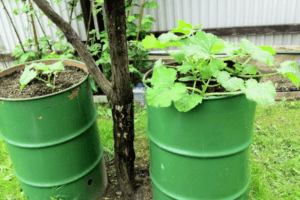
If the crop is grown outdoors, it is recommended to cover the bushes with plastic film after planting the seedlings until the first flowers appear. Choose wind-free locations for planting.
Caring for growing bushes
Plants are fertilized every 5 days using nitrogen, organic, or complex fertilizers. The number of fruits produced directly depends on the amount of fertilizing.
Water the bushes once a week with warm water. If the weather is rainy, you can reduce the frequency of watering, but in hot or dry weather, the plants should be watered daily. Pour enough water onto the bush to keep the soil well-moistened, but avoid creating a puddle underneath the plant. Avoid getting the leaves wet, as this will burn them.
It's recommended to loosen the soil twice a week. Soil aeration accelerates the hybrid's growth. At the same time, soil aeration kills pests that nest on the plant roots. Weeding helps prevent some fungal and bacterial infections. This procedure destroys parasites that settle on weeds and then move on to cultivated vegetables.
To aerate the soil and eliminate root parasites, mulching is recommended. To prevent various diseases, it's helpful to spray the bushes with medicinal products, such as Fitosporin or similar.
Farmers should monitor their plots for garden pests. Insects such as aphids and mites can damage hybrids. To get rid of them, it is recommended to use pesticides such as Inta-Vir or Metaldehyde. Folk remedies such as slaked lime and fly ash can also be used to control insects. If slugs appear in the plot, wood ash should be applied to the roots of the hybrid.
Related posts:
 The best grape varieties for growing in the Urals, planting and care rules in summer
 Methods for planting and propagating cherries at home
 80 Best Eggplant Varieties for Different Regions with Descriptions and Characteristics
 The best methods for growing grapes from seeds at home
 Descriptions of the 20 best cherry varieties for the Moscow region, their planting and care
 Description and characteristics of the best seeds of pea varieties and types
 Growing and caring for hazelnuts in open ground, rules for planting hazelnuts
 How to grow grapes in the Moscow region in open ground without a greenhouse