
- Why is it necessary to remove side shoots from cucumbers?
- Cucumbers that don't require pinching
- How to properly pinch out cucumbers in open ground
- According to the classical rules for insect-pollinated varieties and hybrids
- Pinching out stepsons with female flowering species on the main stem
- Parthenocarpic varieties and hybrids
- When should this be done?
- Tips for further care
Cucumbers are an easy-to-grow crop, yet they thrive on plenty of everything: water, light, and warmth. However, if, even with all the necessary conditions met, cucumbers produce abundant flowers and foliage but few fruits, it's important to determine the cause and remove side shoots. This procedure will increase yields severalfold by removing excess shoots.
Why is it necessary to remove side shoots from cucumbers?
Pinching out side shoots is a particularly necessary process when the shoots are well developed and the plant does not bear fruit or has a poor harvest.
Side shoots are shoots that drain the plant's energy, thereby minimizing cucumber yield. However, removing these shoots must be done very carefully to avoid harming the plant itself and the flowers growing on it. Furthermore, before removing side shoots from cucumbers, it's important to learn how to properly distinguish them from the main stem without causing damage to the plant.
Cucumbers that don't require pinching
If you don't pinch back and properly shape your cucumber plants, you won't get a good harvest. Just like watering and fertilizing, these agricultural practices are essential.
There is an opinion that pinching crops is a waste of time and that crop yield does not depend on it.
However, with uncontrolled bush growth, most of the shoots are male or sterile. Conversely, to increase fruit production, female shoots, which form only on the lateral parts of the plant, are needed.
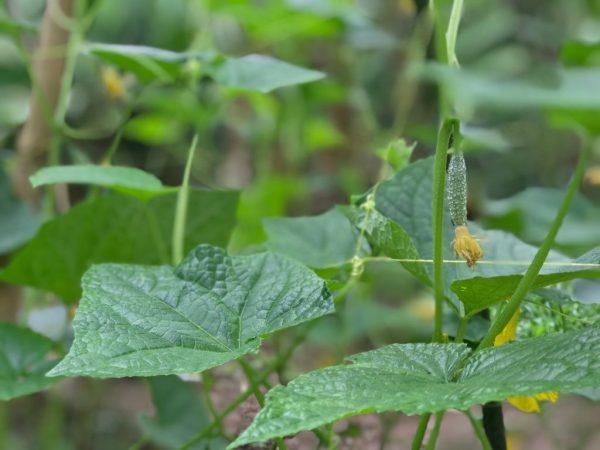
Therefore, pinching out side shoots is a necessary agricultural process that leads to:
- increase in female flowers;
- eliminating the bitter taste of vegetables;
- increased fruiting.
Therefore, all plants grown outdoors or indoors should be pinched without exception. The former are primarily insect-pollinated varieties, which produce more male flowers.
Therefore, such plants require more careful care than greenhouse bushes.
The opinion that hybrid species do not require pinching is true only for those species that have been bred recently; only experienced gardeners can recognize them:
- Valdai.
- Snowstorm.
- Snowstorm.
- Izhorian.
- Northerner.
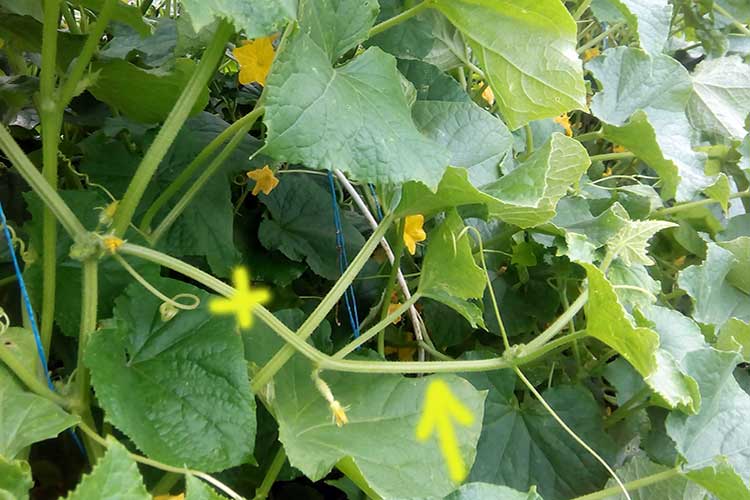
In such crops, the fruits are located on the main stem, and the side shoots develop poorly. Experienced gardeners and agricultural technicians recommend shaping any variety, including hybrids, by removing the side shoots so that the bush grows along the main stem.
How to properly pinch out cucumbers in open ground
To increase the yield of fruits planted in garden beds, side-sonning should be performed. Before side-sonning cucumbers in open ground, consider a few simple rules:
- do not squeeze the bushes close to each other;
- pre-install trellises close to the seedlings;
- the process must begin from the bottom of the crop, removing inflorescences, tendrils, and lateral shoots;
- shape the plant correctly, cutting above the 6th leaf, so that the shoots will grow to the sides and it will be easy to tie them up;
- leave no more than three shoots and four ovaries on cucumbers;
- It's not advisable to remove healthy leaves—they are a storehouse of nutrients. Diseased, rotten, and moldy parts of the plant should be removed.
- Do not cut off short stems.
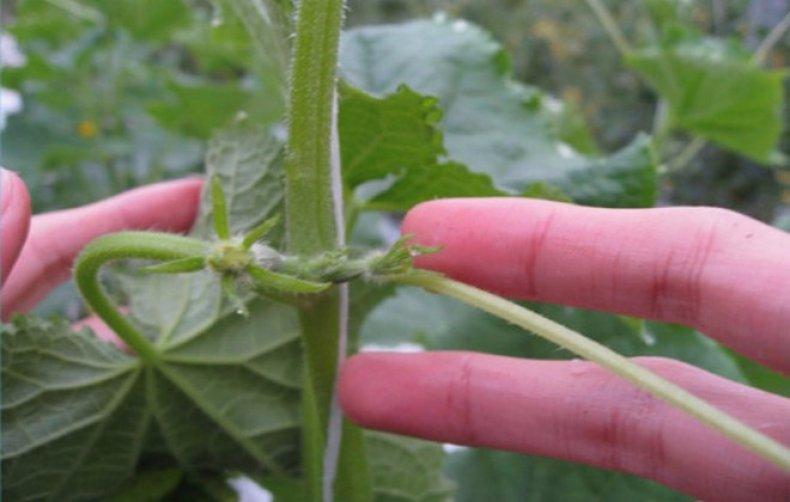
According to the classical rules for insect-pollinated varieties and hybrids
To carry out the procedure necessary for the proper growth and formation of insect-pollinated plants, you should use the classic pinching scheme shown in the picture, following these steps:
- At the bottom of the stems, 3-5 nodes are left, flowers and ovaries are removed, leaving only the leaves.
- Then, for the next 3-4 leaves, do not touch the lateral shoots, pinching them as they develop above the first leaflet.
- After this, the lateral shoots located in the axils of 3-4 leaf blades are also preserved along the stem, pinching them above the second leaf.
- Even higher up, on the lateral shoots, after removing the top, three nodes should remain.
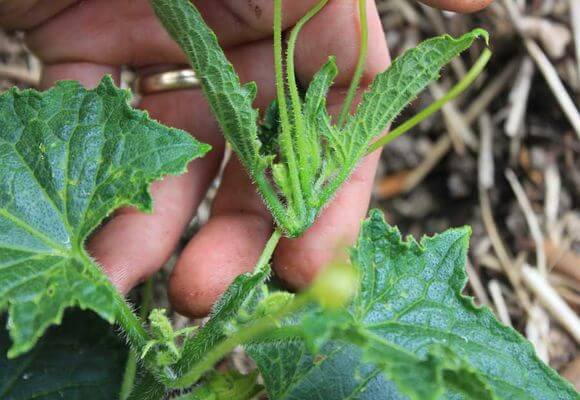
If the stem continues to grow rapidly, it is thrown onto the upper trellis so that it gradually descends downwards, or it is wrapped around a horizontally stretched rope.
Pinching out stepsons with female flowering species on the main stem
If female flowers form on the main stem, you need to follow these detailed instructions:
- Place supports to which to attach young bushes.
- The lower 6-8 nodes are blinding.
- The next 2 leaves are freed from the shoots, leaving 1 ovary in the axils.
- On the next 8 stem nodes, ovaries are formed; lateral shoots are not removed; pinching is carried out after 1 leaf, not taking into account the leaf node extending from the main shoot.
- Even higher, on 4-5 leaf axils, pinch the crop after 2 leaves.
- The central whip is wrapped around the supports, cutting off the top above the 26th leaf node.
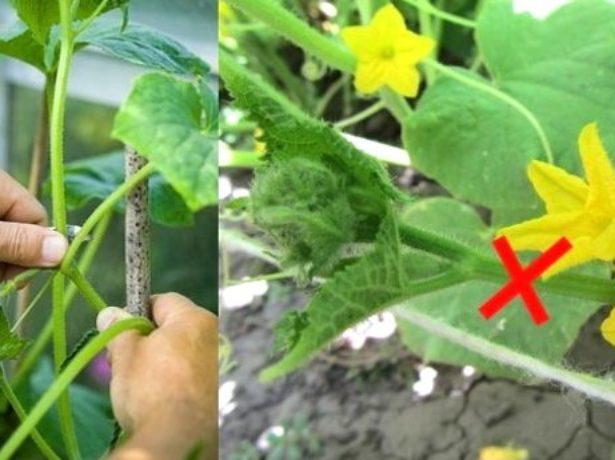
In this case, the yellow lower leaves should also be removed before the plant begins to bear fruit, so that it can freely receive nutrition and moisture.
Parthenocarpic varieties and hybrids
Self-pollinating varieties and hybrid species are formed according to the following principle:
- Blind nodes 1 through 4, leaving no shoots or flowers.
- Starting from the 5th to the 17th node, the shoot rudiments are cut off without touching the ovaries.
- From the 18th node, pinch off after the second leaf.
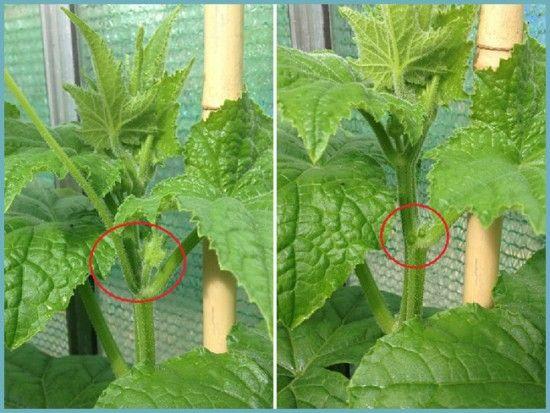
When the bush reaches the trellis, you should wrap the main shoot twice and lead it to the next plant, pinching the main shoot.
When should this be done?
The necessary agronomic measures should be taken after the plant has sprouted 5-7 leaves. All shoots, except the strongest, should be pruned after 4-5 leaves. Subsequent growth will result in the formation of 1-2 lateral shoots.
The next stage of shaping occurs after the formation of the 9th and 11th leaf nodes. After this, all excess shoots are completely trimmed off.
Tips for further care
To achieve maximum yield, here are a few tips to consider:
- Water the plants in the morning with water at air temperature.
- Lake and river water are suitable for irrigation. However, if this is not available, you can collect the water in a container, and it will warm up to the required temperature in the morning.
- Fertilize in mid-July-August, when new ovaries are not forming.
Take a look Also
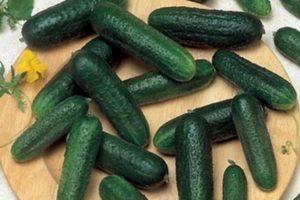
If, for some reason, the number of fruits continues to decrease, and the cucumbers themselves taste bitter, you should immediately determine the cause and take the following steps to increase the fertility of the plants:
- improve plant illumination;
- remove excess plants and weeds;
- carry out daily watering;
- mulch, weed the beds.
Related posts:
 How to prune grapes step by step for beginners
 When and how to prune cherry trees correctly, and tree shaping schemes for a good harvest
 When and how to prune currants, the scheme and timing
 A diagram and how to prune blueberries for beginners
 When and how to prune blackberries: timing and instructions for beginners
 Growing Climbing Roses and the Top 10 Varieties, Planting, and Care in the Open Ground
 Pests and diseases of gooseberries and their control using chemical and folk remedies
 How to properly prepare chrysanthemums for winter and storage methods by region