
- Can crops be planted together?
- Do the care requirements match?
- Is cross-pollination possible?
- Advantages and disadvantages of neighborhood
- Suitable corn varieties for intercropping
- Features of planting vegetable crops
- Timing of planting operations
- How far should cucumbers be planted from corn?
- Recommended layouts
- In open ground
- In the greenhouse
- How to organize proper plant care
- Tips and recommendations from experienced gardeners
Not everyone can boast a garden plot the size of a football field. Typically, it's a small area where you want to fit a flowerbed, fruit trees, berry bushes, and still have room for vegetable crops. Therefore, gardeners try to plant more compactly. For example, they sometimes combine planting corn and cucumbers in open ground.
Can crops be planted together?
Growing crops together is not only permitted, but even recommended. Crops grown in the same area thrive and produce a bountiful harvest. Corn acts as a trellis for cucumbers and provides additional wind protection. As soon as the first tendrils appear on the cucumbers, it is recommended to secure them to the corn stems, as vertical growth minimizes the risk of fungal infection.
Growing two crops in the same bed also significantly extends the harvest period, extending it into September and, in some regions, into mid-October.
Important! The root systems of the crops are located at different depths, so they do not suppress or interfere with each other's development.
Do the care requirements match?
Corn is easy to care for and doesn't require any special conditions, so it's recommended to focus on the good growth of cucumbers.
However, the watering regime must be established taking into account the deep root system of the bush with cobs.
Competition for nitrogen fertilizers may occur. To prevent plants from competing with each other, it's recommended to apply separate fertilizers rather than general ones. Proper mulching (with straw or dried grass) will also have a positive effect.
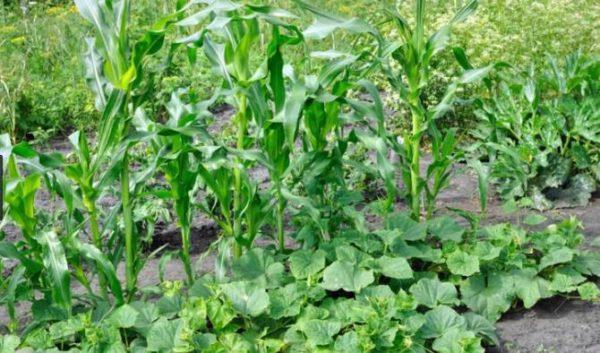
Is cross-pollination possible?
Both corn and cucumbers begin flowering almost simultaneously, attracting pollinating insects and eliminating the need for manual pollination. However, when growing crops in greenhouses, each plant variety will require separate pollination.

Advantages and disadvantages of neighborhood
Growing corn and cucumbers together in the same bed offers a wide range of advantages:
- the absorption of beneficial microelements is improved (through pollination and fertilizing), which accelerates growth and fruiting;
- the period of ripening and harvesting increases;
- cucumbers find themselves under the reliable curtain protection of corn;
- the risk of fungal diseases is reduced;
- Cohabitation greatly saves space and time spent on caring for plants.

However, nothing is perfect, and such a neighborhood also has a number of disadvantages:
- constant struggle for nitrogen fertilizers;
- If cucumber vines are not formed, they can negatively affect the corn harvest.
Important! It's recommended to plant corn a little earlier than cucumber seedlings so that the trunks become reliable trellises and the cucumbers don't choke them with their tendrils.
Suitable corn varieties for intercropping
It's difficult to identify just a few suitable corn varieties for growing alongside cucumbers. The key to planting is a good, tall wall of cobs. This depends greatly on the weather conditions of a particular region. Therefore, in unfavorable climates, it's recommended to consult experienced local gardeners.
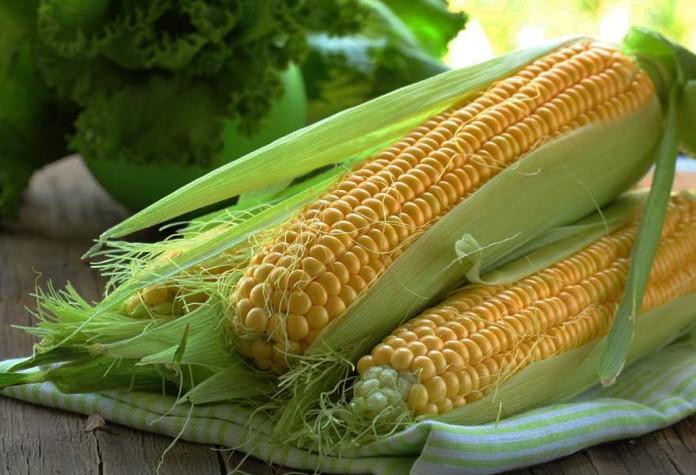
It's important to avoid planting naturally low-growing corn as a companion plant for cucumbers. If the trunks reach less than 1.5 meters, additional supports will be needed.
Features of planting vegetable crops
To increase the yield of each crop, it is recommended to adhere to certain nuances when planting:
- To save time, corn should be sown a little earlier in a greenhouse. This will allow the seedlings to grow and become strong enough to support the cucumbers.
- When sowing or planting (depending on the chosen method), it is recommended to strictly follow the planting pattern.
- It is also necessary to take into account that corn will not create a dense wall and it may be necessary to create additional protection from the wind.

Timing of planting operations
The timing of planting depends entirely on the weather conditions in a particular region. However, it is recommended to begin planting cucumbers and corn once the soil temperature has stabilized at around 10-12 degrees Celsius. This period should be between mid- to late May.
It's also recommended to follow a specific schedule when sowing seedlings. Corn should be sown about a month before cucumbers, allowing the stems to strengthen and provide reliable support. If you sow corn outdoors, you risk wasting precious time planting cucumbers. This can sometimes prevent them from ripening.
How far should cucumbers be planted from corn?
There are several suitable schemes for interplanting crops, and the spacing depends entirely on the chosen method. For a denser wall, use the 1:1 method. This means there's one corn plant per corn stalk. With this arrangement, a 30x30x30 pattern is recommended.

A 2:1 scheme is also acceptable. In this case, the distance between the corn plants is about a meter, and two cucumber vines are placed between the trunks.
Important! Using this method, it is necessary to properly distribute the load on the cob stems so that the vines do not block sunlight from reaching the corn.
Recommended layouts
The choice of crop placement scheme often depends on the desired outcome, weather conditions, plot size, and planting conditions. Planting methods vary depending on whether the crops are planted outdoors or in a greenhouse.

In open ground
In open ground conditions, the optimal planting patterns are "one to one" or "two to one." It's important to keep the distance between plants at least 30 centimeters, otherwise the root system may be suppressed.
In the greenhouse
When planting corn and cucumbers in a greenhouse in the same bed, use a 1:1 arrangement to avoid straining the cob stems. It is also recommended to consider the need for spraying the cob plants with a growth stimulant and additional hand pollination.

How to organize proper plant care
The key to a successful neighborhood is to follow two main rules of care:
- Maintain a watering schedule. This includes quantity, frequency, and temperature. It's not recommended to water plants to the point of creating a pool on the soil surface, as this leads to fungal growth and rot.
- Mulching. When planting two crops adjacent to each other, mulching with dry grass clippings is essential. The mulch layer should be at least 10 centimeters thick. This will reduce the frequency of required watering and eliminate weeds at the root.

Experienced gardeners also recommend fertilizing each plant separately. This will ensure each crop receives the maximum amount of nutrients.

Tips and recommendations from experienced gardeners
To increase yield and ensure good crop growth, experienced gardeners recommend following five key rules:
- It's not recommended to water plants after sunset. Lower temperatures combined with poor soil absorption can encourage spider mites and powdery mildew.
- Watering regimen is a crucial component of healthy plants. Until the third leaf forms, cucumbers should be watered only with warm water. This will help maintain the plant's immunity.
- Both crops require good nutrition. Immediately after planting, animal or bird manure is applied; later, during flowering, ammonium phosphate is applied, along with foliar fertilizers (a mixture of manganese, zinc, boron, and copper).
- Cucumbers definitely need bush shaping and pinching.
- Both plants require regular loosening of the soil and removal of weeds.
Corn and green vegetables thrive in the same bed, saving garden space. Knowing a few basic care guidelines can help you reap a bountiful, high-quality harvest.
Related posts:
 Technology for growing corn in open ground and greenhouses, planting and care
 Corn sowing rules and regulations, how to plant and prepare seeds
 Description and characteristics of the most productive varieties and hybrids of corn
 How to properly plant cucumbers in open ground with seeds, and at what depth
 Technological map for growing corn for silage, seeding rates and yield per 1 ha
 Rules for harvesting corn from fields for different purposes: for grain, for popcorn and for silage
 Description of unusual methods for planting and growing cucumbers
 Why do you need to fertilize corn? Irrigation and watering after applying fertilizer.