
- Benefits of bunching cucumbers
- Fruit size and high yield
- They don't outgrow
- Many fruits ripen at the same time
- Disease resistance
- How to grow cluster-fruited varieties in your garden
- What to consider when growing hybrids
- Wind protection
- Soil composition and structure
- Shelter
- Lighting
- Features of planting bunch varieties
- Optimal times for sowing and planting
- Seating plan and technology
- In greenhouse conditions
- In open ground
- Proper care of hybrid cucumbers
- The nuances of forming ovaries in bunch cucumbers
- Why is the number of ovaries decreasing and what can be done about it?
- Popular hybrids for open ground and greenhouses
- Dwarf F1
- Lisette F1
- Piccolo F1
- Our Masha F1
- Avalanche F1
- Sail F1
- Mother-in-law F1
- Prestige F1
- Okhotny Ryad F1
- Russian style F1
- Robin Hood F1
- King of the Garden F1
- Tom Thumb F1
- Yamal F1
- Detinets F1
- Balcony F1
- Blizzard F1
- Junior Lieutenant F1
The main characteristic of bunch cucumbers is their ability to produce more than two ovaries simultaneously in a single node. There's a long list of advantages these varieties possess. The number of ovaries depends on many factors: the amount of light, nutrients, and soil structure. It's important to ensure proper care, properly train the bush, and follow certain other guidelines.
Benefits of bunching cucumbers
The popularity of bunch cucumber varieties is explained by the presence of a large list of positive characteristics. They tolerate adverse weather conditions well, are resistant to diseases, produce high yields, and do not require special care. After the first stage of fruiting, the second wave begins.
Bunch cucumber varieties differ in their branching type:
- with weak branching, the shoots form a small number of lateral branches, so pinching is not required;
- limited branching makes it possible to harvest for a long time, few lateral shoots are formed;
- Varieties of cucumbers with strong branching allow cucumbers to be harvested for a long time, but at the same time, pinching is not required.
Before planting cucumbers, you need to familiarize yourself with the description of the chosen variety.
Fruit size and high yield
Cluster cucumber varieties will delight you with a bountiful harvest in any weather conditions. This is because the flowers in the cluster open every 3-4 days. This vegetable crop guarantees that even if some clusters are exposed to rain or cold, others will definitely produce fruit.
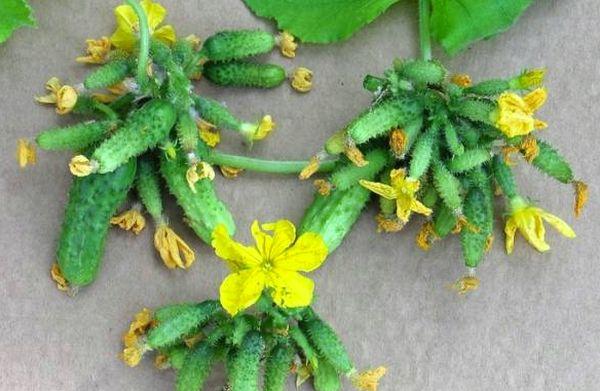
Cucumbers are no longer than 15 cm, so they are used for canning and other preserves. If the fruit is longer than 16 cm, its shape becomes distorted and its flavor is lost.
They don't outgrow
The fruits in a bunch compete with each other for nutrients, so the cucumbers are uniform and never overgrow. The more fruits in a bunch, the slower they grow. This property is especially beneficial for those vegetable growers who don't have the opportunity to visit their garden frequently.
Many fruits ripen at the same time
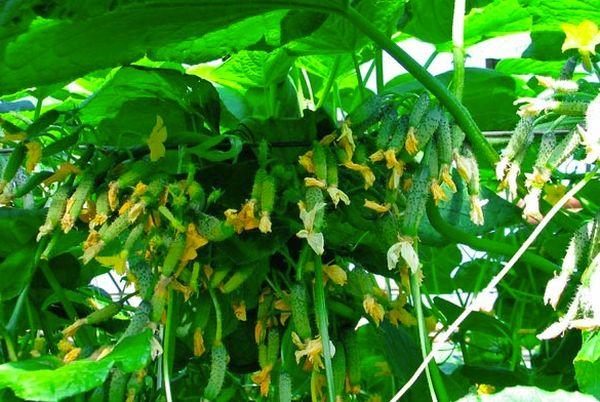
During the peak fruiting season, cucumber vines can produce up to 18 cucumbers per node. A large harvest can be harvested in one go.
Disease resistance
The characteristics of the selected variety should indicate its level of disease resistance. It's best to plant varieties with high resistance to various infections.
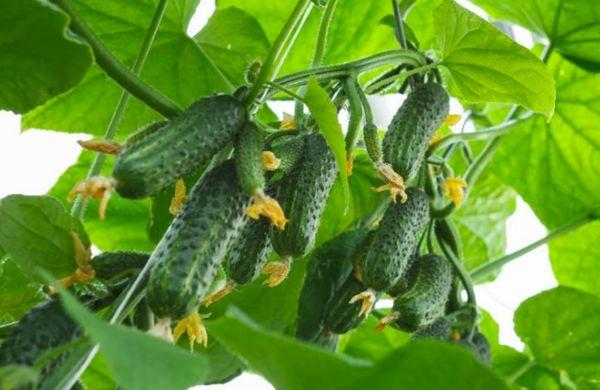
How to grow cluster-fruited varieties in your garden
To ensure that bunch cucumbers form many ovaries and bear fruit actively, certain conditions must be created for them:
- The varieties are demanding of light, so well-lit areas should be chosen for planting.
- Timely fertilization is essential. Fertilization frequency increases from the very beginning of fruiting to once every 7 days.
- To ensure new fruit sets, the harvest must be timely. Typically, harvesting is done every other day.
- It is recommended to install a support for vertical growing.
- It is better to form a bush into one stem.
If you follow these rules, you will be able to grow a good harvest of cucumbers.
What to consider when growing hybrids
When growing cluster hybrids, it's important to follow a few rules. They will help you reap a bountiful harvest and prevent many problems.
Wind protection
To plant vegetable crops, choose a site that is reliably protected from through winds.
Soil composition and structure
Cucumbers grow well in fertile, loose, light soil with a neutral acidity level.
There shouldn't be any standing water, so drainage should be provided at the bottom of the bed. It's also important to choose a site away from groundwater.
Shelter
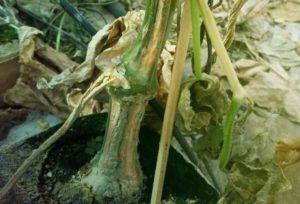
The plant produces numerous ovaries, which require constant nourishment. It's important that the plant has a strong root system, healthy stems, and large leaves before fruiting begins. Only such a plant will provide the necessary micronutrients for the young cucumbers.

It is better to grow cucumber seedlings in a greenhouse or keep them under film until the threat of frost has passed.
Lighting
Cucumbers with cluster-growing fruits should be planted in open areas with unobstructed sunlight throughout the day. If the site is partially shaded, it's best to choose shade-tolerant varieties.
Features of planting bunch varieties
Planting cucumbers in closed or open beds is carried out using seeds or seedlings:
- First, the seeds are selected, disinfected and germinated.
- It is better to plant seeds directly into separate peat containers.
- The soil structure should be loose and light.
- It is important to maintain a distance between the bushes, as cucumbers do not tolerate crowding.
- In the prepared bed, make depressions which are watered with a solution of potassium permanganate.
- Cucumbers are best grown vertically. To do this, stretch a rope from each plant to a pre-stretched wire two meters from the bed.
During cultivation, it is recommended to treat cucumber plantings with products that improve fruit set. Solutions based on Epin or Zircon have proven effective.
Optimal times for sowing and planting
Seedlings are sown in late April. Transplanting into the ground occurs in the last ten days of May, when the first pair of true leaves appears on the seedlings.
First, the seeds must undergo a preparatory stage:
- the planting material is immersed in warm water for 4.5 hours;
- then the seeds are laid out on a damp cloth surface, covered with another layer of wet cloth and left until roots 0.5 mm long appear;
- It is better to plant sprouted seeds in separate cups, since seedlings do not tolerate picking well;
- The containers are covered with film and placed in a dark place until the first shoots appear.
If you plan to sow the seeds directly into open beds, you should wait until the soil warms up thoroughly. Therefore, sowing begins no earlier than the 20th of May.
Seating plan and technology
Cluster cucumbers should be planted at a wide distance from each other. Seedlings can be transplanted into open areas only when the air has warmed sufficiently. The soil temperature should reach 10°C (50°F) at a depth of 11 cm.
The seedlings are planted in pre-prepared holes 10 cm deep. The bushes are planted in a row, keeping a distance of 40 cm.
In greenhouse conditions
Soil preparation for planting begins in the fall. The area is dug over and compost or humus is added. A couple of days before transplanting, the beds are watered generously.
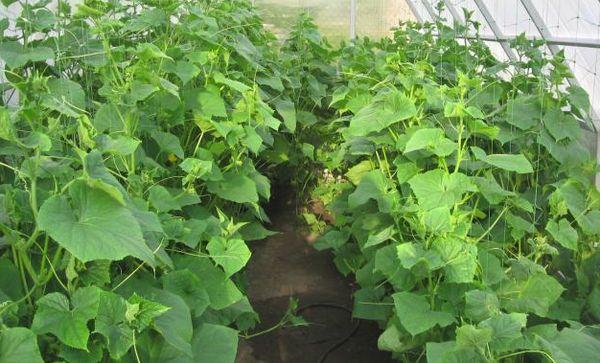
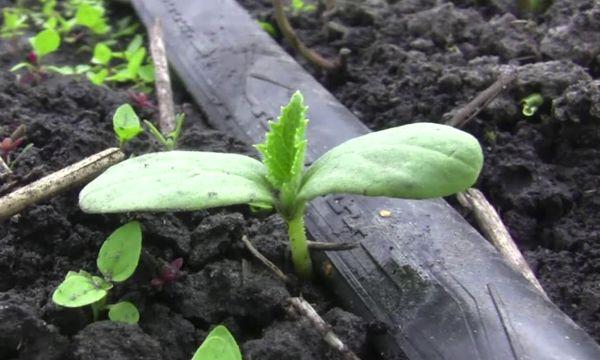
Planting can only begin when the soil warms to 10 degrees Celsius. Sow three seeds in each hole at a depth of 20 mm. Cover the seeds with soil, water, and cover with plastic wrap. Once the seedlings emerge, remove the plastic wrap and thin out the seedlings, leaving the strongest shoots.
It's important to create optimal conditions inside the greenhouse for the favorable development of vegetable crops. Humidity levels are always maintained at 90-95%. Immediately after planting the seedlings, the air temperature should be 23°C (73°F), and during flowering and fruit set, 27°C (80°F).
Cucumbers should be watered only with warm, settled water. Until the first fruits form, watering should be done once every six days. During the fruiting period, water the beds every two days.
In open ground
Avoid planting cucumber plants too close together. In open areas, 3-4 plants per square meter is acceptable. Overcrowding will reduce yield and increase the risk of infection.
The area chosen for planting is dug over and fertilized. The bed is made 70 cm wide, then longitudinal furrows are made 2 cm deep. The bottom of the furrow is watered with a growth-stimulating solution. The seeds are sown at a distance of 50 cm and covered with soil.
Proper care of hybrid cucumbers
Caring for the crop involves simple steps:
- Proper watering involves moistening the soil every two days. Use only warm, settled water.
- After watering, the soil is loosened. This procedure improves the flow of nutrients and air to the plant roots.
- It is essential to combat weeds, which are a source of infection and pests.
- Preventative treatments will help preserve the ovaries and prevent disease and pest attacks.
- Another important factor is timely fertilization. During the active fruiting period, cluster cucumber hybrids absorb large amounts of nutrients from the soil. Fertilizer should be applied in small amounts every week.
- It is recommended to carry out garter and shaping.
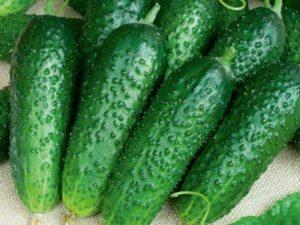

The harvest is collected every two days.
The nuances of forming ovaries in bunch cucumbers
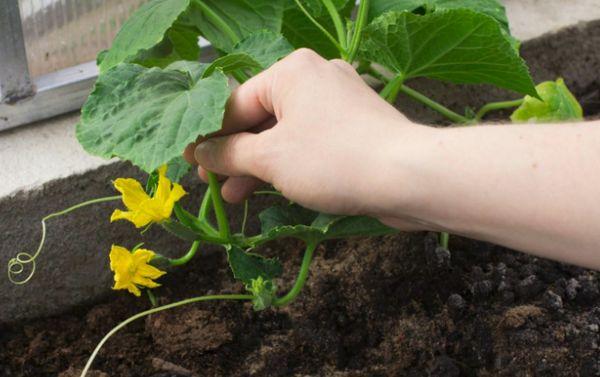
The bush is trained to a single stem to avoid wasting energy on side shoots. Failure to train the plant will significantly reduce yield:
- Leaves and shoots at the level of the four lower nodes are completely removed. Only the ovaries with one leaflet at each node should remain on the stem.
- In the following axils, the lateral branches are removed, leaving two leaves and one bunch.
- Next, leave two bunches and two leaves.
- In the fourth sinus, three bundles are left.
In order for the shoots to grow upward, you need to install a support to tie up the stem.
Why is the number of ovaries decreasing and what can be done about it?
The number of ovaries in a bunch may vary, depending on growing conditions and care features. Unfavorable factors that lead to a decrease in ovaries include:
- over-fertilization (especially nitrogen);
- failure to comply with the watering regime (excess or deficiency of moisture);
- air temperature changes;
- insufficient lighting;
- infestation with pests and infections.
To prevent the problem, gardeners need to carefully care for the crop and carry out preventative measures.
Popular hybrids for open ground and greenhouses
Cluster and super-cluster cucumbers are common in garden plots. They require little effort or time, yet yield a bountiful and delicious harvest. The key is to follow proper growing techniques and follow a few recommendations.
Dwarf F1
This hybrid is an early, parthenocarpic cucumber variety. Harvesting begins after 44 days. The bush is medium-height and produces abundant fruit. The oval-cylindrical, smooth cucumbers reach up to 7 cm in length. This variety is rarely susceptible to infection, withstands adverse weather conditions well, and is suitable for long-distance transportation.
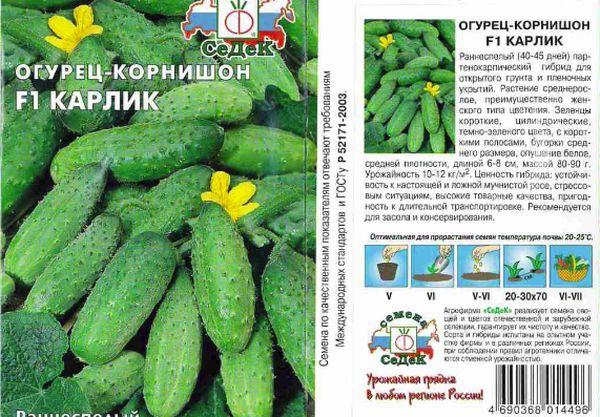
Lisette F1
Lisette is an early-maturing vegetable crop. Harvesting begins after 36 days. Its parthenocarpic flowering pattern makes it suitable for growing indoors. The bush is low, with a strong stem and few side branches. Each leaf node produces eight even, dense, 7.5 cm long cucumbers. Their surface is covered with large tubercles. The yield is high and ripens at a consistent time.
Piccolo F1
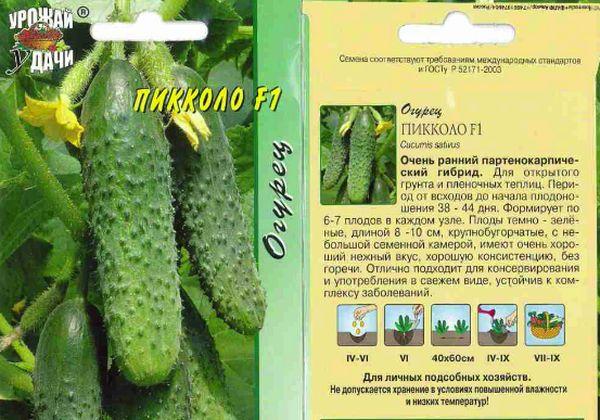
This self-pollinating hybrid begins to produce fruit early. Harvest maturity occurs at 39 days. More than seven ovaries form in a single bunch. The dark green fruits are covered with large tubercles, reaching 9.5 cm in length. It is highly resistant to a wide range of cucumber diseases.
Our Masha F1
The Nasha Masha hybrid has an early ripening period. Harvesting of the abundant crop begins after 41 days. It belongs to the parthenocarpic group of plants with indeterminate growth. The elongated, smooth gherkins grow no more than 8.5 cm in length and weigh 72 g. Tubercles are clearly visible on the surface. The variety is distinguished by its high resistance to infections.
Avalanche F1
Lavina F1 is an ultra-early, self-pollinating hybrid. The period from the first shoots to the beginning of harvest ripening takes no more than 1.5 months. The young fruits grow no more than 8 cm. The dense skin is covered with large tubercles, which are adorned with black spines. These plants are distinguished by their high hardiness and strong immunity.

Sail F1
Parus F1 cucumbers are characterized by early fruiting and an indeterminate growth pattern. Gardeners begin harvesting after 43 days. Pollination is parthenocarpic, so they can be grown indoors. The fruits begin to ripen simultaneously. The cucumbers are round-cylindrical, reaching 88 mm in length and weighing up to 89 g. The surface is partially covered with small tubercles, with short light stripes visible against the dark green background.
Mother-in-law F1
The plant is a female flowering type. A bountiful harvest begins after 46 days. The cucumbers grow up to 10.5 cm in length and weigh up to 112 g. The entire surface is covered with tubercles with dark spines. The hybrid is undemanding and resistant to adverse conditions.
Prestige F1
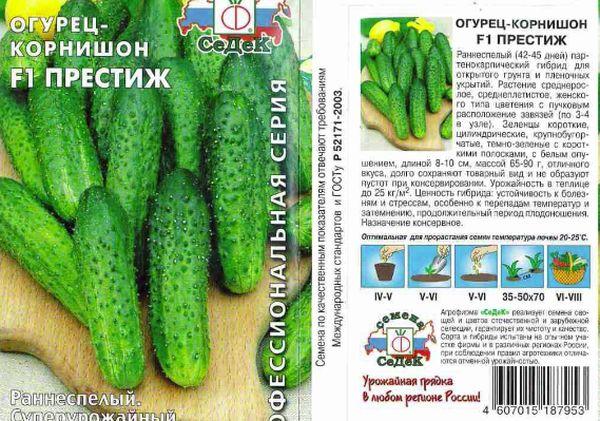
This hybrid cucumber variety belongs to the self-pollinating, early-ripening group. Harvesting of the mature crop begins after 1.5 months. The plant is short and vigorous. The cucumbers are short, cylindrical, and weigh 83 g. The skin features large bumps with whitish spines. The interior is smooth, not watery, and sweet. High disease resistance, a long fruiting period, and abundant harvests are the main advantages that attract vegetable growers.
Okhotny Ryad F1
This hybrid belongs to the parthenocarpic, ultra-early group of cucumbers. The bush is vigorous, reaching up to 230 cm. The cucumbers grow cylindrical, with skins covered with sparse tubercles and light-colored spines. The fruit length is no more than 9.5 cm, weighing up to 105 g. It exhibits high disease resistance and produces a bountiful harvest.
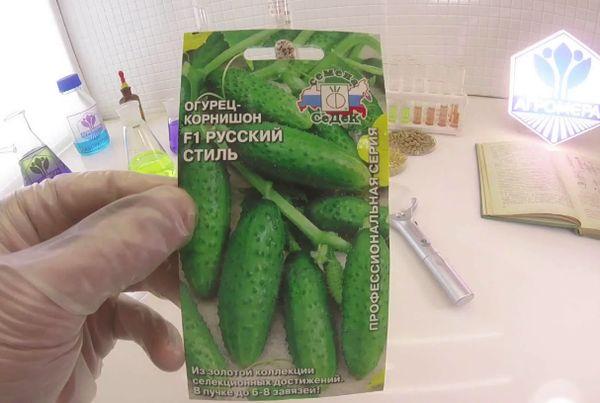
Russian style F1
Self-pollinating, mid-early vegetable crop. Harvesting begins after 47 days. The bush is characterized by an indeterminate growth pattern. The cucumbers are cylindrical and grow up to 12 cm in length. The pods have small tubercles with light pubescence. The variety is distinguished by high disease resistance.
Robin Hood F1
This parthenocarpic hybrid is distinguished by its early ripening and abundant harvest. A cluster contains up to six fruits. The bush is medium-sized, with little branching. The round-cylindrical cucumbers grow up to 6.5 cm in length. The skin is covered with large tubercles, tipped with black spines. Light stripes are clearly visible on the dark green skin.
King of the Garden F1
King of the Garden is an early-ripening, self-pollinating variety. Up to six round-cylindrical cucumbers are borne in a single bunch. Harvesting begins after 44 days. The fruits are 9.5 cm long and weigh 87 g. The surface is marked by bumps with dark spines. This hybrid boasts high immunity and the ability to produce a bountiful harvest.
Tom Thumb F1
Tom Thumb belongs to the parthenocarpic group of vegetables. The fruit ripens early, in just 37 days. It produces a profusion of fruits in any weather. The cucumbers are short, no more than 8.5 cm long, weighing 88 g. They are oval in shape, with numerous tubercles with whitish spines on the surface, stripes, and pubescence. The variety's positive qualities include high resistance to infections, a long shelf life for the harvested crop, and suitability for long-distance transport.
Yamal F1
This hybrid will delight you with its abundant and early harvest. Fruiting begins after 42 days. The vines reach up to 240 cm. The cylindrical cucumbers reach 10.5 cm in length, weigh 79 g, and have skins covered with small tubercles. This variety rarely suffers from diseases and tolerates inclement weather well.
Detinets F1
This self-pollinating hybrid begins to ripen after 45 days. The bush is characterized by an indeterminate growth habit. Five ovaries form in each leaf axil. The cucumbers are short, up to 11 cm, cylindrical, with small tubercles and light pubescence. The fruit weighs 120 g. The plant exhibits good disease resistance.
Balcony F1
This early-ripening, bunch-type hybrid is suitable not only for growing in open beds, but also for windowsills. It is parthenocarpic, easy to grow, and early-ripening. It begins bearing fruit after 40 days. A single axil can contain up to 8 ovaries. The fruits are oval-cylindrical, short, with small tubercles all over the surface and white spines, weighing 85 g. Fruiting is prolonged.

Blizzard F1
The plant is parthenocarpic, with early fruit ripening. Fruiting begins after 38 days. The vines stretch up to 80 cm. Up to 7 ovaries form in the leaf axils. The cucumbers are cylindrical, weighing 65 g. Numerous tubercles and white stripes appear on the surface.
Junior Lieutenant F1
This hybrid is characterized by the formation of a large number of fruits, parthenocarpic flowering, and early ripening. Up to seven ovaries form per node. The fruits are short, reaching 11 cm in length, covered with tubercles with white spines. The variety is resistant to many infections and tolerates other adverse conditions well.
Related posts:
 Top 50 Best Cucumber Varieties for Polycarbonate Greenhouses with Descriptions
 Description of the best early-ripening cucumber varieties for open ground and greenhouses
 TOP 30 best determinate cucumber varieties with descriptions
 Description of the best, most productive and new varieties of cucumbers for 2025
 TOP 30 best varieties of cold-resistant cucumbers with descriptions and characteristics
 When to plant cucumbers in open ground in Siberia, how to grow them, and the best varieties
 Description of the best varieties of pickling and barrel cucumbers for greenhouses and open ground
 Description of the best varieties of Chinese cucumbers, planting, growing and care
I wonder why you haven't mentioned the Grape Bunch variety? We've been growing this variety for several years now. It's very resilient to various natural disasters. The cucumbers are small and tasty, the skins are thin, so you don't need to peel them off for salads. They're also good for storing in jars for the winter, or even pickled.