- Goals and objectives of transplantation
- What season is best for replanting?
- In the spring
- In the fall
- Is it possible to transplant bushes in summer?
- Preparatory stages
- Choosing a location
- Preparing the soil and planting hole
- Preparing red and black currant bushes
- Do currants need to be pruned?
- Rules for landing at a new location
- What should be taken into account when replanting young and old currants
- Specifics of transplanting different types
- Black
- Red and white currants
- Further care of the crop
- Result
The time to transplant currant bushes to a new location is crucial not only for normal plant development but also for increasing yield. Transplanting can be done at any time, but spring and fall are preferred. During this time, the plant adapts to its new location and is much less susceptible to disease.
Goals and objectives of transplantation
Transplanting currant bushes to a new location becomes necessary for bushes over 10 years old. This procedure is performed to achieve the following goals:
- If the bushes are planted too close together and interfere with the normal development of other crops, spacing is necessary to ensure the normal development of not only the currants but also the neighboring crops.
- In situations where a bush has been growing in one location for a long time and rejuvenation is necessary, this process increases yield and prevents potential plant death.
- When young bushes no more than two years old need to be replanted. This situation most often occurs when propagating plants using cuttings.
- When growing in one place, the soil becomes depleted and the crop should be transplanted to more fertile land.
- If the soil is contaminated and not suitable for further cultivation of the crop.
The purpose of replanting is to obtain a harvest and provide the plant with all the necessary conditions for normal growth and development.
What season is best for replanting?
To ensure the bush quickly adapts to its new location, it's important to follow the planting timing. The plant can be replanted in spring or fall.
In the spring
Repotting a shrub in the spring is done in the first month, when the plant is dormant. This prevents it from dying if accidentally damaged. Spring planting is suitable for plants that are at least three years old and have developed roots.
In the fall
Autumn is the perfect time to transplant currant bushes. Bushes should be replanted in late September or early October. The plants will establish themselves in their new location and take root before frost sets in. Bushes transplanted in the fall are much less susceptible to disease and will bear fruit the following year. Currant bushes should be replanted before temperatures drop, and humus should be added to the soil during the transplanting process.
Is it possible to transplant bushes in summer?
Currant bushes are rarely replanted in the summer, but the procedure is performed if necessary. Replanting occurs in July; to ensure the plants take root, the bushes should be removed along with a large lump of soil. Replanting should be done in the evening, when the sun is not as hot. Regular watering is essential during the first few days. Late-ripening varieties can be planted in August; this will reduce the risk of pests and diseases.
Summer planting is also used for container-grown seedlings. Such planting material requires thorough soil warming, so in regions with cold weather, it is planted in summer.
Preparatory stages
In order for currants to take root, certain preparatory features must be observed.
Choosing a location
Choosing the right planting site affects not only the yield of the crop but also its adaptation to the new location. The site must be cleared beforehand, removing all roots and weeds. The bush should be planted in a sunny location. The humidity level in the area should be neutral. Sites with close groundwater levels are not suitable for planting currants. The area should also be protected from drafts. Planting bushes close to buildings is not recommended, as this will hinder the plant's normal development.
Important: Keep in mind that crop varieties and cultivars may have different site requirements. Therefore, site selection is based on the variety.
Preparing the soil and planting hole
Once the site has been selected and cleared of the grass, the soil must be properly prepared. Humus is added to the area and thoroughly dug. Holes up to 50 cm deep are dug. The soil from the holes is used to prepare a nutrient mixture. Mix 2 parts soil, 1 part humus, 1 part wood ash, and 0.5 parts superphosphate. Fill the holes a quarter full with the nutrient mixture and leave for a week.
Important: When preparing the soil, be careful to ensure it is light. If it has a clayey consistency, add river sand.
Preparing red and black currant bushes
To ensure the plant quickly adapts to its new location, some preparatory work should be carried out. Preparing the bush involves the following steps:
- Before the transplanting process, it is necessary to apply fertilizer so that the plant gains the necessary strength;
- some of the branches are removed, leaving only the strong ones;
- digging is carried out at a distance of 10-15 cm from the bush;
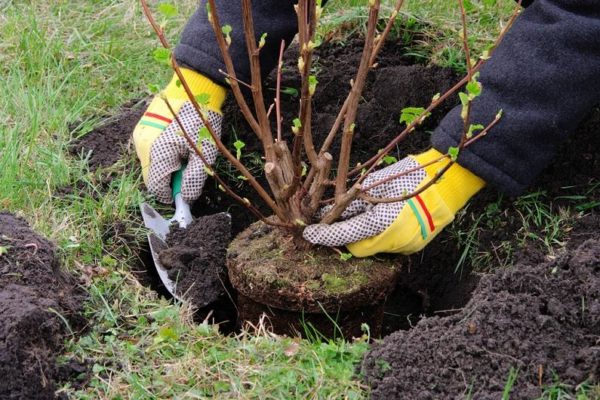
- an adult bush must be removed along with the root ball;
- After digging, the bush must be planted in a new growing location within 24 hours.
If rot is observed during repotting, treat the roots with a mild solution of potassium permanganate. This will not only protect the roots from further infection but also strengthen the plant.
Do currants need to be pruned?
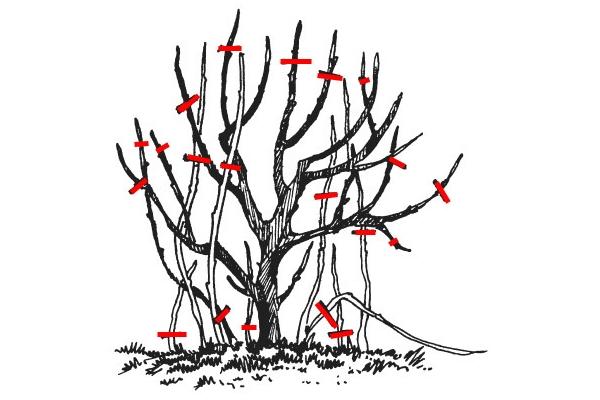
Before transplanting to a new location, pruning is performed. However, this procedure should be performed in the fall. If replanting in the spring, some shoots are removed. This is primarily necessary to avoid excessive stress on the plant's roots. After transplanting, the bush is in a weak state and requires a large amount of nutrients. After pruning, all nutrients will be distributed to the roots, which is necessary for adaptation to the new growing location.
Rules for landing at a new location
To properly transplant currants to a different growing location, it's important to consider the specifics of the process. The rules for transplanting currants are as follows:
- After the seedling has been dug up, it is necessary to wrap the branches in burlap; this will reduce the risk of damage during transportation;
- Before planting, you need to pour a bucket of water into the hole;
- place the seedling in the hole and straighten the roots;
- if the seedling is placed with a lump of soil, the soil is not removed, and a nutrient mixture is poured on top;
- the soil is compacted;
- After planting, the bush must be thoroughly watered and damaged branches must be trimmed.
If the bush is replanted in early spring, the shoots must be shortened.
Important. It is necessary to keep a distance between mature currant bushes. At least 1.5 meters. Also, currants should not be planted in areas where trees grow close together.
What should be taken into account when replanting young and old currants
Bushes over three years old require careful handling, as they often do not tolerate transplantation well. Mature bushes have developed roots, so it's important to leave as much soil as possible when replanting. Young, buried currant bushes can be planted without soil, as young bushes establish quickly and are less susceptible to disease.
Specifics of transplanting different types
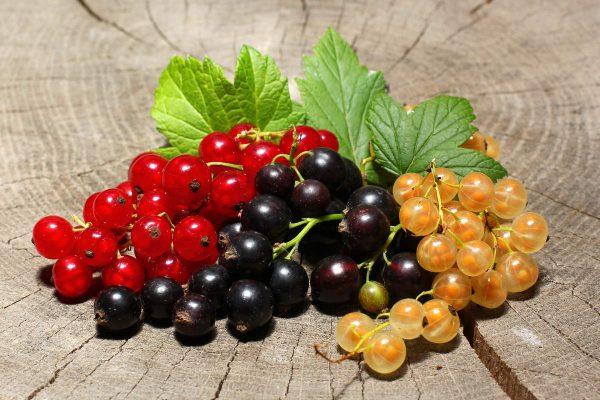
Different varieties of currants require specific care, as black and red currants require different care and grow in different locations.
Black
Unlike other varieties, blackcurrants require little maintenance and are undemanding in terms of planting location. With proper fertilization, blackcurrants can bear fruit in any type of soil. Blackcurrants can also be grown in shaded areas and are rarely susceptible to disease.
Red and white currants
Red and white currants are demanding in terms of soil type and care. To ensure a good harvest, it's important to carefully select the planting site. The soil should be rich in nutrients and loose. Red currant roots are also prone to root rot, so when planting, it's important to lay a drainage layer and dig a hole at least 50 cm deep.
Further care of the crop
Replanting bushes is necessary to increase yield. Proper care and timely pest control are essential to ensure healthy plants.
| Action | Procedure |
| Watering | Currants should be watered daily for the first week after transplanting. Once the plant has established itself, water every 5-7 days. |
| Loosening | In order for the soil to be saturated with oxygen, it is necessary to regularly loosen the soil and remove weeds that can provoke the formation of diseases. |
| Fertilizer | Additional nutrients should be added a week after repotting. Organic fertilizers are used for this purpose. For the remaining time, fertilize according to the standard schedule. |
| Trimming | It's important to monitor the bush's condition and, if necessary, perform sanitary pruning. In the fall, shoots are shortened and damaged branches are removed. |
| Shelter | Currants are covered only when necessary. The roots need to be insulated with humus and spruce branches. |
To prevent the formation of pests and diseases in the spring, spraying with insecticides is carried out.
Result
Transplanting currants requires following certain rules that will not only preserve the plant but also increase its yield. After transplanting, currants require proper and regular care. Otherwise, the plant may weaken or die.
Related posts:
 When is the best time to plant currants to get a good harvest?
 How to plant grapes step by step, with a description of the process and care
 5 easy ways to propagate currants with cuttings in summer
 20 Best Blackcurrant Winter Preserves Recipes
 How to propagate and grow peas, cultivation technology, and care in open ground
 Description and rules for growing black currant variety Veloy
 Growing and caring for white currants, description of the best varieties
 What is the best way to treat currants against diseases and pests after harvesting?