
Thyme, also known as wild thyme, belongs to the genus of the Lamiaceae family. This genus includes low-growing shrubs and subshrubs with pronounced aromatic properties. The name "thyme" was coined by Max Vasmer, a German linguist, lexicographer, Slavicist, and Balkanist of Russian descent. This plant's popularity is currently breaking all records, making growing thyme in the Urals more important than ever.
Features of growing thyme in the Urals
Thyme is widespread across almost the entire Eurasian continent (except tropical zones). Representatives of the genus also grow in North Africa and Greenland.
There are approximately 170 species of thyme found in Russia. It grows primarily in the south and southwest of the Moscow region, where gray forest chernozems with a high humus content are found.
In addition, thyme thrives in the wild Ural nature, in the Amur region, and even in the Far East.
In the Urals, thyme is distributed mainly in the southern zones - where thyme grows, the climate is not too harsh and the most favorable environment exists (open, sunlit areas, most often on mountain slopes and hills).
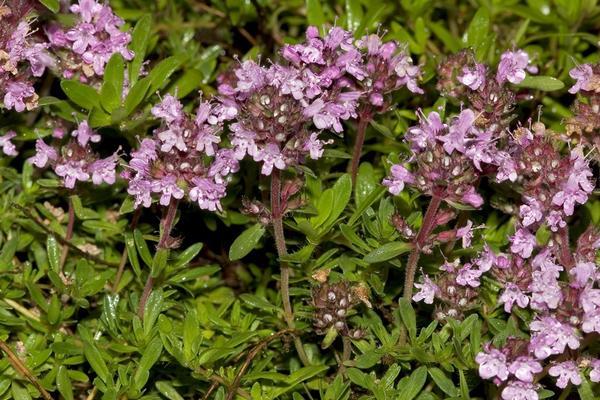
In the Urals, thyme can be grown not only in the south but also in the northern regions. However, in this case, additional winter care will be required—specifically, when cold weather sets in, the bushes will need to be covered.
To grow thyme in the northern regions of the Urals, you will need:
- water the bushes in the second half of October – before the frost sets in;
- cover with cardboard or lutrasil;
- in spring, somewhere around the beginning of May, remove protection from the cold;
- Cut off dry and frost-damaged branches with pruning shears.

Planting dates
The planting time will depend on the planting method chosen by the gardener.
Thyme reproduces in two ways:
- seed;
- vegetative (for example, by dividing the bush or by cuttings).
Seeds are sown in March to produce seedlings. Seeds are typically planted in the ground between the second half of April and May, depending on when the soil has warmed enough to create favorable growing conditions for the thyme.
Propagation by dividing the bushes is carried out before the onset of cold weather.

Soil preparation
Before preparing the soil, the gardener must choose a place for planting, taking into account the following:
- Thyme loves sunny places - in the shade the stems will stretch out, and the bush will become thinner and bloom less well;
- thyme does not like highly acidic soils;
- The best soil for this plant is sandy or rocky soil mixed with black soil.
When selecting a growing site, it's recommended to keep in mind that it will take at least 5 years for the plant to reach full growth. A separate area is ideal.
After all preparatory activities, the soil is prepared in the following order:
- the planting area is carefully dug up in the fall – all weeds and remains of other plants are removed;
- Fertilizers are added - rotted manure or superphosphate are ideal;
- in the second half of April, the planting area is again carefully dug up and leveled;
- At the final stage of preparation, urea is added as a fertilizer.
Landing
A gardener can choose one of two possible planting options in the Urals:
- sowing seeds;
- or the seedling method of dividing bushes.

Seeds do not germinate very quickly, so in the Urals the most common method of cultivation is by dividing the bushes.
Planting procedure by division:
- In the fall, before the onset of cold weather, the thyme bush is dug up completely and divided into parts, each of which should be at least 5 centimeters long;
- each bush is rooted under a jar or in a greenhouse;
- After the root system has fully formed, the bush is planted in a pre-selected location.

The procedure for planting using seedlings:
- wait until the weather warms up (+20 degrees and above);
- sprinkle seeds directly into the soil in small rows, with a distance of at least 30 centimeters between them;
- sprinkle the seeds with a thin layer of river sand;
- Cover the sowing area with film and wait for the first shoots to appear (approximately 15 calendar days after planting).

Care
Care for this plant is carried out by:
- loosening the soil;
- weeding;
- watering the plant;
- and, if necessary, also by fertilizing.
Also, don't forget to cover the plants with cardboard, lutrasil, peat or fallen leaves before the onset of frost.
Watering
Watering schedules should depend on the soil conditions. Avoid overwatering thyme, as this will make the plant sick.
It is recommended to increase the intensity of watering:
- in dry summers;
- during the plant's growing season;
- and before flowering.
In any case, you should not water thyme more than twice a week.

Top dressing
To feed thyme, most gardeners use:
- ammonium;
- superphosphate;
- potassium salt;
- or ammonium nitrate.
Feeding procedure:
- in the fall, when weeds are removed and the soil is dug up, a mixture is added consisting of 40 grams of superphosphate and 1 glass of wood ash per 1 square meter of soil;
- In the spring, after loosening the soil, add 1 teaspoon of urea per square meter.
Pests
Thyme has a strong spicy scent, which is why it repels most pests.
Despite this, the plant is still affected by:
- weevil;
- aphids;
- meadow moth.
To prevent pest infestation, a solution containing the following components is used:
- 1 liter of water;
- 1 tablespoon of soda ash;
- laundry soap.

Diseases
Thyme rarely gets sick. Most cases of disease are due to improper care by the gardener.
The most common disease is a fungal infection, which occurs as a result of frequent watering or untimely removal of grass.
To prevent fungus, it is recommended to add lime or alkaline-based fertilizers to the soil.

Harvesting
Thyme is grown for medicinal purposes and is used as an anthelmintic, disinfectant and pain reliever.
To ensure the plant displays all its beneficial properties, it must be harvested correctly:
- wait until flowering (usually early to mid-August);
- wait for a warm and sunny day;
- Begin harvesting by cutting off the above-ground part of the plant with garden shears or pruning shears.

Further storage of the collected plant is done by natural drying. Using special dryers is strongly discouraged, as this will cause the essential oils to evaporate.
Related posts:
 The main varieties and types of thyme with a description of how to grow thyme and its benefits
 Medicinal properties and contraindications of thyme for the human body, application
 Growing thyme from seeds and propagating by cuttings, planting and care in open ground
 How to grow thyme from seeds and cuttings at home in a pot, and care for the plant on a windowsill
 Growing lemon thyme in pots and soil, planting and care, plant varieties
 Growing and overwintering thyme in open ground and greenhouses in the Moscow region
 Description and beneficial properties of Marshall's thyme, rules for harvesting and using thyme
 How to store fresh thyme and how to dry it at home