
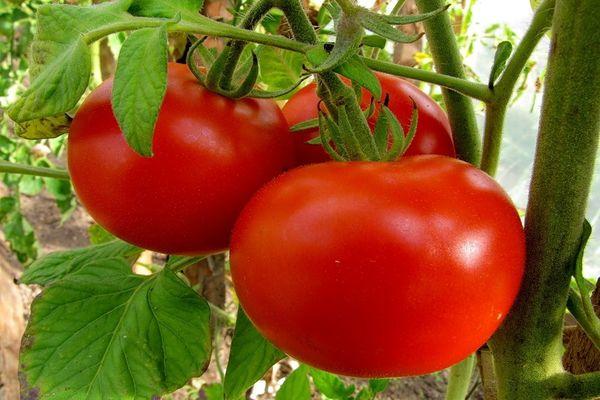
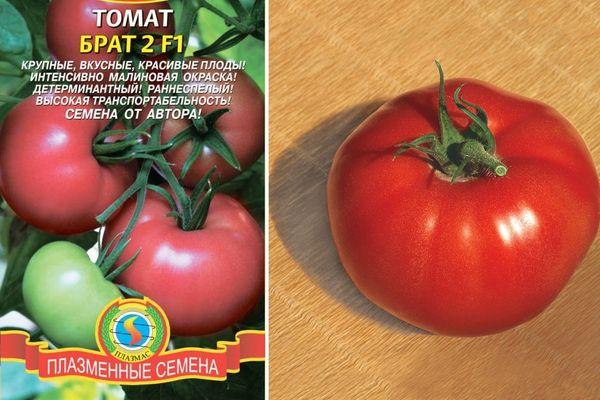
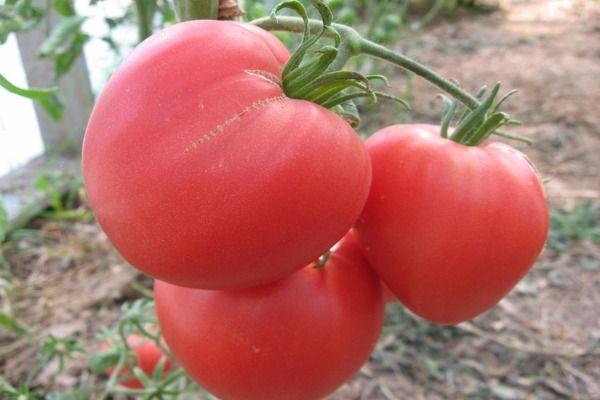
The Brat 2 F1 tomato is a hybrid variety from the Siberian collection. It meets all vegetable growers' requirements for this crop. This variety can be grown outdoors, under plastic cover, and in a greenhouse. The fruits are large, fleshy, and tasty. The yield is quite high.
What is the tomato Brat 2?
Description and characteristics of the variety:
- Tomato Brat 2 is a universal variety, suitable for both fresh consumption and winter preparations.
- It is an early-ripening fruit, with the harvest ripening in 100-110 days.
- Up to 18 kg of tomatoes ripen per 1 m².
- The bushes are of the determinate type, the average height of which is 90-120 cm.
- The first inflorescence appears above the 5th or 6th leaf, and the subsequent ones appear after every 2nd leaf.
- Each inflorescence or brush produces 5-6 fruits.
- The weight of one tomato is from 180 to 250 g.
- The tomatoes are bright crimson in color and round in shape.
- The elastic skin protects the fruits from cracking and deformation, so they can be transported over long distances.
- The inside of the tomatoes is fleshy and firm.
How to grow tomatoes?
A shallow container filled with soil is ideal for sowing. Make furrows 1 cm deep. It's recommended to use tweezers to place the seeds. Cover the seeds with a thin layer of soil and spray with water.
To create a greenhouse effect and speed up the germination process, cover the container with glass or film. Place the container in a warm place where the temperature is maintained at 25°C.
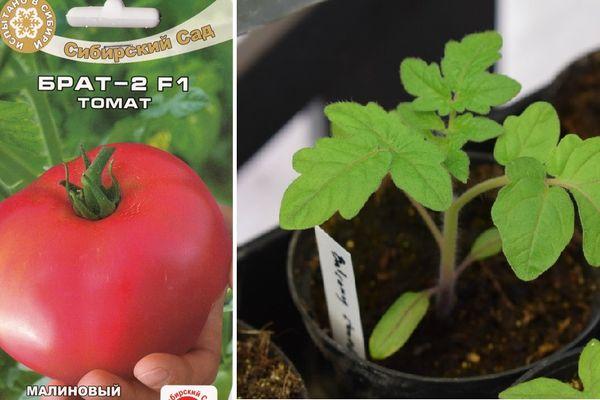
When seedlings begin to emerge above the soil surface, remove the covering and move the container to a bright location (but not in direct sunlight). Approximately 10 days after sowing, fertilize the plants with a solution of saltpeter and calcium. After 2-3 leaves have formed, transplant.
Seedlings transplanted into individual containers grow better and stronger. During the initial stage, the root system is actively developing. The stronger and healthier the roots, the better the fruiting of the bush. After transplanting (approximately two weeks later), the seedlings can be fed with a sodium-potassium fertilizer.
Two months after planting, the seedlings are prepared for transplanting into the ground. This preparation involves hardening them off. The site for the Bratishka tomato is prepared well in advance. Choose soil that has not previously been used for vegetable crops such as potatoes, turnips, eggplants, peas, and tomatoes.
The soil becomes depleted after they've been planted, as they draw out all the nutrients. The location should be bright but protected from direct UV rays. The soil should be tilled and conditioned.
When planting, maintain a distance of at least 40-50 cm between seedlings. The depth should correspond to the length of the roots. Caring for bushes in the ground involves periodic loosening of the soil, weeding, hilling, watering, fertilizing, and shaping.
It's best to cultivate the soil after watering. Loosening the soil cultivates the roots and improves drainage. Weeding removes weeds, which rob the roots of nutrients and strength. Hilling maintains soil moisture. All of these actions are crucial for the plant; they increase yield and promote normal fruit development.
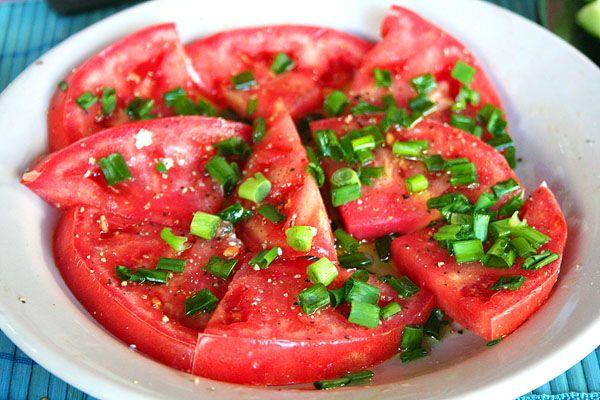
Gardeners' reviews of this variety are positive. They describe the tomatoes' excellent taste and the plant's undemanding nature and disease resistance. Another positive feature is that the bushes bear fruit in all weather conditions, even in areas with lower temperatures. This is a very important feature for many regions of our country.
Related posts:
 How to propagate and grow peas, cultivation technology, and care in open ground
 Description of varieties of sowing peas and cultivation, to which family they belong
 How to properly plant peas in a greenhouse and open ground
 80 Best Eggplant Varieties for Different Regions with Descriptions and Characteristics
 The best eggplant varieties for growing in a polycarbonate greenhouse: planting and care
 Description and characteristics of the best seeds of pea varieties and types
 The best grape varieties for growing in the Urals, planting and care rules in summer
 Description of the best cabbage varieties for 2025 for different regions
