
The Gulliver tomato, the characteristics and description of which will be given below, was developed by Russian breeders. This variety is intended for cultivation in open ground in the south of the country or in plastic greenhouse blocks in the central and northern regions of Russia. These tomatoes can withstand long-term storage (25-30 days) in a cold room and can be transported over long distances. The Gulliver tomato variety was registered in the State Register of Vegetables in 2009. Tomatoes are consumed fresh, used to make salads, juice, paste, ketchup, and canned.
Technical data of the plant and fruit
Gulliver tomatoes have the following characteristics and description:
- This variety ripens mid-season. Its growing season lasts approximately 100 days. Breeders have developed two varieties of this plant: Gulliver F1 and Gulliver's Heart.
- The average height of a plant bush ranges from 0.6 to 0.7 m. In greenhouses, bushes grow up to 120 cm.
- The stems have a moderate number of leaves. For maximum yield, the bush is formed from 2 or 3 stems. Removing side shoots is not necessary when growing tomatoes.
- The plant develops a simple inflorescence with 5 or 6 fruits.
- The fruits resemble peppers in shape. They have two chambers containing a small number of seeds. The diameter of the berries reaches 40-50 mm, and the length is about 12 cm.
- Fruit weight ranges from 90 to 120 g, but when grown in a greenhouse, gardeners most often obtain berries with an average weight of 0.2 to 0.4 kg. Farmer reviews indicate that, if all specialist requirements are met, tomatoes can be obtained weighing 0.8 to 1.0 kg. Therefore, the bushes need to be supported, otherwise their branches will break under the weight of the fruit.
- The tomato's skin is thick and red. This prevents the berries from cracking.
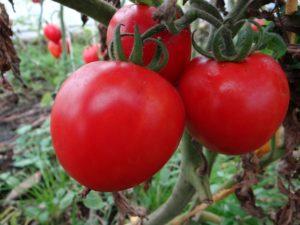

Experience shows that Gulliver tomatoes, when grown outdoors, yield between 3.5 and 4 kg of berries per plant. Growing tomatoes in greenhouses can increase this yield to 7 kg per plant. Gulliver tomatoes are resistant to diseases such as late blight, root rot, and blossom-end rot. The plant tolerates short-term temperature fluctuations well.
How to grow tomatoes in your garden?
First, you need to purchase seeds. It's recommended to treat them with a weak solution of potassium permanganate. Plant the seeds in special tomato soil. Plant them 12-15 mm deep and water them. Once sprouts appear, feed them with organic fertilizer. If you used containers or boxes to grow the hybrid, transplant the seedlings when they develop 2-3 leaves. You can avoid this procedure by planting the seeds in individual peat pots.

Gulliver requires bright light for normal development. Therefore, as soon as sprouts appear, the container is moved to a well-lit area or special lamps are used. The seedlings are watered with warm water. A second feeding with liquid complex fertilizer is given to the seedlings before transplanting them to their permanent beds.
The seedlings are transplanted to permanent soil when they are 50-55 days old. Before this, the plants need to be hardened off for 7-10 days. They are planted in the ground after May 15th. The planting pattern is 0.4 x 0.6 or 0.4 x 0.7 m. To do this, dig holes and add 1 tablespoon of complex mineral mixtures.

Fertilize the plants three times per season, using alternate fertilizers containing potassium, phosphorus, or organic mixtures. Watering is recommended once a week. As they grow, tie them to sturdy stakes or a trellis. Loosen the soil in the beds every 5-7 days to improve aeration of the tomato plant's root system. Weed the beds once every 15 days.


Pest and disease control
Although the variety described has good immunity to fungal and viral diseases, with high planting density, it is recommended to use mulching of the soil, ventilation (if tomatoes are grown in a greenhouse), and removal of the lower leaves from each stem to protect young bushes.

Young bushes should be sprayed with a weak solution of potassium permanganate or copper-containing products. Gardeners most often use Fitosporin for this purpose. If damaged fruits or leaves are noticed on the bushes, they are removed and then destroyed outside the area.
When growing Gulliver in a greenhouse, the plant is susceptible to attacks from garden pests such as aphids, spider mites, and other insects. To prevent their proliferation, farmers should eliminate weeds and ensure adequate ventilation.
If bushes are infested with aphids, a soap solution is used to kill them. Spider mites are eradicated using special products, applied to the bushes 2-3 times with 5-6 day intervals. However, these chemicals should not be used once the plants have already begun to bear fruit.
Related posts:
 The best eggplant varieties for growing in a polycarbonate greenhouse: planting and care
 Causes and treatment of eggplant pests and diseases, how to combat them at home
 Growing and caring for hazelnuts in open ground, rules for planting hazelnuts
 Methods for planting and propagating cherries at home
 Description and rules for growing Solaris grapes
 Is it possible to soak treated cucumber seeds before planting and how to do it correctly?
 Peach tree care and agricultural secrets, pest control
 The best grape varieties for growing in the Urals, planting and care rules in summer