
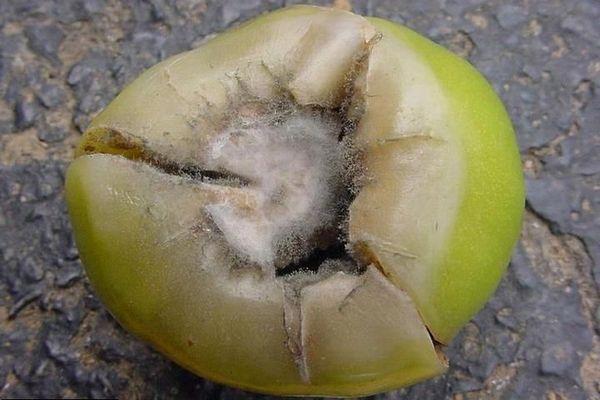
Gray mold develops on tomato plants during fruiting. This most often occurs during cloudy weather. Gray mold affects the upper part of shoots, inflorescences, and fruits. Young seedlings begin to become infected when the first fruits appear. Tomato rot spreads widely in greenhouses and hothouses if preventative measures are not taken promptly.
Symptoms of plant diseases
Signs of the disease development are as follows:
- Gray and brown spots appear on the affected nodal areas of the stem.
- In some places, a grey coating may form.
- In areas closer to the leaves and tomato trusses, the lesions are brown. These brown spots grow to 40-50 mm in size within 3-5 days, eventually encircling the tomato stem.
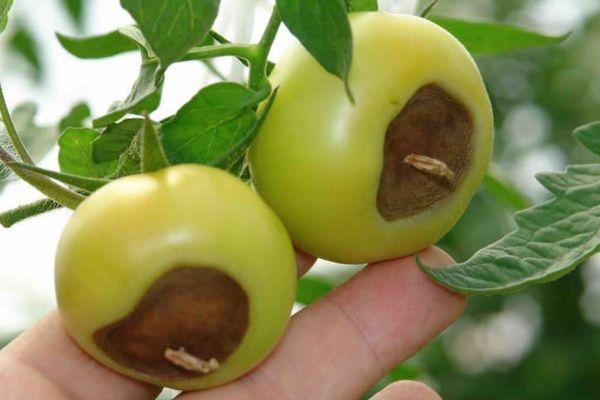
After this, the spot's central area begins to change color. It initially fades, then takes on a straw-colored hue. Ring-shaped stripes appear in its place. For the first week, no traces of gray mold spores appear on the spot, as the plant tissue is affected within the stem.
Plants begin to wilt due to the loss of water supply to the affected area. Leaves above the affected area begin to turn yellow, and aerial roots develop on the stems.
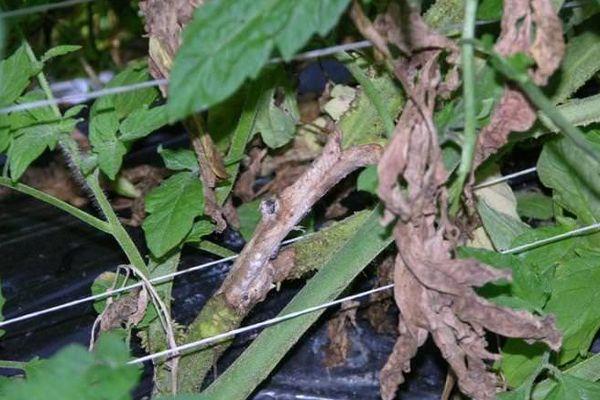
When the tomato core dies, the symptoms are similar, but the spots are pale and a single shade of brown. They most often resemble narrow stripes. However, when the core dies, the plant wilts almost entirely, while gray mold that appears on greenhouse tomatoes affects only the part of the plant above the brown spot. About a week later, gray or ash-colored spots develop due to the emergence of fungal spores.
Tomatoes are infected by Botrytis cinerea, a form of mold known as a wound parasite. The disease spreads through the air during cultivation or harvesting. Tomatoes can also become infected when their seeds are sown in soil previously occupied by cucumbers, lettuce, and other crops.
How to protect plants from rot?
Many gardeners are interested in how to treat this disease. Although measures to protect tomatoes from the disease are well-developed, their implementation is often delayed, reducing treatment effectiveness and causing crop losses.
This is due to the lack of a reliable means of diagnosing botrytis at an early stage, when existing tomato protection measures are most effective. Farmers and gardeners often confuse gray mold with fusarium, didymella, and other plant diseases, so it is important to detect the initial outbreak and then implement the appropriate agronomic measures. To date, breeders have not succeeded in developing tomato varieties resistant to the disease.
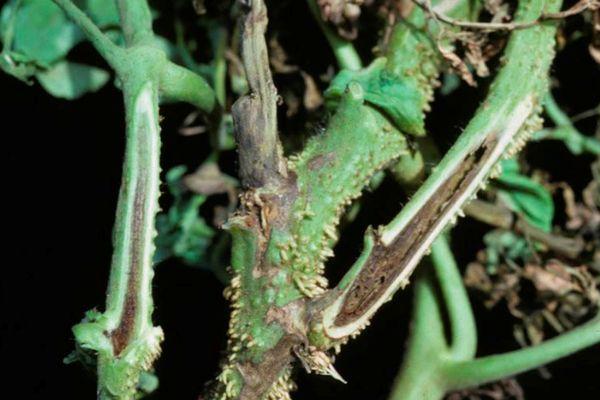
Therefore, at the first suspicion of a fungal infection, trim away any damaged stems and leaves. It's recommended to trim them in dry weather with a sharp knife. Remove all debris from the greenhouse, as it could serve as a source of fungal infection.
If rot spots are detected in the early stages of the disease, they are treated with a fungicide paste. To reduce crop losses, it is recommended to switch to drip irrigation and the use of covering mulch mixtures. Some gardeners prefer to use standard tomato varieties and their hybrids. This reduces losses from the fungus.
Sodium humate is recommended for treating tomatoes. Its use reduces crop losses due to rot by 1.5-2 times. Trichodermin suspension, applied after removing diseased leaves, has a beneficial effect on tomatoes. Gliocardin spore suspension can also be used for plant treatment. Although biological control is labor-intensive, it yields good results. You need to spray the cuts of leaf petioles during the day so that the stems dry out before nightfall.
Chemical protection of tomatoes is necessary if there is no primary treatment for gray mold outbreaks in the greenhouse. Euparen Multi is used for this purpose (up to 2 kg/ha on average). Another medication, Bayleton, has recently become available, but it is not yet officially registered.
Related posts:
 Description and treatment of potato diseases, methods of control using folk and chemical means
 Description of tomato diseases and their treatment, how to process them
 Diseases and pests of home lemons, treatment options, and solutions
 Causes of pepper diseases in greenhouses, their description and treatment
 Causes and symptoms of 30 plum diseases, treatment and pest control
 Description of 30 varieties and types of Muscat grapes, planting, cultivation and care
 How and when to treat grapes against gray mold, preparations and folk remedies
 Why does white rot appear on cucumbers in a greenhouse and what can be done to treat it?
Take a look Also

This is a common problem in my garden. Every summer I struggle with this rot without understanding what's going on. I always thought it was due to drought, but active watering didn't help. It turns out it's a fungal disease. Better to find out about it late than never. Now I'll fight this problem wisely.