For lovers of exotic garden tomatoes, the Kalinka-Malinka variety description and its characteristics will seem uninteresting. These tomatoes don't have an unusual color or exquisite flavor, nor do they even have a distinctive fruit shape. This is a fairly ordinary variety with mid-season ripening berries, but even such tomatoes have their merits.
General characteristics of the plant
The Kalinka-Malinka tomato bush is classified as a superdeterminate variety. Compact standard varieties are convenient due to their small size: they can be planted in the garden, in a greenhouse, or under plastic shelter, and can also be grown indoors on a balcony or directly on a windowsill. The average stem height is only 25-30 cm, and the bushes require no staking or training.
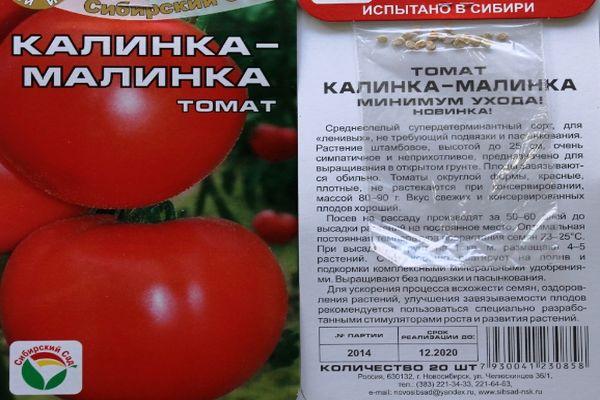
The root system is not very developed. This advantage makes dense planting possible (up to 6-8 plants per 1 m²). Tomatoes produce well even in a limited space.
Vegetable growers note that the variety's characteristics and descriptions indicate that these tomatoes are low-maintenance and cause no problems for their owners. Mini tomatoes only need to be earthed up about a week after planting, and don't forget to water them regularly if they're growing in a container on a balcony. However, Kalinka-Malinka tomatoes also tolerate slightly dry soil. Outdoors, the plants can produce well even in the Urals, Altai, and Siberia.
A bed of these tomatoes is also convenient because it can be quickly covered with plastic or lutrasil during a sudden cold snap. The compact size of the bushes allows for several groups of tomatoes to be planted. Vegetable growers can harvest tomatoes at various times, starting as early as early summer.
A distinctive feature of superdeterminate varieties is their very uniform yield. A single plant produces only 3-4 clusters of fruit, after which stem growth ceases, and the tomatoes ripen almost simultaneously.
Gardeners agree that taking up greenhouse space with such varieties is unwise. However, miniature Kalinka-Malinka tomato bushes can be planted in alternation with tall, long-bearing varieties. After an early harvest of Kalinka-Malinka, the finished-season bushes are harvested.

The variety yields 2.5-4 kg per square meter, depending on planting density. The minimum distance between plants is 30 cm.
Fruit characteristics
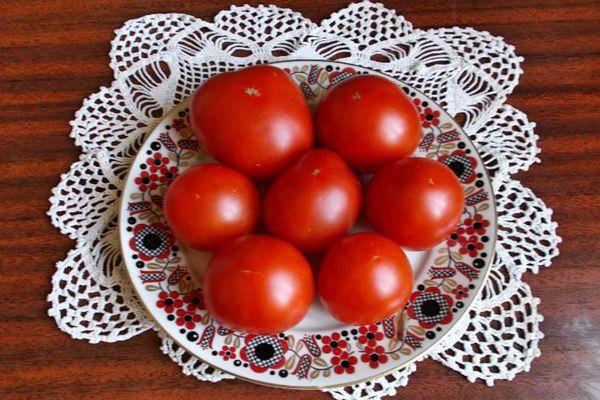
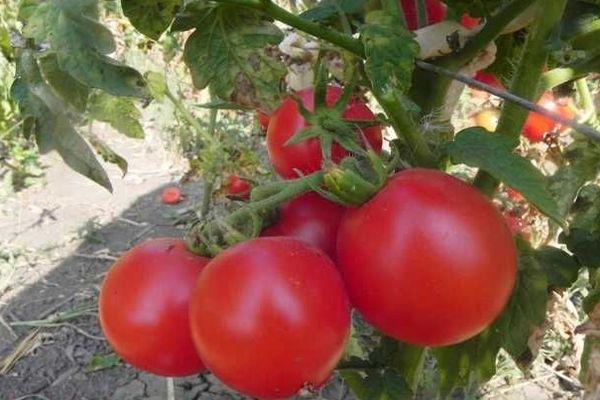
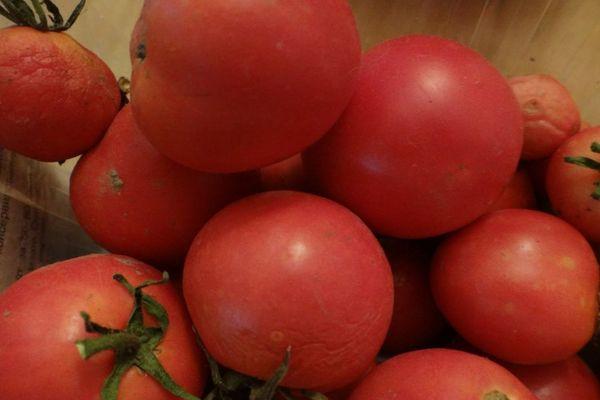
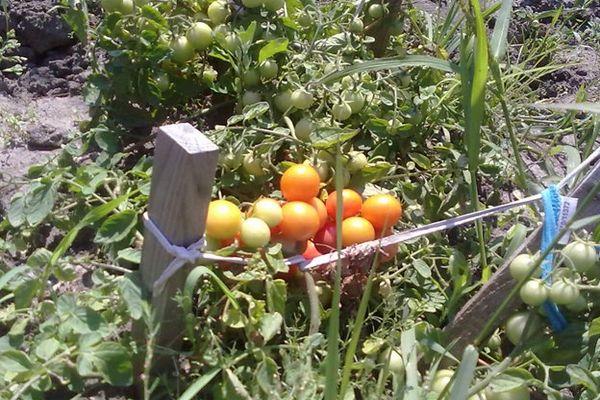
The first ripe tomatoes will begin to appear 110 days after sowing the seeds. Despite the compact size of the bush, reviews from those who have planted this variety note the tomatoes' rather large size. Each fruit averages 50-90 g in weight and is approximately 4 cm in diameter. The round red berries are collected in complex clusters of 6-7, making the small plant appear completely covered in them.
The skin is thick and doesn't crack during ripening or heat treatment during canning. These tomatoes withstand long-distance transportation well. Kalinka-Malinka tomatoes can be stored for several days in a fully ripe state without showing signs of spoilage. Gardeners report that unripe tomatoes ripen well after picking, and their flavor remains unaffected.
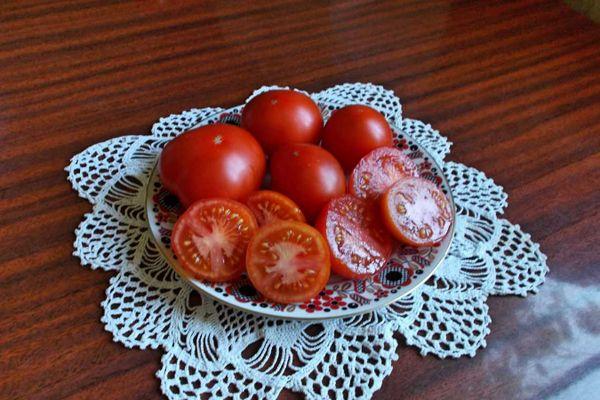
The flesh is intensely colored, and the fruit contains two seed chambers containing numerous seeds. The berry walls are thick, up to 1 cm. The flesh is firm and may have a slight crunch when unripe. When canned, the fruit's structure remains intact, retaining its shape well, and the tomato can be cut with a knife.
Kalinka-Malinka tomatoes are versatile. They're delicious fresh; their sweet and sour flavor complements any vegetable salad. These miniature tomatoes can also be used to decorate a holiday table, making them perfect for canapés and platters. Red tomatoes are perfect for any dish, as their vibrant flesh adds a lovely touch of color to sauces and savory soups.
Surplus produce can be preserved in any way. Small, calibrated tomatoes are ideal for whole-fruit pickling or marinating. They can be processed into juice or sauces if there's a large harvest. The dense texture of the Malinka tomato makes it suitable for drying. Unripe berries can even be used to make exotic jam.
Take a look Also

How to grow a variety in a plot?
When growing seedlings, consider the sowing time: early-ripening tomatoes should be sown no earlier than 50-60 days before transplanting to a permanent location. The sowing soil is prepared from equal parts fertile soil, sand, and humus, adding 2 tablespoons of ground chalk for every 10 kg of the mixture. To disinfect the soil directly in the box, generously water it with a hot dark solution of potassium permanganate.
This is a non-hybrid variety (F1). If you harvested the seeds yourself for propagation, they also need to be treated before sowing. For soaking, you can prepare a solution of Fitosporin-M or Epin, or disinfect with a light pink solution of potassium permanganate. Soak the solution at 35°C for 30-40 minutes. After soaking, dry the seeds on paper or cheesecloth.
By this time, the sowing soil will have cooled. You can begin spreading the seeds over the surface of the substrate. Cover the seeds with a thin layer of dry sand or soil (0.5 cm), cover the container with perforated plastic, and place it in a warm place (+25°C). Seedlings will appear in 4-5 days, but this period may increase if the temperature drops.
When the seedlings have developed 2-3 leaves (excluding the cotyledons), transplant the tomatoes into individual pots or a shared container, using a 10x10 cm pattern. Further care consists of regular watering. Fertilizing is not necessary.
You can plant it on the site at different times:
- They are transplanted into a greenhouse in mid-May, and harvesting begins in mid-June;
- You can plant in the beds only at the beginning of June, after the frosts have ended;
- They are planted in a greenhouse between the first two methods, since the plants are not at risk of dying from frost, but in mid-May it is not warm enough under the film.
By combining these options, you can harvest from mid-June to about mid-July.
Related posts:
 The best eggplant varieties for growing in a polycarbonate greenhouse: planting and care
 Methods for planting and propagating cherries at home
 The best grape varieties for growing in the Urals, planting and care rules in summer
 Is it possible to soak treated cucumber seeds before planting and how to do it correctly?
 Carrot care guidelines for outdoor cultivation to ensure a good harvest
 Top 40 DIY New Year's Baking Recipes for 2020
 Causes and treatment of eggplant pests and diseases, how to combat them at home
 The health benefits and contraindications of black currants