
The Korean Long-Fruited Pepper-Shaped Tomato is a variety distinguished not only by its unusual fruit shape. Gardeners also praise its excellent taste and other remarkable qualities. However, the plant also has its own care requirements.
General characteristics of tomato
The bushes are indeterminate and tall. In a greenhouse, the vine reaches a height of 1.8-2 m, so it must be trained and tied to a trellis. For a larger fruit production, it is recommended to grow the plant in 2-3 stems. Growers' descriptions of the variety emphasize the gracefulness of the bush and the delicate texture of the foliage.
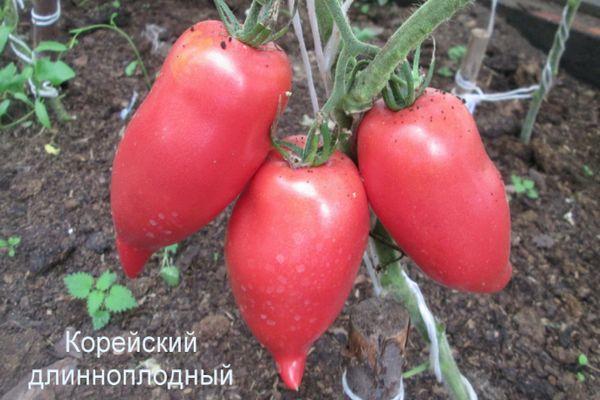
Fruiting is prolonged, with tomatoes setting throughout the summer. When grown outdoors, it is recommended to pinch the stem tips approximately one month before the onset of autumn frosts. The yield of the Korean Long-fruited variety is considered high. Up to 10 clusters, each bearing 4-7 fairly large fruits, form on the stem. The total yield from each plant can be approximately 8 kg of marketable produce.
The Korean Long-fruited variety is a heat-loving variety; if grown outdoors during unfavorable seasons, it can disappoint growers. Harvests are more stable in a greenhouse. In hot weather, it is recommended to ventilate the room more frequently, as excessively high temperatures can cause pollen sterility in all plants, regardless of variety.
The variety is immune to many fungal diseases, resistant to alternaria and downy mildew, and in open ground can suffer from late blight in years of its widespread distribution.
A disadvantage is a high susceptibility to blossom-end rot. To prevent this disease, lime the soil under Korean long-fruited tomatoes.
Fruit characteristics
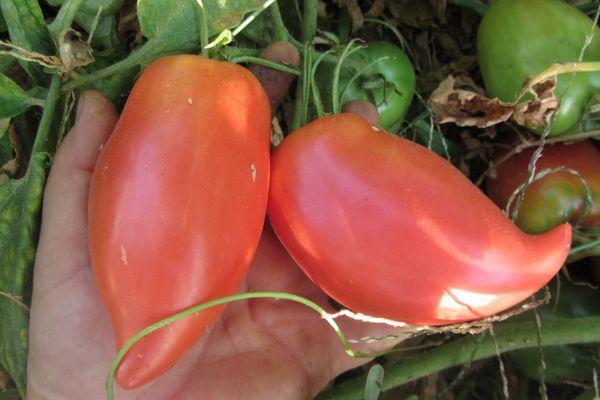
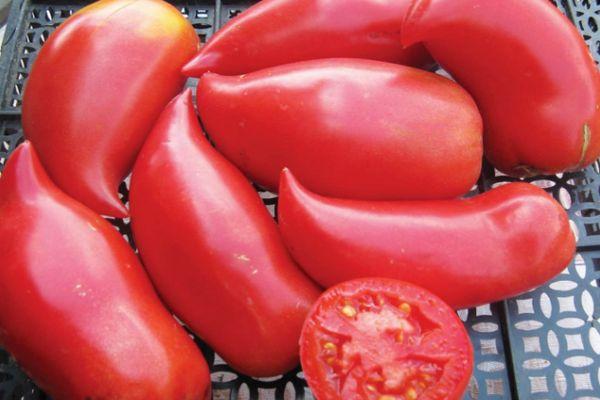
The clusters of this variety of tomatoes consist of several large tomatoes weighing up to 200-300 g. The tomatoes are cylindrical, elongated, and gradually taper toward the tip. The narrow part forms a "nose," which on some fruits gracefully curves to the side. Smaller tomatoes can be curved along their entire length, resembling a crescent moon or a banana.
The skin is very dense, making the tomatoes resistant to cracking and resistant to heat during canning. They retain their marketable appearance for a long time even when stored ripe, and those picked at the blanched stage can be stored and ripened for up to two weeks at room temperature. The skin color of the fruit at technical maturity is light green, darker at the base, but as it ripens, the coloring becomes uniform and takes on a beautiful raspberry-pink hue. When grown outdoors, greenish zones sometimes remain on the shoulders and near the stem.
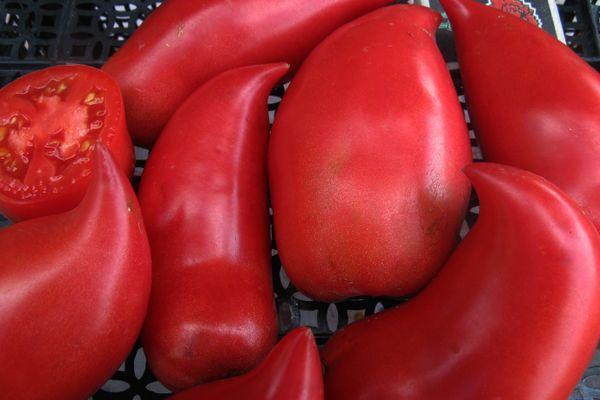
The flesh is a rich pink hue, delicate in texture when ripe, and firmer when slightly unripe. A distinctive feature of this variety is the almost complete absence of seeds. The fruit has a fleshy structure, and the chambers may be invisible in the flesh, especially near the base. The flavor profile of Korean Long-fruited tomatoes notes the increased sugar content. The tomatoes are sweet, with little or no tartness. The aroma is classic.
Their primary purpose is to be eaten fresh. These tasty, vibrant tomatoes make a wonderful addition to any vegetable salad. Their unusual, seedless flesh adds a touch of spice not only to sliced dishes but also to sandwiches and gourmet appetizers. Sweet tomatoes can be included in gazpacho, Italian sauces, and Asian and Caucasian dishes. They don't add much color to dishes, so it's best to use a different variety of tomato for borscht or kharcho.
Korean long-fruited cucumbers can be used to make beautiful marinades or pickles. However, most of the fruits are too large for this purpose, although they can be processed into juice. The resulting product is delicious, and the high lycopene and vitamin content in the fruit make it very healthy. By boiling down the pulp, a home cook can create a sweet sauce for lecho and tomato-based appetizers.
Agricultural technology of Korean tomatoes
This is an early-ripening variety, with the first ripe fruits taking about 110 days from sowing to harvest. These tomatoes are typically sown for seedlings approximately two months before transplanting them to their permanent location. If the seeds are not pre-treated by the manufacturer, they should be soaked in a pink solution of potassium permanganate or Fitosporin (dilute according to the instructions) for 30-40 minutes. After this, the seeds should be allowed to dry slightly.
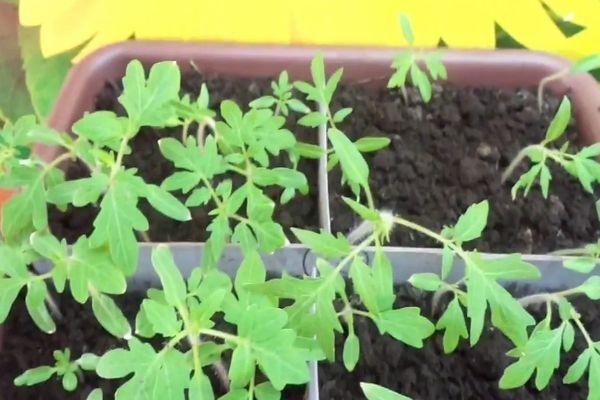
The soil is prepared from equal parts humus, sand, and garden soil. To enrich the mixture with calcium and reduce acidity, ground chalk or eggshells are added to the mixture (2 tablespoons per 10 kg of soil). The prepared substrate is scattered among the boxes and disinfected by soaking it in a hot, dark solution of potassium permanganate. The seeds can be sown only after the mixture has cooled.
Spread the tomato seeds over the soil and cover with dry sand or soil. Cover the container with plastic wrap, poke 2-3 holes in it, and place the container in a warm place (25°C) to germinate. Seedlings will appear in 4-5 days.
When the seedlings have developed 2-3 leaves (not cotyledons), transplant them into individual 0.5-liter pots. The tomato plant should be buried in soil up to the cotyledons to allow new roots to grow underground on the stem. The main care for seedlings after transplanting is timely watering, as soon as the soil dries to a depth of 0.5-1 cm. Use lukewarm water to prevent the plants from experiencing temperature shock.
When planting Korean long-fruited grapes, it is essential to add 1-1.5 kg of chalk or dolomite flour and 500-600 g of wood ash per 1 m², even if the soil is already enriched with organic matter and complex mineral fertilizers. This simple measure will help protect the crop from blossom-end rot and ensure the formation of a larger number of large ovaries.
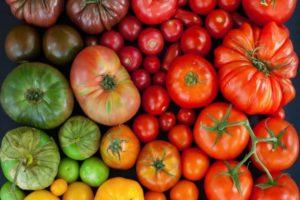
Korean long-fruited tomato seedlings always look thin and frail. If they've become too stretched, plant them horizontally, placing the stems in a 15-20 cm deep trench. Leave only the tops with 4-5 leaves above the surface. Space the plants 40 cm apart, and the rows at least 70 cm apart.
Related posts:
 The best eggplant varieties for growing in a polycarbonate greenhouse: planting and care
 Methods for planting and propagating cherries at home
 Causes and treatment of eggplant pests and diseases, how to combat them at home
 The best grape varieties for growing in the Urals, planting and care rules in summer
 Is it possible to grow an apricot tree from a seed in your garden? How to plant and care for it?
 Is it possible to soak treated cucumber seeds before planting and how to do it correctly?
 Top 40 DIY New Year's Baking Recipes for 2020
 How to properly grow a peach tree from a seed at home, planting and care